SEO for Insurance Companies: A Guide for Agencies, Brokers and Carriers

Ishant
Published on November 20, 2026
Ishant

SEO for insurance companies is the work of getting an agency, brokerage or carrier found in Google and in AI answers when people search for coverage, quotes or a local agent. It combines a Google Business Profile that follows Google’s rules, one page per line of business, honest reviews, tracked quote forms and content that meets state insurance advertising rules.
Summarize this article with:
Key Observations
- Google treats insurance agents as individual practitioners. A branded solo agent uses the name format “Allstate: Joe Miller”, and lead generation agents for corporations cannot have a profile, per the Google Business Profile guidelines.
- The NAIC life insurance and annuity advertising model counts the Internet as advertising. It asks for the insurer’s name, fair comparisons, sourced statistics and five years of ad records.
- State adoption varies. The NAIC Summer 2026 state chart shows 40 of 52 listed jurisdictions with some citation to that model and 12 with no current activity.
- Google’s Maps content policy bans incentives for reviews, even though the FTC review rule allows incentives that are not tied to a positive opinion. Follow the stricter rule.
- Google says there are no extra requirements to appear in AI Overviews or AI Mode. A page must be indexed and eligible to show a snippet.
This guide to insurance SEO is for owners and marketing leads at US agencies, brokerages and carriers who want more quote requests from search. Our client work is covered by signed NDAs, so this guide shares the process we follow rather than client names or results.
This guide is general information, not legal or compliance advice. Insurance advertising rules differ by state and by line of business. Check new pages with your compliance lead, your carrier or your state department of insurance before they go live.
What is SEO for insurance companies?
Insurance SEO is search engine optimization for businesses that sell or distribute insurance, such as agencies, brokers and carriers. It earns unpaid visibility in Google Search, Google Maps and AI answers for searches like “home insurance quotes near me” or “contractor liability insurance Texas”. The goal is quote requests and calls from people you are licensed to serve.
Three things make insurance SEO harder than SEO for most local businesses. First, Google’s Search Quality Rater Guidelines put money topics that could hurt a person’s ability to support their family under “Your Money or Your Life” (YMYL). Second, state insurance advertising rules can apply to web pages. Third, your licenses limit the states where you can sell.
The table shows the parts of an insurance SEO program and who usually owns each one.
| Part of insurance SEO | What it covers | Who usually owns it |
|---|---|---|
| Local SEO | Google Business Profile for each staffed office, citations, reviews, office pages | Agency principal or office manager, with the SEO team |
| Line-of-business pages | One page each for auto, home, life, commercial and other lines you write | SEO team, reviewed by a licensed agent |
| Content | Answers to coverage questions, life events and comparisons | SEO writer, reviewed by a licensed agent |
| Technical SEO | Speed, crawling, indexing, structured data, site structure | SEO team and web developer |
| Tracking | Quote forms, calls and bound policies by page and line | SEO or analytics team, with your agency management system |
| Compliance review | Advertising rules, carrier brand rules, record keeping | Compliance lead, carrier or counsel |
How does SEO differ for independent agents, brokers and carriers?
Your SEO plan depends on whom you represent. The NAIC describes a captive agent as selling for one company, an independent agent as selling policies from many companies, and a broker as representing the buyer. Those roles change your profile name, the brands you can mention and the searches you can win.
Agents mix these terms up too. One Insurance Forums thread is an agent asking how producer, independent, captive and broker differ. Use the plain terms your buyers use on your pages, and say clearly who you work for.
| Business type | Who you represent | Main SEO focus | Watch out for |
|---|---|---|---|
| Captive agent | One carrier | Maps visibility for your office, your name with the carrier brand | Carrier brand and website rules, profile name format |
| Independent agency | Several carriers | Maps plus line-of-business pages that name the carriers you place with | Naming carriers you are not appointed with |
| Broker | The buyer | Industry and specialty pages, state pages where licensed | Implying licenses in states where you hold none |
| Carrier | Its own policyholders | Product pages, state availability, claims help and agent locators at scale | Filed product wording, state disclosures, thin city pages |
SEO for captive insurance agents
Captive agents win most of their search leads from Google Maps. Google’s own example of a branded solo agent profile name is “Allstate: Joe Miller”, in the format “[brand]: [practitioner name]”. Read your carrier’s agent marketing guidelines before you build a separate website, add reviews widgets or change your listing.
If your carrier gives you an agent page on its own site, ask what you can edit. Some captive agents also run their own local site, and others cannot. Get the answer in writing before you spend money on SEO.
SEO for independent insurance agencies and brokers
Independent agencies and brokers can rank for searches that a single carrier cannot answer, such as “independent insurance agent near me” or “insurance for restaurants in Ohio”. SEO for insurance brokers usually leans toward commercial and specialty lines, with one page per industry you serve. Name the carriers you place with only where you hold an appointment.
SEO for insurance carriers
Carriers deal with scale. A carrier site may have thousands of product, state, claims and agent locator pages, so crawling, indexing and duplicate content become the main risks. Product pages should match filed product names and show where each product is sold. Our technical SEO services cover large sites like these.
What keywords should an insurance agency target?
An insurance agency should target searches that match the lines it sells in the places where it is licensed and has offices. That means local agency searches, line-of-business plus town searches, commercial niche searches by industry, life events and the coverage questions customers really ask. Broad national terms are much harder for a local agency to win.
The table shows the keyword types an insurance business should target, with example searches and the page each one belongs on. We left out search volumes on purpose because they change by town and state. Check them for your area in Google Keyword Planner or Semrush before you build pages.
| Keyword type | Example searches | Searcher intent | Best page |
|---|---|---|---|
| Local agency | insurance agency near me, insurance agent in [town] | Ready to talk | Homepage, office page and Business Profile |
| Line of business plus place | car insurance [town], homeowners insurance [county] | Wants a quote | Line-of-business page |
| Commercial niche | general liability insurance for contractors, restaurant insurance [state] | Wants a quote | Industry page |
| Life events | insurance when buying a house, turning 65 Medicare options | Researching, then quoting | Guide page |
| Coverage questions | does homeowners insurance cover water damage, what is umbrella insurance | Learning | Blog post or FAQ |
| Comparisons | independent agent vs captive agent, term vs whole life insurance | Comparing | Comparison page |
| Carrier plus agent | [carrier] agent near me | Looking for a named brand | Business Profile and office page, only if you are appointed |
Which keywords can a local insurance agency realistically win?
A local agency usually wins local, line-plus-town and niche industry searches first. One agent on Insurance Forums argued that most agents will not rank for common insurance questions, and that the best home policy differs by location. We agree, which is why local detail matters more than generic definitions.
Life-event pages can work for years. In the same thread, another agent said a “Turning 65” page still brought regular traffic. The best source of topics is your own phone log: write down the questions customers ask your service reps each week, then answer them on your site.
How do you set up local SEO for an insurance agency office?
Local SEO for an insurance agency starts with a Google Business Profile that follows Google’s rules for practitioners and offices. Each staffed office gets one profile with its real-world name, a staffed address, a local phone and the most specific category. Then you add matching citations, steady reviews and an office page on your website.
These are the Google Business Profile rules that trip up insurance offices most often:
- Use your real-world name. Google does not allow taglines, phone numbers, website URLs or location words in the business name.
- Use a staffed address. P.O. boxes, remote mailboxes and virtual offices are not eligible.
- Hide the address if you only meet clients at their location. Google calls this a service-area business.
- Follow the brand format if you are a branded solo agent. Use “[brand]: [your name]”.
- Check eligibility. Google says sales associates or lead generation agents for corporations are not individual practitioners and are not eligible for a profile.
After the profile, make your name, address and phone match on your website, carrier locator, chamber of commerce and industry directories. Our local SEO services handle this setup and the monthly upkeep.
Can each agent in an insurance office have their own Google Business Profile?
Yes, in many cases. Google lists insurance agents as individual practitioners. When several practitioners work at one location, Google says the organization should have its own profile for that location, and each practitioner’s profile title should include only the practitioner’s name. Decide who manages each profile and what happens to it when an agent leaves.
Should an insurance agency build a page for every town it serves?
No. Google’s spam policies list “doorway abuse”, which includes pages aimed at specific regions or cities that funnel users to one page. Build a location page where you have an office, a local team or real local detail, such as local weather risks, local carriers or local business types you insure.
What pages does an insurance website need for each line of business?
An insurance website needs one strong page for each line of business you sell, such as auto, home, life and commercial. Each page should explain who the coverage is for, what it usually includes and excludes, which carriers you place it with, which states you are licensed in and how to get a quote from a licensed agent.
The table shows what searchers ask about on each core line and what each page should include.
| Line of business | Searchers ask about | Page should include | Compliance check |
|---|---|---|---|
| Auto | Discounts, teen drivers, SR-22, state minimums | Coverages explained, what affects price in your state, a short quote form | No “cheapest” or rate promises unless true and supportable |
| Home and renters | Water damage, storms, what is not covered | Common exclusions, local perils that need extra coverage, a claims help link | Name the insurer for any specific product |
| Life | Term vs whole, how much coverage | Plain comparison of policy types, who each fits, next steps | Genuine testimonials only, sourced statistics |
| Commercial | General liability, workers’ comp, business owner’s policy | One page per industry you serve, certificate turnaround, carriers you use | Do not imply licenses in other states |
| Medicare | Turning 65, plan types, enrollment periods | Separate pages for Medicare products, kept apart from other lines | Federal Medicare rules apply as well as state rules |
Each line page needs a named licensed agent as author or reviewer, the states you are licensed in and a date the page was last checked. Our SEO content services write pages in this format, with your licensed staff signing off.
How do you write insurance content that meets YMYL standards?
Google’s helpful content guidance says its systems give even more weight to content with strong E-E-A-T on topics that affect financial stability. E-E-A-T stands for experience, expertise, authoritativeness and trust. Google adds that E-E-A-T is not a specific ranking factor, and that trust matters most.
- Show a named author or reviewer with their license type and states.
- Explain exclusions and limits as clearly as benefits.
- Link to your state department of insurance for rules and consumer help.
- Date every statistic and recheck it when you update the page.
- Say how the page was made and who checked it, which Google calls “Who, How, and Why”.
What extra rules apply to Medicare pages?
Medicare pages sit under federal rules as well as state rules. The federal rules for Medicare Advantage marketing are in 42 CFR Part 422, Subpart V, “Medicare Advantage Communication Requirements”. That subpart has a section on websites and a section on agent, broker and third-party requirements. Ask your carrier or marketing organization to review Medicare pages before they go live.
What advertising rules apply to insurance websites and SEO content?
Insurance web pages can count as advertising under state insurance rules. The NAIC model regulation on life insurance and annuity advertising lists the Internet as covered media, and many states cite a version of it. So service pages, blog posts and landing pages need the same care for truth, insurer identification and record keeping as print ads.
The table maps sections of the NAIC Advertisements of Life Insurance and Annuities Model Regulation to website work.
| Model 570 section | What it says | What it means for your website |
|---|---|---|
| 2.A | Advertising includes the Internet | Web pages and blog posts can be ads |
| 4.A | Ads must be truthful and not misleading, judged by overall impression | Headlines and summaries matter, not only the fine print |
| 4.Q | Testimonials must be genuine | Real customers only, with financial interests disclosed |
| 4.R | Statistics must be accurate, recent and relevant, with the source identified | Link and date every number you publish |
| 4.V | No unfair or incomplete comparisons, no disparaging others | Comparison pages need a full and fair basis |
| 5.M | “Free” and “no cost” only when true | Say “free quote” only if it really is free |
| 6.A | The insurer’s name must be clearly identified | Name the carrier on product pages |
| 7 | Do not imply licensing beyond licensed areas | List the states you are licensed in, avoid “nationwide” unless true |
| 9.A | Keep each ad on file for five years after use ends | Archive dated copies of pages you change or remove |
Adoption differs by state and by model. The Summer 2026 chart for Model 570 shows 40 of 52 listed jurisdictions with some citation, often to older versions, and 12 with no current activity. The Fall 2024 chart for the accident and sickness advertising model shows activity in 51 of 56 listed jurisdictions.
Some states write website rules into law. Texas Insurance Code section 541.082, “Advertising and Internet Websites”, says web pages that describe specific policies available in Texas, or let people apply or get a quote, must carry the advertising disclosures Texas requires. The NAIC Unfair Trade Practices Act model also covers misrepresentation and false advertising of policies.
Can insurance agencies publish comparison pages?
Yes, with care. Comparison pages often match how people search, but Model 570 bans unfair or incomplete comparisons and disparaging other insurers or producers. The safest comparisons explain policy types or business models, such as term vs whole life or independent vs captive agents, rather than ranking named carriers on price.
- Compare on the same coverage, limits, deductibles and date.
- Show where every figure comes from and when you checked it.
- Avoid “cheapest in [town]” unless you can prove it and keep it current.
- Do not criticize other carriers or agents.
How do you track quote forms and calls from organic search?
Track every quote form and phone call as a lead, tag it by line of business and follow it to a bound policy. Google Analytics 4 has recommended lead generation events for each stage, from generate_lead to close_convert_lead, so you can see which pages bring quotes that actually close.
The table maps Google’s lead events to a typical insurance sales pipeline.
| GA4 event | Google’s description | Insurance pipeline stage |
|---|---|---|
| generate_lead | Submits a form online or information offline | Quote request or first call |
| qualify_lead | Fits the criteria to become a qualified lead | In a licensed state, a line you write |
| working_lead | Contacts or is contacted by a representative | Agent has called back |
| close_convert_lead | Became a converted lead (a customer) | Policy bound |
| disqualify_lead | Marked as disqualified for a reason | Out of state or a line you do not write |
| close_unconvert_lead | Marked as not converting for a reason | Quoted but not bound |
- Add a line of business field to every quote form and pass it with the lead event.
- Use call tracking on your website, and keep your main local number on your Business Profile.
- Keep names, emails and policy details out of analytics. Send only an ID and the stage.
- Update bound and lost status from your agency management system each week.
- Report quotes, binds and premium by landing page and line each month.
If you also run ads, our guide to Google Ads conversion tracking shows how to feed the same lead stages back to your campaigns.
How should insurance agencies get and handle reviews?
Ask every customer for a review the same way, at a natural moment such as policy delivery or a closed claim, and never reward people for Google reviews. Google’s Maps policy bans incentives and selective requests for positive reviews. The FTC’s review rule bans fake reviews and incentives tied to a positive or negative opinion.
The table compares the two rule sets. Where they differ, follow the stricter one.
| Practice | Google Maps policy | FTC rule (effective Oct 21, 2024) | Safe approach |
|---|---|---|---|
| Asking every customer | Allowed | Generalized requests to all buyers are allowed | Ask everyone, the same way |
| Asking only happy customers | Not allowed (selective requests) | FTC staff say it could still break the FTC Act | Do not filter who gets asked |
| Reward for any review | Not allowed | Allowed if not tied to sentiment and disclosed | No rewards for Google reviews |
| Staff reviewing the agency | Conflict of interest content not allowed | Insiders must disclose the link | Staff do not review the agency |
| Getting bad reviews removed | Not addressed on the policy page | Threats or intimidation to remove reviews banned | Reply calmly and offer to talk offline |
Sources: Google Maps user generated content policy and FTC Consumer Reviews and Testimonials Rule Q and A.
When you reply to a review, do not confirm policy numbers, claim details or personal facts in public. Testimonials on your own site must be genuine under Model 570, so keep the customer’s written permission on file.
How do AI Overviews change SEO for insurance queries?
AI Overviews do not need a separate insurance playbook. Google says there are no extra requirements or special optimizations to appear in AI Overviews or AI Mode, and a page must be indexed and eligible to show a snippet. What changes is that clear, quotable answers to coverage questions get more chances to be cited.
Google’s AI features page explains that AI Overviews and AI Mode may use “query fan-out”, running several related searches across subtopics to build one answer. Traffic from these features is counted in the Search Console Performance report under the Web search type. Google also says clicks from results pages with AI Overviews are higher quality.
Agents are asking about this. In 2026 an agent on Insurance Forums asked what had changed in SEO with “AIO”. Our answer is to make each section easy to quote:
- Answer each heading in the first two or three sentences.
- Name the state, the line of business and the type of customer in the answer.
- Keep facts dated and sourced, and show the licensed reviewer.
- Add InsuranceAgency structured data. Schema.org lists it under LocalBusiness and FinancialService. Test it with our free schema checker.
- Check which AI answers mention your agency with our AI visibility checker.
For a full program, see our answer engine optimization services.
Should an insurance agency invest in SEO or Google Ads?
Most insurance agencies need both, in different roles. Google Ads buys quote leads now, at a high price in this category, while SEO builds unpaid visibility that keeps working. WordStream by LocaliQ data, reported by Search Engine Land, puts Finance and Insurance in the $7+ average cost per click group.
The same 2025 report gives Finance and Insurance a 2.55% conversion rate, the lowest of any industry, against an all-industry average cost per lead of $70.11, per Search Engine Land. Ads also come with policy gates that SEO does not have.
| Factor | SEO | Google Ads |
|---|---|---|
| Speed | Builds over months | Leads can start once ads are approved |
| Cost model | Monthly work, no cost per click | Pay per click plus management |
| Policy gates | State ad rules and Google’s spam policies | State ad rules plus Google Ads policies and certifications |
| What you keep | Pages, reviews and rankings | Data and audiences, traffic stops when spend stops |
| Best for | Local Maps, line pages, coverage questions | High-intent quote searches, new offices, seasonal pushes |
In the US, Google requires certification to advertise health and medical insurance, starting with a G2RS Health Insurance Providers Certification, per its health insurance policy. Google’s financial services verification list did not include the United States when we checked in October 2026, and its financial products policy says ads must follow state and local rules. See our PPC management page if you want both channels run together.
How long does SEO take for an insurance agency?
Google does not publish an SEO timeline, and no honest insurance SEO company can promise one. Fixing a Business Profile and tracking can happen in the first month, while line pages and reviews build over several months. Local Maps visibility tends to move before statewide or national rankings, which can take far longer.
An agent on Insurance Forums put it bluntly: local rankings are much easier than regional or national ones. The plan below is how we sequence the first 90 days. It is a work plan, not a results promise.
| Period | Work | What you should see |
|---|---|---|
| Days 1 to 30 | Audit, Business Profile fixes, citations, quote and call tracking | Clean profiles, leads tracked by line |
| Days 31 to 60 | Line-of-business pages, compliance review, technical fixes | New or rebuilt pages live and indexed |
| Days 61 to 90 | Review program, first question-led guides, monthly report | A baseline of quotes and binds by page |
What should an insurance SEO company deliver?
An insurance SEO company should deliver a written plan by line of business and location, fixes you can see, compliant pages, a review process and monthly reports on quotes and bound policies, not just rankings. You should own the website, domain, Business Profiles, Search Console, Analytics and all content from the first day.
- An audit of your site, profiles, citations, reviews and tracking.
- A keyword and page map by line of business and licensed state.
- Rewritten or new line pages, each with a licensed reviewer step.
- Business Profile setup and monthly upkeep for each office.
- A review request process that follows Google and FTC rules.
- Quote and call tracking tied to bound policies.
- A monthly report on quotes, binds and the pages that drove them.
- A dated archive of changed pages for your compliance file.
For a general view of the work, read what an SEO company does.
How much does insurance SEO cost?
Insurance SEO pricing depends on the number of offices, states and lines you need covered. Hustle Marketers prices SEO from $500 a month as a starting range, and the scope is set by your offices, lines and states. Compare options on our SEO packages page and test the numbers with our SEO ROI calculator.
What are the red flags when hiring an insurance SEO agency?
The biggest red flags are ranking guarantees, agency-owned accounts and shortcuts that break Google or state rules. An agent on Insurance Forums warned peers to distrust first-page promises and to keep the domain and hosting in their own name.
- Guaranteed first-page rankings or a fixed number of leads.
- Domain, website or Business Profile registered to the agency.
- Dozens of near-identical city pages.
- Paid links, link networks or “free” sites in exchange for appointments.
- Paid, filtered or staff-written reviews.
- Copied carrier text or rate claims with no source.
- No step for a licensed agent or compliance review.
- Reports that show only rankings and traffic.
What should you ask an insurance SEO agency before you sign?
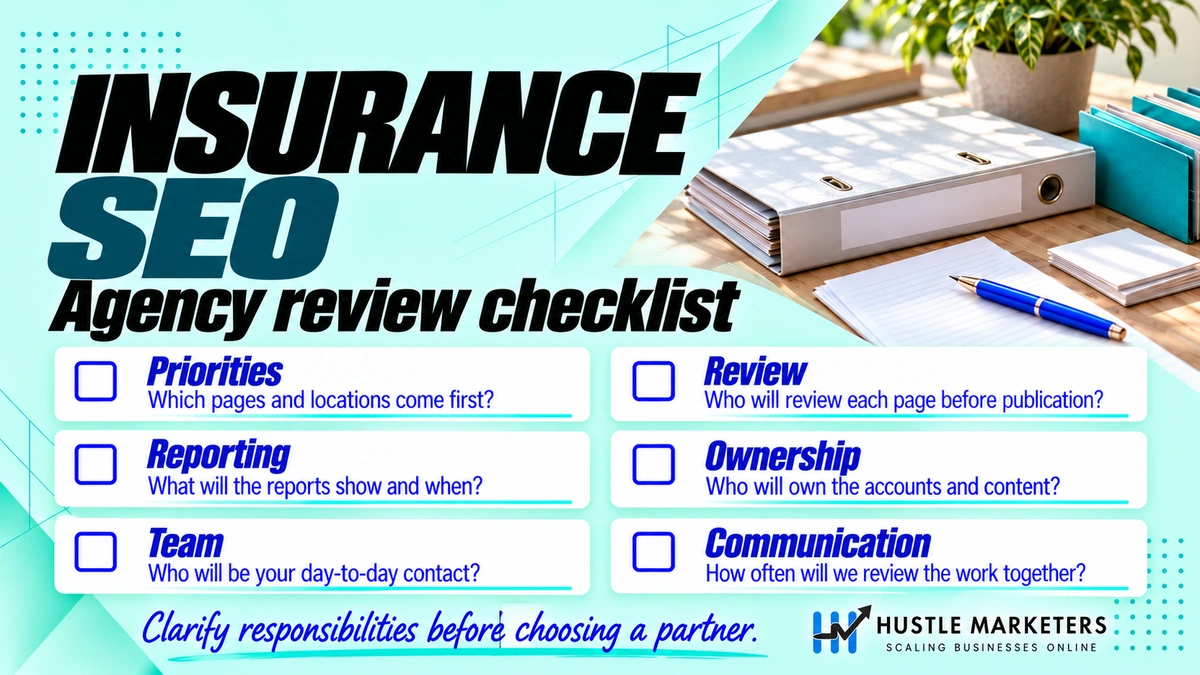
- Which states and lines will you build pages for first, and why?
- Who reviews pages for state advertising rules before they go live?
- How will you track a lead from quote form to bound policy?
- Who will own the website, profiles, analytics and content?
- How do you ask for reviews without breaking Google’s rules?
- Who runs our account day to day, and how often do we talk?
Why choose Hustle Marketers for insurance marketing?
Hustle Marketers runs SEO and paid search for businesses that want clear pricing and accounts they own. The agency was founded in 2020 by Ishant Sharma, who has worked in Google Ads, Microsoft Ads and SEO since 2013. Hustle Marketers is a Google Partner, Meta Business Partner and Microsoft Advertising Partner.
- SEO from $500 a month, as a starting range that varies by business.
- PPC management at $600 to $800 per platform per month, month to month.
- You own your Search Console, GA4, Google Business Profiles, ad accounts and content.
- 591+ reviews across Google, Trustpilot, Clutch, G2, DesignRush, Upwork and other platforms.
- Clutch Award wins in 2023, 2024 and 2026.
- Free marketing tools and open-source SEO and Google Ads code on GitHub.
- Delivery team in Zirakpur, India, serving clients worldwide, including the US.
We do not offer organic social media posting. Our client work is covered by signed NDAs, so we share our process on a call rather than client names or results.
SEO for insurance companies FAQs
Is SEO worth it for a small insurance agency licensed in only a few states?
Yes, if you aim it at the right searches. A small agency does not need national rankings. It needs a correct Business Profile, pages for the lines it writes in the states it is licensed in, and steady reviews. Agents in an Insurance Forums thread on this question gave similar advice: target a few local terms and build SEO into the site from the start.
Can an independent agent outrank big carriers in Google?
Sometimes, on local searches, where a nearby office with a complete profile and steady reviews can appear alongside carrier offices. Broad national terms like “car insurance” are a much harder fight for a local agency. Focus on your towns, your lines and the niche industries you know well, and treat any ranking promise with care.
Can I use my carrier’s name in my Google Business Profile?
A branded solo agent can, in Google’s format “[brand]: [your name]”, such as “Allstate: Joe Miller”. Check your carrier’s agent brand rules first. Independent agencies should use their own real-world business name and mention carriers on the website only where they hold an appointment.
Should an insurance agency show license numbers on its website?
Showing license numbers and states helps buyers check you with their state department of insurance, which the NAIC tells consumers to do. Whether it is required depends on your state and the type of ad. Ask your compliance lead or state regulator, and show license details on author and contact pages either way.
Does schema markup help an insurance agency website?
Schema markup helps Google read your business details, but it does not guarantee rich results or rankings. Use the InsuranceAgency type for each office, with the same name, address and phone as your Business Profile. Mark up only what is visible on the page.
Do insurance advertisers need Google Ads verification in the US?
Health and medical insurance advertisers in the US need Google certification first. Google’s separate financial services verification covered other countries, not the United States, when we checked in October 2026. Ads must still follow the state and local rules for each place you target.
How long should an insurance company keep copies of its web pages?
Model 570 asks insurers to keep each ad for five years after its use ends, where a state has adopted that rule. Since web pages can count as ads, keep dated copies of pages you change or remove. Your state may set a different period, so confirm it with your regulator.
Want to know where your agency’s search leads are leaking? We will review your Business Profiles, line pages, reviews and quote tracking, then send you a plain list of fixes.