Is Microsoft Ads Worth It for Ecommerce? What Our Account Data Shows

Ishant
Published on November 20, 2026
Ishant
Most answers to this question say yes, because Microsoft clicks are cheaper. Our own account data says it is not that simple. Here is a verdict for online stores and the settings that decide it, from Ishant Sharma, founder of Hustle Marketers and a Bing Ads (Microsoft Advertising) specialist since 2013.
Summarize this article with:
Key Observations
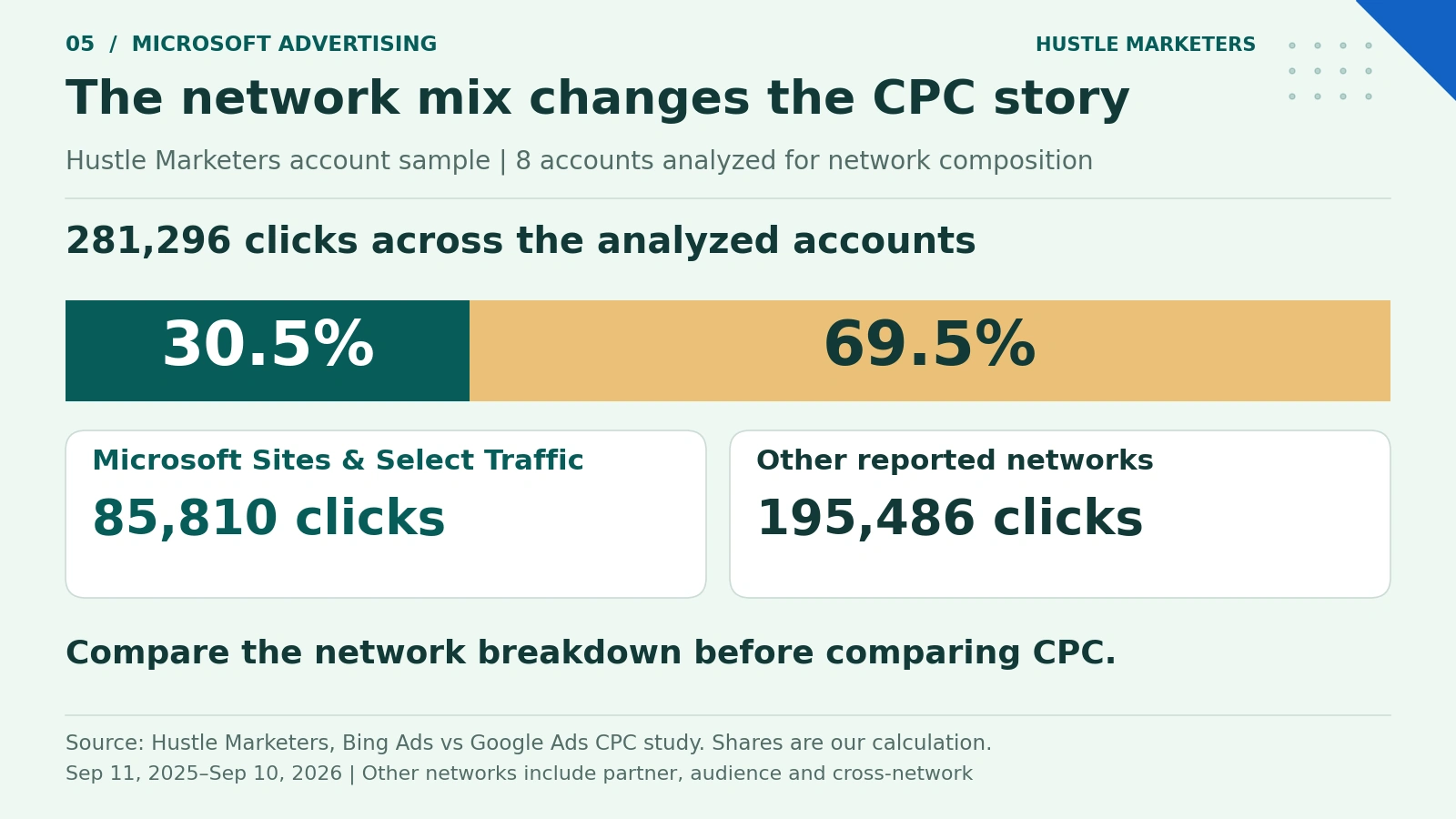
- Across 8 ad accounts we manage, only 31% of Microsoft clicks came from Microsoft’s own sites and select search traffic. The rest came from partner sites and audience placements (our CPC study).
- Cheaper is not a rule: Microsoft was 72% cheaper per click than Google on one account we manage and 72% dearer on another (account data).
- Built properly, it works: a commercial epoxy flooring brand hit 10.8x return on ad spend on Microsoft Advertising, with one campaign at 16.1x and its Best Sellers Shopping campaign at 12.0x (case study).
- The fix: set ad distribution to “Microsoft sites and select traffic”, then exclude the bad partner and audience sites you find in the Website URL (publisher) report.
- Judge Microsoft on sales and return on ad spend, never on clicks or cost per click.
- Budget at least $1,200 a month (about $40 a day) for 60 to 90 days, then increase it once the account proves itself (budget guide).
Watch: is Microsoft Ads worth it for Shopping campaigns?
In this 7 minute video, Ishant Sharma, founder of Hustle Marketers and a Bing Ads (Microsoft Advertising) specialist since 2013, walks through the account data behind this guide: where Microsoft clicks really come from, the blended CPC trap, the 10.8x flooring account and how to test Microsoft Shopping on your own store.
Video chapters
- 0:00 Is Microsoft Ads worth it for Shopping campaigns?
- 0:14 The short answer
- 0:38 Who sees Microsoft Shopping ads?
- 1:07 Is Microsoft Ads cheaper than Google Ads?
- 1:34 The blended CPC trap
- 2:13 How to exclude syndicated partners
- 2:50 Real Microsoft Shopping results: 10.8x ROAS
- 3:48 How Copilot changes Microsoft Shopping
- 4:22 Microsoft feed rules vs Google
- 4:53 What breaks when you import Google Ads
- 5:34 When is Microsoft Ads not worth it?
- 5:52 How to test Microsoft Shopping in 60 to 90 days
- 6:38 The verdict
Is Microsoft Ads worth it for ecommerce? Yes for many US online stores, but only when you control where the ads run and judge the channel on sales. On default settings, much of a Search budget can go to partner sites and audience placements, so a cheap click is not proof of a good channel.
On this page
- Watch the video
- When is it worth it?
- Where Search ads show
- Is it cheaper than Google?
- The blended CPC trap
- Google vs Microsoft table
- Which ad distribution setting?
- How to judge results
- Microsoft Shopping
- How Copilot changes Shopping
- Feed rules vs Google
- What return is possible?
- Importing from Google
- Setup checklist
- How much to spend
- 60 to 90 day test plan
- When it is not worth it
- FAQs
- How we got these numbers
When is Microsoft Ads worth it for an online store?
Microsoft Ads is worth testing for an online store that already sells profitably on Google Ads, ships to US buyers and tracks purchase revenue. Then the test measures one new thing: the Microsoft traffic.
| Your store today | Our verdict | Why |
|---|---|---|
| Profitable on Google Ads, US buyers, revenue tracked | Worth testing now | Only the traffic source changes |
| Sells to businesses or trade buyers | Worth testing | LinkedIn profile targeting can raise bids by company, industry or job function |
| Large catalog with a clean Google Shopping feed | Test Shopping first | Google Shopping campaigns and feeds can be imported |
| No purchase revenue tracking | Not yet | You cannot judge the channel on sales |
| Google Ads not yet profitable | Not yet | Fix offer, pages and tracking on the bigger channel first |
| Most buyers outside the US | Check your market | The share figures below are US only |
Bing had 18.8% of US desktop searches in September 2026 (StatCounter desktop) and 9.78% across all platforms in October 2026 (StatCounter all platforms).
Not sure where your Microsoft clicks really go? Our free audit covers Google Ads and Microsoft Ads, arrives within 48 hours and includes a walkthrough call.
Get Free Audit Worth $500Where do Microsoft Search ads actually show?
Microsoft Search ads show on Microsoft sites such as Bing, MSN and Outlook.com, on select partner traffic such as Yahoo and, on the default setting, on additional syndicated search partners such as Ask.com and Forbes. Microsoft’s ad distribution page adds that “All options include search and Audience ads”, so a Search campaign can also serve native and display ads.
That is why our first check on any Microsoft account is the network split. Across 8 ad accounts we manage, only 31% of Microsoft clicks came from Microsoft’s own sites and select search traffic. Cheaper partner and audience clicks pull the blended average down, as our Bing Ads vs Google Ads CPC study shows.
Why is my Search campaign showing on MSN, Outlook and partner sites?
Search campaigns are eligible for the Microsoft Audience Network by default. In July 2026 a Microsoft support moderator wrote that there is “no direct opt-out or bid adjustment for Audience Network delivery that is universally available” (Microsoft Q&A). You can limit it but not switch it off, and our Microsoft Audience Network guide shows how.
Are Microsoft Ads cheaper than Google Ads for ecommerce?
Microsoft Ads is not reliably cheaper than Google Ads. Microsoft was 72% cheaper per click than Google on one account we manage and 72% dearer on another (our CPC data). Published averages often mix partner and audience clicks into one figure, so check how any average was measured.
Cheap clicks can still lose money. In an October 2026 Microsoft community thread, a small insurance agency reported 4,205 clicks and one sale from $1,600 of spend, with its Search campaign spending 77% on display traffic (Microsoft Q&A). We see the same pattern in ecommerce audits.
Compare search only cost per click first, then cost per sale for the same products. For fees and minimum budgets, see our Bing Ads management guide; the CPC data also sits in our PPC statistics roundup.
The 49 second version: the short below sums up the cheaper click myth and the fix in under a minute.
What is the blended CPC trap in Microsoft Ads?
The blended CPC trap is judging Microsoft Ads on its account average cost per click, which mixes cheap partner and audience clicks with pricier core clicks. In our Bing Ads vs Google Ads CPC study, blended CPC understated the core cost per click in 5 of 8 accounts, by as much as 184%.
Core here means the Microsoft Sites and Select Traffic category, which the study notes is not pure Bing search. In the other 3 accounts the core clicks cost less, so an average can mislead either way.
The same problem hits platform comparisons. These four accounts from the study ran both platforms:
| Account | Microsoft search CPC | Google search CPC | Result |
|---|---|---|---|
| Industrial coatings ecommerce | $0.83 | $2.92 | Microsoft 72% cheaper |
| Driver training school | $0.81 | $2.55 | Microsoft 68% cheaper |
| Furniture ecommerce | $2.12 | $1.23 | Microsoft 72% dearer |
| Pet products ecommerce | $1.47 | $0.97 | Microsoft 52% dearer |
Source: Hustle Marketers CPC study. The study marks these four rows provisional because they use each account’s full history, not matched dates. Read them as proof that the direction varies, not as a benchmark.
To avoid the trap, compare the Microsoft search row with the Google Search row for the same dates, then compare cost per sale.
How is Microsoft Ads different from Google Ads for ecommerce?
Microsoft Ads runs the same kind of auction as Google Ads, but it reaches fewer searchers and mixes more partner and audience inventory into Search campaigns.
| Area | Microsoft Ads compared with Google Ads | What it means for your store |
|---|---|---|
| US search share | Bing 18.8% desktop, 9.78% all platforms; Google 74.71% and 85.45% | Fewer clicks, weighted to desktop |
| Where Search ads run | Audience ads included under every distribution setting | Check the network split before judging CPC |
| Click cost | 72% cheaper on one account we manage, 72% dearer on another | Test it; never assume a discount |
| Partner control | Syndicated partners are blocked in advance only by the distribution setting; Yahoo and select traffic stay | Some traffic is judged on sales, not blocked |
| Shopping | Microsoft Merchant Center; Google Shopping campaigns and feeds can be imported | Fast start, then Microsoft specific feed work |
| Campaign import | Once or on a schedule; not everything imports | Choose one time or scheduled before you edit |
| Business buyers | LinkedIn company, industry and job function bid adjustments | Useful for trade and B2B ecommerce |
| Performance Max negatives | Campaign or account level lists since March 2026 | Account level negatives protect every campaign |
Sources: StatCounter desktop, StatCounter all platforms, ad distribution, Google import, LinkedIn targeting, March 2026 update; CPC result from accounts Hustle Marketers manages.
Which ad distribution setting should an ecommerce store use?
Most online stores should choose “Microsoft sites and select traffic”. Microsoft’s ad distribution page lists two options, “The entire Microsoft Advertising Network (recommended)” and “Microsoft sites and select traffic”. The second keeps Microsoft sites and select partner traffic and drops the additional partner traffic, where syndicated search partners sit.
Ad distribution is chosen when you create a campaign but lives at ad group level: Campaigns, Ad groups, select the ad group, then Settings, Ad group settings, Advanced settings, Ad distribution. Since “All options include search and Audience ads”, this removes syndicated partners but not Audience ads, so exclusions come next.
Can you exclude bad partner sites in Microsoft Ads?
Partly. Microsoft says that in Search campaigns “you cannot block your ads from serving on Yahoo search and Microsoft search traffic (including Bing and AOL), but you can block your ads from serving on audience traffic (including MSN, Microsoft Edge, and Outlook.com)” (Microsoft exclusions help).
- Find them: sort the Website URL (publisher) report by spend with no sales.
- Exclude sites: add up to 2,500 URLs by hand, or use website exclusion lists.
- Exclude apps: add the Mobile Bundle ID from the same report to your exclusion list.
- Accept the rest: select traffic sites keep serving in Search campaigns even if listed.
Our guide to removing Microsoft syndicated search partners walks through the change with screenshots.
Want your ad distribution, exclusions and Shopping setup checked before you spend more on Microsoft? We look for wasted spend and missed sales in both accounts.
Get Free Audit Worth $500How should you judge Microsoft Ads results?
Judge Microsoft Ads on sales and return on ad spend, split by network, against your break-even ROAS. Click-through rate tells you little: Microsoft support has said “CTR and conversion performance alone are not used to determine whether traffic is valid or invalid” (Microsoft Q&A).
- Track revenue: UET on every page with the order value. See our Microsoft UET tag guide.
- Split by placement: the Website URL (publisher) report now shows conversions, clicks and spend (Microsoft, May 2026).
- Set the bar: judge every campaign against your break-even ROAS.
- Check for bots: high click-through with no engaged sessions needs a closer look, as our Bing Ads click fraud guide explains.
Is Microsoft Shopping worth it for online stores?
Microsoft Shopping is worth setting up for most stores already running Google Shopping, because you can import Google Shopping campaigns and feeds into a Microsoft Merchant Center store with a claimed domain. The feed and search terms then need Microsoft specific work.
Hustle Marketers runs Shopping on both Google and Microsoft for ArmorPoxy, ArmorGarage, Universal Nail Supplies and 1800 Eichlers. ArmorPoxy’s published $1.58M at 12.84x ROAS is a Google Ads result, not a Microsoft figure. Our published Microsoft Shopping result is the Best Sellers Shopping campaign in the epoxy flooring case study, at 12.0x.
- Recurring product import, so prices and stock stay in step with the store.
- Microsoft data for feed changes: we optimize the feed from Microsoft Merchant Center and Bing search term data.
- Best sellers first: a separate Shopping campaign for products that already sell.
For setup, see setting up Bing Merchant Center and our Bing Shopping feed guide. Our Google Shopping agency service runs Google and Microsoft Shopping together.
Should ecommerce stores use Performance Max on Microsoft?
Test Performance Max once Shopping and Search have conversion data. It is easier to control in 2026: negative keyword lists at campaign or account level (March 2026), Website URL reporting with conversions (May 2026) and optimization experiments (September 2026). From 1 October 2026, Max CPC is no longer available on new non portfolio Maximize campaigns (August 2026). Our Microsoft Performance Max guide covers setup.
How does Copilot change Microsoft Shopping?
Copilot makes your Microsoft Merchant Center feed do more than run Shopping ads. In June 2026, Microsoft announced Universal Commerce Protocol support so brands can power AI experiences, including Copilot checkout, with accurate product data. Microsoft says feeds mainly help products show up in AI responses, while the protocol handles checkout.
Here is what Microsoft has published, with dates:
- June 2026: the Activate 2026 recap says Universal Commerce Protocol “Enables brands to power AI-driven experiences (including Copilot checkout) with accurate, up-to-date product data”.
- Copilot Checkout: Microsoft’s agentic commerce page (checked 18 November 2026) says it “lets shoppers complete purchases directly inside Microsoft Copilot”, on Copilot.com and the Copilot mobile app.
- Who qualifies today: the same page says “Only English-language merchants who sell to US buyers are eligible at this time (supporting USD)”. It marks the Merchant Center setup as a pilot for select customers and says Shopify merchants were enrolled automatically, with controls in Shopify admin.
For an online store, the same product data now serves ads and AI answers, so a wrong price or stock level shows up in both.
How are Microsoft Merchant Center feed rules different from Google’s?
Microsoft Merchant Center takes Google style product data but does not use every Google field. Microsoft’s product documentation says it ignores additional image links, AdWords grouping and labels, destinations and taxes, which are kept only “for Google compatibility”. It also expires a product 30 days after its last update unless you set an expiration date.
| Feed field | What Microsoft’s documentation says | How we handle it |
|---|---|---|
| Additional image links | Not used by Microsoft Merchant Center; kept for Google compatibility | Put the strongest image in the main image link |
| AdWords grouping, AdWords labels, destinations, taxes | Not used; kept for Google compatibility | Use custom labels for campaign splits |
| Title | Up to 150 characters, with no promotional text | Word titles from Bing search term data |
| Custom labels | Five labels of up to 100 characters, used to filter products for Microsoft Shopping campaigns | Label best sellers for their own campaign |
| Expiry | 30 days after the last add or update if no expiration date is set | A recurring import keeps products live |
Source: Microsoft’s Products resource documentation (last updated 28 October 2026), the reference for Microsoft Merchant Center product data.
On refresh, Microsoft’s help page on scheduled feed downloads (updated June 2026) offers daily, weekly and monthly schedules (Microsoft help).
That is why our Microsoft product import runs on a recurring schedule, and why we optimize the Microsoft feed from Microsoft Merchant Center and Bing search term data instead of copying Google’s changes. Our Bing Shopping feed guide covers the work attribute by attribute.
What return can Microsoft Ads deliver for an ecommerce brand?
Built properly, Microsoft Ads can carry real revenue. A commercial epoxy flooring brand we manage hit 10.8x return on ad spend on Microsoft Advertising, with one campaign at 16.1x and its Best Sellers Shopping campaign at 12.0x (epoxy flooring Bing Ads case study).
That account split Search and Shopping by intent. It is one account’s result, not a forecast, and we never promise a client a ROAS figure.
What does a strong Microsoft Ads account look like over two years?
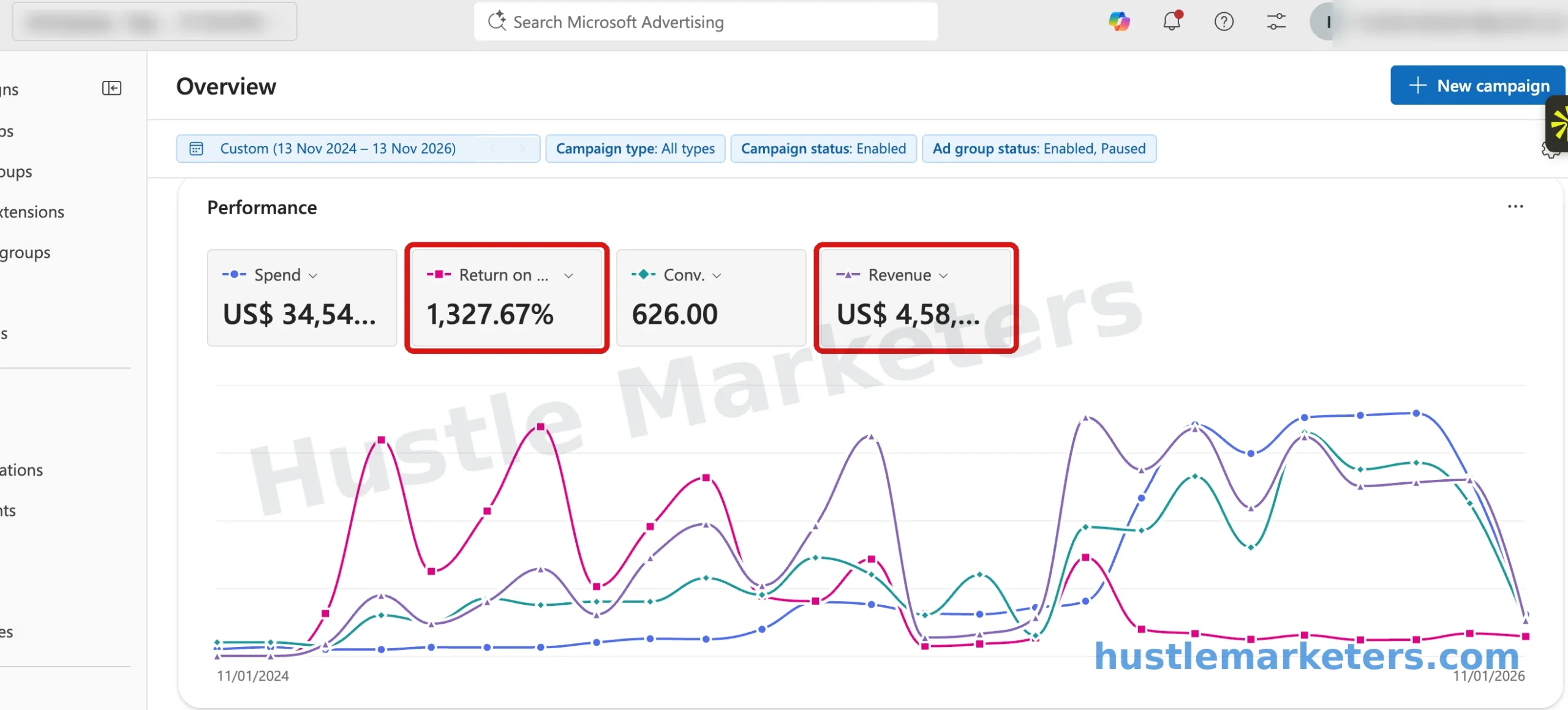
Here is another Microsoft Advertising account we manage, over two years from 13 November 2024 to 13 November 2026: 1,327.67% return on ad spend (13.3x) and 626 conversions on just over $34,500 of spend, which works out to more than $458,000 in revenue. The client name is hidden because the account is covered by an NDA. The return on ad spend and revenue figures are marked in red.
Can you just import your Google Ads campaigns into Microsoft Ads?

“Bing does not fail advertisers. Unedited Google imports fail advertisers, and then Bing gets the blame.”
Ishant Sharma, Founder, Hustle Marketers, Bing Ads specialist since 2013
You can, but treat the import as a first draft. Microsoft’s Google import guide offers Auto, Now, Once, Daily, Weekly and Monthly schedules and warns that “Not all information will be imported”. A scheduled import can overwrite edits made for Bing.
For 1800 Eichlers, we added Microsoft Ads in October and November 2026 by copying Search and Performance Max from Google as a one time import with no scheduled sync. Google budget changes do not carry over, so the Microsoft account runs on its own numbers. Our guide to importing Google Ads to Microsoft Ads covers each option.
How do you set up Microsoft Ads for an online store?
Set up tracking first, then the import, then network settings and exclusions. For account creation and billing, follow our guide to advertising on Bing.
- Install UET with revenue on every page.
- Import from Google once, unless you want Google changes copied in.
- Choose “Microsoft sites and select traffic” in every ad group.
- Build account level negatives in phrase and exact match before launch.
- Start Search on exact match, and go broader only once there is conversion data.
- Connect Microsoft Merchant Center, claim the domain and schedule a recurring product import.
- Review placements weekly and exclude sites that spend without selling.
- Judge on sales: ROAS against break-even, cost per sale against Google.
How much should an online store spend on Microsoft Ads?
Start with at least $1,200 a month in Microsoft ad spend, which is about $40 a day, then increase the budget once the account proves itself. That is the minimum monthly budget Ishant Sharma, founder of Hustle Marketers, sets for an online store. Proof means cost per sale and return on ad spend against your break-even ROAS, not cheap clicks.
Why $1,200 a month and not less?
A $1,200 monthly budget gives Microsoft enough sales data to learn from. Microsoft’s own Performance Max best practices say the learning period takes two to four weeks or two to three conversion cycles, that a constrained budget hinders optimization, and that Target ROAS should be added only after at least 30 conversions in the last 30 days.
- Too little data: a small budget runs out before the campaign learns which products and searches sell.
- Limited by budget: the campaign misses auctions it could win, so the results look worse than the channel really is.
- No path to Target ROAS: without about 30 sales a month, you cannot move to the bid strategy that protects margin.
How many sales does $1,200 a month buy?
Divide $1,200 by your expected cost per sale. The table below is a worked example, not a forecast for your store: plug in the cost per sale your Google Shopping campaigns already get for the same products.
| Cost per sale | Sales a month on $1,200 | Enough for Target ROAS (30 a month)? |
|---|---|---|
| $20 | About 60 | Yes |
| $40 | About 30 | Just |
| $80 | About 15 | No, stay on Maximize conversion value or raise the budget |
If your cost per sale is high, a bigger monthly budget, or fewer products in the test, gets you to useful data faster.
When should you increase the Microsoft Ads budget?
Increase the budget once cost per sale and ROAS have held above break-even for about 30 days. Raise it in steps and change one thing at a time, because Microsoft advises waiting two weeks after each target change and making small changes while a campaign ramps up.
- Month one: $1,200, learning period, fix tracking, feed and placements. Do not judge on early numbers.
- Month two: keep $1,200, judge on cost per sale and ROAS against break-even and against Google for the same products.
- Month three onward: if results hold, move budget into the campaigns and products that sell, then raise the total.
| Cost | Amount | Notes |
|---|---|---|
| Microsoft ad spend | At least $1,200 a month (about $40 a day) | Paid to Microsoft from your own account |
| Hustle Marketers management (optional) | $600 to $800 per platform a month | Month to month, no lock-in, you own the account |
| Free audit before you start | Worth $500 | Covers Google Ads and Microsoft Ads |
We never promise a return on ad spend for a new Microsoft account. For fees at other spend levels, see our PPC management pricing guide.
How do you test Microsoft Shopping in 60 to 90 days?
Run Microsoft Shopping for 60 to 90 days on at least $1,200 a month in Microsoft ad spend, so $2,400 to $3,600 in total, with revenue tracking, a Microsoft ready feed and tight distribution settings in place from day one. Then judge it on cost per sale and return on ad spend against your break-even ROAS, and scale only what proves itself.
Ishant covers this test in the video chapter at 5:52. The written plan below uses the rules set out on this page:
- Track revenue before launch: UET on every page with order value, and your break-even ROAS worked out.
- Import once, then edit: copy Search and Shopping from Google as a one time import, then change them for Microsoft.
- Connect the feed: Microsoft Merchant Center with a claimed domain and a recurring product import.
- Lock down distribution: “Microsoft sites and select traffic” in every ad group, plus account level negatives in phrase and exact match.
- Split best sellers out: give products that already sell their own Shopping campaign.
- Review placements weekly: exclude sites and apps in the Website URL (publisher) report that spend without selling.
- Improve the feed from Microsoft data: add Bing search terms to titles where they show demand.
- Decide at the end: compare cost per sale and ROAS with break-even and with Google for the same products, then scale or fix.
When is Microsoft Ads not worth it for an online store?
Microsoft Ads is not worth it for a store that cannot measure sales, has not made Google Ads profitable, or sells mostly outside the US without checking Bing’s share there. Our ecommerce PPC management team fixes those basics before adding Microsoft.
- No revenue tracking: you can only judge clicks, and clicks mislead on Microsoft.
- Google is not profitable yet: a smaller channel will not fix an offer or page that does not convert.
- Phone only buyers: Bing’s US share is 18.8% on desktop but 9.78% across all platforms (StatCounter).
- No time for weekly placement reviews: partner and audience spend grows unchecked.
- Too few sales to learn from: a handful of orders a month cannot separate good settings from luck.
Microsoft Ads for ecommerce FAQs
How big is Bing’s share of US search in 2026?
StatCounter puts Bing at 18.8% of US desktop searches in September 2026 and 9.78% of US searches across all platforms in October 2026. It measures page views, not ad clicks.
Why do my Microsoft ads show on Yahoo instead of Bing?
Yahoo is part of the select partner traffic that every ad distribution option includes, and Microsoft says Search campaign ads cannot be blocked from Yahoo search. Judge that traffic on sales.
Is Microsoft Ads traffic real or bots?
Microsoft filters clicks it judges invalid and decides which ones those are. Low conversion rates alone do not prove a click was invalid, so protect yourself with distribution settings, exclusions and sales based reporting.
Is Bing Ads good for Shopify stores?
Yes, under the same rules as any store: track purchase revenue with the UET tag, send products through Microsoft Merchant Center, set ad distribution with care and judge the channel on sales.
Can I use LinkedIn targeting for ecommerce on Microsoft Ads?
Yes, if you sell to businesses. LinkedIn profile targeting by company, industry and job function works in Search, Shopping and Audience campaigns. It adjusts bids and does not narrow who sees your ads.
Should I advertise on Bing as well as Google?
Yes, if your Google Ads already sell at a return you are happy with and you track revenue. Give Microsoft its own budget and compare cost per sale on both platforms before you scale.
How much should an online store spend on Microsoft Ads?
Start with at least $1,200 a month in Microsoft ad spend, about $40 a day. Increase the budget later, once cost per sale and return on ad spend show the account has proved itself. Do not judge it on clicks.
Do Microsoft Ads show in Copilot?
Microsoft says they do. In August 2025 it reported that ads in Copilot drew 73% higher click-through rates than traditional search, from its own February to May 2025 data. The Microsoft pages we checked do not list which campaign types are eligible, so keep your feed and Search campaigns clean.
How we got these numbers
The 31% figure (clicks from Microsoft’s own sites and select search traffic) comes from 8 Microsoft Advertising accounts we manage, and the 72% cheaper and 72% dearer figures from accounts running both Google and Microsoft. The accounts are covered by NDAs, so we do not name them. Our CPC study sets out the method and anonymized tables.
The 10.8x, 16.1x and 12.0x figures are from the published case study. Microsoft settings were checked against Microsoft’s help pages in November 2026. For Microsoft and Google run by one team, see our Bing Ads agency service.
Adding Microsoft Ads, or unsure your current account pulls its weight? We will check where your clicks run, what they sell and what we would change first.
Get Free Audit Worth $500