A Bing Shopping feed is a structured product data file you submit to Microsoft Merchant Center. It powers Bing Shopping ads, free product listings and Microsoft Copilot product recommendations across Bing, MSN, Yahoo, DuckDuckGo, Ecosia, Microsoft Edge and the Microsoft Audience Network.
There is no keyword bidding in Bing Shopping. Your feed data alone decides which searches your products match, where they appear and how much you pay per click. Here is what that means in practice.
- Eight attributes are required:
id,title,description,link,image_link,price,availabilityandcondition, plus brand and GTIN in most categories - The hard limits: ID 50 characters, title 150, link 2,000, description 10,000, image link 1,000, image file 3.9 MB, feed file 4 GB
- Titles carry the most weight. Microsoft never rewrites a weak title the way Google often does, so the feed has to do all the work
- Free product listings run off the same feed. Organic Shopping tab placements at zero cost per click, and most stores never switch them on
- Your feed now feeds Copilot. Merchant Center became UCP-ready in April 2026, which makes feed accuracy a checkout dependency rather than just an ad concern
- The silent killer is not rejection. Price mismatches and “limited” product states keep serving while quietly losing reach, and there is no manual review request to speed up a fix
- The payoff: cost per click roughly 40 to 70% below Google Shopping on comparable queries, with higher average order values
Why Bing Shopping feed optimization matters in 2026
Lower competition, cheaper clicks and a desktop audience that spends more. However, none of it works on a weak feed.
Most advertisers pour everything into Google Shopping and treat Bing as an afterthought. That habit has created a real opening. Bing continues to deliver lower cost per click, stronger desktop purchase intent and higher average order values than many Google categories.
Here is the honest catch. None of those advantages survive a weak feed. A poorly structured feed reduces impressions, triggers disapprovals, matches the wrong search terms and pushes Microsoft Ads into inefficient bidding.
This guide covers the whole picture: the feed specification, the setup process, free listings, Copilot eligibility, campaign structure, advanced optimization and a documented fix for every common disapproval. It is the same framework we run inside our ecommerce PPC management engagements.
Quick comparison: unoptimized feed vs optimized feed
Same catalogue, same budget. The difference is entirely in the data you submit.
| Area | Unoptimized Bing feed | Optimized Bing feed |
|---|---|---|
| Query matching | Broad titles match few searches | Attribute-rich titles match long-tail buyer queries |
| Impressions | Drop silently with no disapproval notice | Stable and expanding across Microsoft surfaces |
| Disapprovals | Price, GTIN and image errors accumulate | Caught before the next crawl cycle |
| Impression share | Capped by low relevance and trust signals | Grows without raising bids |
| Free listings | Usually never enabled | Running alongside paid ads at zero cost |
| Copilot visibility | Products not eligible for AI recommendations | Eligible for Copilot shopping answers |
| Cost per click | Inflated by weak quality signals | Roughly 40 to 70% below Google Shopping |
The takeaway: Bing Shopping is not a smaller copy of Google Shopping. It is an incremental channel with its own rules, and the feed is the only lever that matters.
Not sure where your feed is losing impressions? We audit Bing Shopping feeds SKU by SKU and send back a prioritised fix list.
Get a free feed audit worth $500What is a Bing Shopping feed?
A product catalogue file formatted for Microsoft Advertising. Same specification as Google, stricter enforcement.
A Bing Shopping feed is a product catalogue file formatted for Microsoft Advertising shopping campaigns. Each item describes one product using standard attributes.
In practice, Microsoft Merchant Center reads this file, validates it, matches products to searches and then decides placement.
What a Bing Shopping feed contains
- Product titles and descriptions
- Images and additional image links
- Pricing, sale pricing and currency
- Availability and stock status
- Product identifiers: GTIN, UPC, EAN, MPN and brand
- Product categories and product type paths
- Custom labels for campaign segmentation
- Shipping and tax information
If you already run Google Merchant Center, the format will look familiar. Microsoft accepts the Google feed specification and the full Google product taxonomy.
As a result, that compatibility is exactly why so many advertisers import a Google feed and stop there. It is also why so many of them see limited reach without ever understanding why.
Where your products actually appear
Your products do not appear only on Bing.com. One approved feed distributes across:
- Bing search results and the Bing Shopping tab
- MSN Shopping and Microsoft Start
- Yahoo and DuckDuckGo through syndication
- Ecosia
- Windows Search and the Microsoft Edge sidebar
- Outlook placements
- Microsoft Audience Network, including dynamic remarketing
- Microsoft Copilot product recommendations
Each surface weights signals a little differently, but all of them read the same feed. In other words, one round of feed work multiplies across eight placements.
Syndicated traffic from Microsoft’s search partner network can behave very differently from Bing.com traffic. If your Shopping numbers look inconsistent, read our guide on how to exclude Microsoft syndicated search partners before you blame the feed.
Bing Shopping vs Google Shopping: full comparison
Three comparison tables: the feed spec, the platform, and the audience.
Feed specification differences
| Area | Google Shopping | Bing Shopping |
|---|---|---|
| Title handling | Often rewrites weak titles automatically | Never rewrites. The feed must do the work |
| Title character limit | 150 characters | 150 characters, display truncates near 70 |
| Description limit | 5,000 characters | 10,000 characters |
| Product ID limit | 50 characters | 50 characters |
| Image minimum | 250 x 250 px apparel, 100 x 100 px other | 220 x 220 px across categories |
| Image file size cap | Up to 16 MB | 3.9 MB |
| Identifier enforcement | Warnings on many GTIN issues | Stricter. Invalid GTINs disapprove faster |
| Category system | Google product taxonomy | Accepts Google taxonomy, bing_product_category still needs review |
| Maximum feed size | 4 GB | 4 GB |
Platform and workflow differences
| Feature | Google Merchant Center | Bing Merchant Center |
|---|---|---|
| Setup complexity | Lower since Merchant Center Next | Higher, more manual configuration |
| Feed approval | Strict | More flexible in most retail categories |
| Disapproval behaviour | Aggressive | Moderate, but silent ineligibility is common |
| Manual review request | Available | Not available. You wait for the next crawl |
| Diagnostics tool | Merchant Center diagnostics | Product Explorer plus Recommended Actions |
| Supplemental feeds | Supported | Supported, globally available since Sept 2025 |
| Negatives in Shopping | Limited | Supported at campaign and ad group level |
| Professional targeting | Not available | LinkedIn job title, company and industry |
| AI shopping surface | AI Overviews and AI Mode | Copilot, Copilot Checkout, Edge shopping |
Audience and cost differences
| Dimension | Google Shopping | Bing Shopping |
|---|---|---|
| Audience | Universal, mobile-heavy | Higher income, desktop-heavy, corporate |
| Advertiser competition | High | Lower |
| Cost per click | Baseline | Roughly 40 to 70% cheaper |
| CPC stability | Fluctuates with competition | More stable, easier to scale |
| Order value, average | Baseline | Around 76% higher per order in our accounts |
| Default placement | Chrome and Android | Windows, Edge, Office and enterprise desktops |
If you want the Google side of this in depth, see our guide to Google Shopping feed optimization and Google Merchant Center AI attributes.
How Bing Shopping works
No keywords, no manual targeting. Bing reads your attributes and decides everything from there.
Bing Shopping follows a simple and strict rule. Your product feed controls everything. The platform does not assume meaning, guess intent or reward creative tricks.
Microsoft Ads uses the data you upload through Bing Merchant Center to understand what you sell, connect products to search terms and decide where your ads appear.
1. Bing reads structured product data
Each product moves through Microsoft’s processing system, where Bing reviews the core attributes:
- Product title and description
- Product category and product type
- Brand, GTIN, UPC, EAN and MPN
- Image URLs
- Price and sale price
- Availability
- Shipping and tax
These are not visual elements. They tell Bing:
- What the product actually is
- Which searches it should appear for
- How it compares against competitors
- Whether it matches buyer intent
- Whether the offer deserves auction placement
Therefore, missing or weak attributes reduce visibility immediately.
2. Feed-based targeting
Google and Bing Shopping share one rule. No keywords means no manual targeting. Bing connects products to searches using titles, descriptions, categories, GTIN associations, brand, MPN, historical performance and competitiveness indicators.
When your title reads Black Running Shoes Lightweight Men Size 10, Bing can match:
- best lightweight men’s running shoes
- black running shoes size 10
- men’s marathon training shoes
However, if the title only says “Running Shoes”, performance drops sharply. In that case Bing has no context to match intent.
3. Eligibility checks before a product can serve
Before any product shows, Bing checks:
- Landing page accuracy and accessibility
- Image quality and policy compliance
- Price consistency between feed and page
- Stock status
- Shipping rules
- Brand validity
- GTIN accuracy
If a check fails, the product is not banned. Instead, it simply becomes ineligible, and impressions stop without warning.
Consequently, many advertisers watch traffic decline while their account shows zero disapprovals. Silent ineligibility is the single most under-diagnosed problem in Microsoft Shopping.
4. Product reviews in Bing Merchant Center
Reviews are not handled the way they are in Google Merchant Center. Bing supports review integration, but the process is more technical and less plug-and-play.
Option A: third-party review platforms
Some review platforms can surface star ratings in Bing Merchant Center, but integration depth varies. Before relying on any automation, confirm:
- Seller ratings versus product review support
- Microsoft feed compatibility, not just Google compatibility
- Correct GTIN and SKU matching
- Direct syndication to Bing
Review.io is a licensed partner for seller ratings, which means store-level reviews may qualify for ad stars. Stamped.io and Bazaarvoice may offer product review feed exports. If the difference between the two rating types is unclear, our guide on seller ratings vs product ratings breaks down which one applies where.
Option B: FTP-based review feed upload
You can also submit review data manually. This requires:
- Product IDs matching your primary feed
- A valid GTIN or MPN where applicable
- Review ID and reviewer name
- A rating on a 1 to 5 scale
- Review text and review date
Finally, feeds are submitted via FTP in XML or tab-delimited format.
5. How Bing decides placement
Bing weighs six signals when deciding where and how often to show a product:
- Relevance to the query
- Historical click-through rate
- Pricing strength against competitors
- Image clarity
- Merchant trust score
- Title precision
As a result, optimized feed data expands reach automatically, with no change to your bids.
Bing Shopping feed specification and limits
Eight required attributes, five hard character limits, three file formats, a 4 GB cap.
A valid Bing Shopping feed requires eight core attributes: id, title, description, link, image_link, price, availability and condition. Brand is required for most categories, and a GTIN is required for any product with a manufacturer-issued barcode. Microsoft accepts XML, TXT and CSV formats up to 4 GB.
Full attribute reference
| Attribute | Status | Limit | Notes |
|---|---|---|---|
id | Required | 50 characters | Unique and stable across updates. Never recycle IDs |
title | Required | 150 characters | Display truncates near 70. Front-load brand and product type |
description | Required | 10,000 characters | No HTML, no currency symbols, no promotional text |
link | Required | 2,000 characters | Must include the http:// or https:// protocol |
image_link | Required | 1,000 characters | HTTPS, publicly accessible, no watermark or overlay |
price | Required | 0.00 to 10,000,000.00, 2 decimals | Must match the landing page exactly |
availability | Required | No limit | Only in-stock products are eligible to serve |
condition | Required | No limit | new, used, refurbished. Defaults to new if blank |
brand | Required (most categories) | 70 characters, 10 words | Never use “Generic” or “N/A” |
gtin | Required where a barcode exists | 8, 12, 13 or 14 digits | Manufacturer-issued only. Never invent one |
mpn | Required if no GTIN | 70 characters | Must be unique per product |
identifier_exists | Conditional | TRUE / FALSE | Set FALSE for handmade, custom or vintage items |
sale_price | Recommended | 0.00 to 10,000,000.00, 2 decimals | Use for promotions instead of editing price |
sale_price_effective_date | Recommended | No limit | Prevents stale sale pricing after a promo ends |
additional_image_link | Recommended | Up to 10 images | Powers multi-image Shopping ads |
product_type | Recommended | 750 characters | Your own taxonomy. Use full paths with > as the separator, not broad labels. Microsoft documents a 750 character limit and disapproves values over it |
google_product_category | Recommended | 255 characters | Microsoft accepts Google’s taxonomy as-is |
custom_label_0 to _4 | Recommended | 5 fields | Margin, season, bestseller, clearance, test group |
shipping | Required in some markets | No limit | Must match storefront checkout options |
item_group_id | Recommended for variants | No limit | Groups size and colour variants together |
Supported feed formats compared
| Format | Best for | Watch out for |
|---|---|---|
| XML (RSS 2.0 or Atom 1.0) | Platform-generated feeds, large catalogues | Unescaped special characters break the whole file |
| TXT (tab-delimited) | Exports from ERP, PIM or spreadsheets | Stray tabs inside descriptions shift columns |
| CSV | Manual edits and small catalogues | Commas inside descriptions need proper quoting |
Additional technical constraints worth noting:
- Maximum file size: 4 GB. Split larger catalogues or use the Content API
- FTP address:
ftp://feeds.adcenter.microsoft.com, notftps:// - Processing frequency: indexes run roughly once a day, so allow 36 to 48 hours for updates to reflect
- Character encoding: UTF-8 throughout, or accented characters corrupt on import
Image and logo specifications
- Minimum image size 220 x 220 pixels
- Maximum file size 3.9 MB, well below Google’s 16 MB allowance
- Image URLs must use HTTP or HTTPS
- Clean white or neutral background
- No watermarks, text overlays, borders or promotional badges
- No animation
- Lifestyle images should be secondary, never the primary
image_link - Store logo required: 88 x 31 pixels classic spec, plus a 1:1 square and 4:1 wide logo in current store setup
To check a feed against every limit above before you upload it, run it through our free Google Shopping feed validator and Bing feed mapper. It reads a CSV, TSV, TXT, XLSX or Google Sheet, flags every attribute that is missing, over the limit or in a format Microsoft rejects, and exports a Microsoft ready file.
How to set up a Bing Shopping feed, step by step
Five steps. Domain claim is the hard gate. Nothing works until it clears.
Step 1: Create your Microsoft Advertising account
Sign up at ads.microsoft.com, complete advertiser verification, and choose Expert Mode rather than Smart Mode.
Expert Mode unlocks:
- Campaign priority settings
- Product groups and product filters
- Custom label segmentation
- Full bid strategy control
Before you touch the feed, set billing, timezone and currency. Timezone and currency cannot be changed later.
Step 2: Claim and verify your domain
Microsoft offers four verification methods:
- UET tag: fastest if you already run Universal Event Tracking for conversions and remarketing
- Meta tag: add
msvalidate.01to your site header - XML file upload: upload to your root domain
- DNS TXT record: slower, but the best option for headless setups
Step 3: Create a Microsoft Merchant Center store
Inside Microsoft Advertising, go to Tools, then Merchant Center, then Manage stores, and select Create a store.
Configure in this order:
- Store name, website URL and country of sale
- Business contact information matching your site
- Store category
- Logos in both 1:1 and 4:1 ratios
- Shipping zones, costs, carriers and handling time
- Tax settings
- Enhanced listings, which unlock ratings, sale badges and free shipping annotations
Shipping accuracy matters more here than on Google, because Microsoft cross-checks feed shipping values against your live checkout options and disapproves mismatches quickly.
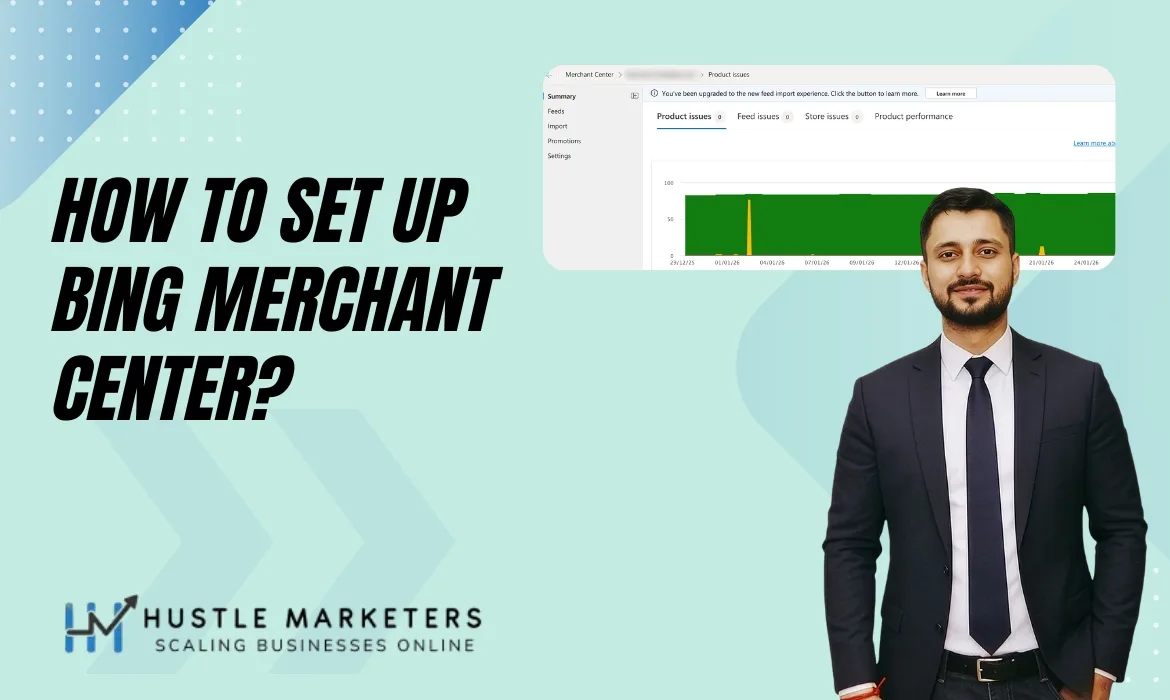
Our full walkthrough with screenshots lives in the Bing Merchant Center setup guide, including the ten prerequisites Microsoft checks before it will approve a store.
Step 4: Choose your upload method
| Method | Best for | Automation | Notes |
|---|---|---|---|
| Manual upload | Testing, small catalogues | None | Entire feed replaced each time. Error risk grows with catalogue size |
| Scheduled fetch | Most Shopify, WooCommerce and BigCommerce stores | High | Host the feed at a URL. Set fetch to daily |
| FTP or SFTP | Enterprise, ERP and PIM exports | High | Strict file naming. One error can reject the whole feed |
| Content API | Catalogues over 50,000 SKUs, flash sales | Real time | Instant price and stock updates, no fetch delay |
| Google import tool | Active Google Shopping brands | Medium | Fastest migration, but Google errors import too |
| Feed management tool | Multi-channel sellers | High | Handles formatting, monitoring and multiple destinations |
If you would rather let a tool handle formatting and error monitoring, our roundup of the 10 best apps for product feed management compares the options that support Microsoft as a destination.
Step 5: Submit and validate the feed
In Merchant Center, go to Feeds and select Create feed. You will be asked for:
- Feed name and feed type, usually Products
- Destination, usually Online Product Ads
- Language, country of sale and currency
- Input method and source URL if using scheduled fetch
Once the feed processes, review the errors and warnings report. Errors block products from running, while warnings do not block delivery but still cost you impressions.
How long approval actually takes
| Stage | Typical duration | Common blocker |
|---|---|---|
| Store verification | 24 to 48 hours | Missing business contact details on site |
| Catalogue or feed review | 48 to 72 hours | Required attributes missing |
| Image and policy checks | 1 to 3 additional days | Watermarks, overlays, restricted claims |
| Full account approval | 3 to 7 business days | Unclear return or shipping policy pages |
Microsoft has no equivalent to Google’s manual review request. After you fix a disapproval, you wait for the next scheduled crawl or feed fetch. Set your fetch schedule to daily so corrections propagate within 24 hours instead of several days.
Free product listings vs paid Bing Shopping ads
Both run off the same feed. Free listings set the floor, paid ads raise the ceiling.
Bing Shopping is not a paid-only channel. Free product listings are organic placements on the Bing Shopping tab with no cost per click. They run off the same product feed as your paid ads, so one round of feed optimization lifts both.
| Placement or feature | Free product listings | Paid shopping ads |
|---|---|---|
| Main Bing search results | No | Yes |
| Bing Shopping tab | Yes | Yes, top row |
| Partner network (MSN, Yahoo, DuckDuckGo) | No | Yes |
| Microsoft Audience Network | No | Yes |
| Copilot product surfaces | Eligible | Eligible, plus Offer Highlights |
| Cost | Free | Pay per click |
| Bid and targeting control | None | Full |
| Reporting depth | Limited | Full click, impression and conversion data |
| Runs when budget is exhausted | Yes | No |
In addition, feed quality determines your ad quality score in paid campaigns, which directly affects how much you pay per click. Therefore the practical order is simple:
- Enable free listings immediately for zero-cost impressions
- Layer paid ads on top for top-of-page positions and partner network reach
- Use free listing performance to identify which products deserve paid budget
The same logic applies on Google. We covered how the two channels interact and how to track them separately in GA4 in our guide to free Shopping listings vs paid Shopping ads, with the Google-specific setup in free listings in Google Merchant Center.
Core components of a high-performance feed
Nine components. Titles carry the most weight, pricing causes the most disapprovals.
1. Product titles
Above all, titles carry the most weight in Bing Shopping. Because Microsoft does not rewrite unclear titles, the feed must do the work.
A strong Bing title includes:
- The primary keyword
- The product type
- A key attribute such as size, colour or material
- The brand
- Clear variant details
Title formulas by vertical
| Vertical | Formula | Example |
|---|---|---|
| Electronics and appliances | Brand + Model + Category + Key spec | Gateway GM5626 Desktop Computer 16GB RAM 512GB SSD |
| Apparel | Brand + Gender + Colour/Material + Type + Size | Kenneth Cole Men’s Black Cotton Dress Shirt Size L |
| Media | Title + Author/Artist + Format | Touch of Evil Kay Hooper Paperback |
| Home and furniture | Brand + Type + Material + Dimensions + Colour | Malm Oak Bedside Table 55x49cm White |
| Beauty | Brand + Type + Key ingredient + Size | CeraVe Moisturising Cream Ceramides 454g |
| Auto parts | Brand + Part type + Compatibility + Part number | Bosch Brake Pads Front Toyota Camry 2018-2022 BP1234 |
Before and after
- Weak:
Running Shoes - Strong:
Nike Air Zoom Pegasus 41 Men's Running Shoes Black Size 10 - Result: the strong title becomes eligible for “nike pegasus 41 black”, “men’s running shoes size 10” and “lightweight marathon training shoes” instead of one generic head term
2. Product descriptions
Descriptions tell Bing how the product works, what it is made from, who it is for and what makes it different. Cover:
- Product function and use case
- Materials and specifications
- Target buyer
- Benefits and differentiators
- Compliance details where your category requires them
However, leave out HTML, currency symbols, quotation marks, all-caps text and promotional phrases such as “Free Shipping” or “15% Off”, since those trigger warnings and can suppress delivery.
3. Pricing structure
Pricing affects ad rank, visibility, click-through rate and competitiveness against similar items. Bing enforces:
- Exact price match between feed and landing page
- Correct currency for the target market
- No artificial price manipulation
If you sell products other retailers also carry, pricing strategy matters as much as feed hygiene. Our breakdown of MAP pricing vs MSRP covers how to stay competitive without breaking manufacturer agreements.
4. Product images
Bing applies stricter image standards than Google. Similarly, strong images improve click-through rate, auction eligibility and engagement score.
5. Product type and category mapping
Category structure affects relevance, query flow and algorithm confidence. As a result, correct categorisation leads to higher impression share and better intent alignment. By contrast, incorrect categories produce low-quality traffic or none at all.
6. GTIN, EAN and UPC requirements
Microsoft enforces identifiers more strictly than Google. A GTIN is required for:
- Branded products
- Retail-standard items
- Anything with a manufacturer-issued barcode
Consequently, missing GTINs cause limited reach, lower trust and reduced impressions.
7. Brand and MPN
For unbranded or custom products, the brand value must stay consistent and the MPN must be unique. In turn, this improves catalogue recognition, variant grouping and rich ad eligibility.
8. Shipping and tax accuracy
Shipping data helps Bing decide where products appear, which delivery annotations show and what you pay per click. Therefore inaccurate shipping causes ranking drops, disapprovals and limited delivery regions.
9. Availability rules
Only in-stock products are eligible to serve. Build a feed rule that filters out-of-stock items automatically and reinstates them when stock returns. Correct availability delivers:
- Real-time accuracy across surfaces
- No wasted spend on unavailable items
- Stable catalogue health and trust score
Step by step: how to optimize your Bing Shopping feed
Seven steps in priority order. Identifiers first, because they are the fastest win.
Step 1: Fix product identifiers
First, identifiers help Bing verify products and match them with high-intent searches. Without them, reach declines because trust drops.
- Add GTIN, UPC or EAN where applicable
- Keep brand names consistent across the feed and the website
- Assign a correct, unique MPN for custom products
- Remove duplicate identifiers across variants
As a result, clean identifiers deliver stronger relevance, faster approvals, higher-quality traffic and fewer errors. In short, this is usually the fastest win in the entire feed.
Step 2: Improve product titles for intent matching
- Start with the main keyword
- Include the brand name
- Add size, colour or material
- Keep length between 90 and 120 characters, with the most important terms inside the first 70
- Avoid unrelated terms and keyword stuffing
Format: Brand + Product Type + Key Feature + Variant.
Step 3: Improve descriptions for query understanding
Use short paragraphs and bullets. Above all, clear descriptions help Bing place products in the correct buying-intent category and support expanded ad placements.
Step 4: Map categories correctly
- Choose the closest Bing product category
- Use detailed full
product_typepaths, not broad labels - Create separate mapping rules for different product groups
Correct mapping improves query accuracy, eligibility and ranking. Conversely, wrong categories remove visibility entirely.
Step 5: Optimize product images for higher CTR
- Clean neutral background, no watermarks or text overlays
- Minimum 220 x 220 pixels, file size under 3.9 MB
- Clear product angle on the primary image
- Lifestyle shots as secondary images only
- Variant-specific photos where possible
Step 6: Use custom labels for smarter bidding
Custom labels turn a feed into a strategy tool. Useful segments include:
- Profit margin tier
- Seasonal products
- Bestsellers
- High-ROAS items
- Clearance stock
- New arrivals
In practice, they let you control bids, split campaigns and focus spend where the margin actually is. The same label discipline carries into Performance Max asset group structure if you run both channels.
Step 7: Strengthen shipping accuracy
- Correct delivery timelines by region
- Region-based shipping costs matching checkout
- Accurate carrier details
- Live inventory sync
Want this done for you? We handle feed rebuilds, disapproval clearance and Microsoft Shopping campaign structure for ecommerce brands and white-label partners.
See our ecommerce PPC servicesMicrosoft Shopping campaign structure and bidding
A clean feed is wasted inside a bad campaign structure. Two tables to get it right.
Shopping campaign types compared
| Campaign type | Where it serves | Best for |
|---|---|---|
| Shopping search campaign | Bing search results and Shopping tab | Core high-intent product traffic |
| Shopping audience campaign | Microsoft Audience Network placements | Prospecting and dynamic remarketing |
| Performance Max | All Microsoft surfaces including Copilot | Scaled automation once conversion data exists |
| Local Inventory Ads | Bing search with in-store availability | Retailers with physical stores |
Notably, Local Inventory Ads setup was simplified from three feeds to two: a primary product feed and a local product inventory feed. That change alone makes in-store visibility on Bing far less painful than it used to be.
Bid strategies compared
| Strategy | Optimises for | Use when |
|---|---|---|
| Maximize Clicks | Traffic volume | New account with no conversion history |
| Enhanced CPC | Conversions, manual base bids | You want control while gathering data |
| Maximize Conversions | Conversion count | Steady conversion volume, flexible CPA |
| Target ROAS | Revenue efficiency | Consistent conversion volume already established |
| Cost per sale | Fixed cost per transaction | Predictable margin structure |
| Portfolio bid strategy | Shared goals across campaigns | Multiple campaigns chasing one target |
Campaign priority and product groups
Campaign priority decides which campaign enters the auction when several target the same product. In short, high beats medium, and medium beats low.
The standard structure most ecommerce accounts use:
- High priority, low bid: broad catchall for cheap discovery traffic
- Medium priority, medium bid: category or product type level
- Low priority, high bid: bestsellers and high-margin SKUs you want to win
Then layer negative keywords across the tiers so traffic falls into the right bucket. Unlike Google, Bing supports negatives in Shopping campaigns properly, which makes this structure far easier to control.
Microsoft supplemental feeds: change titles and labels without touching your main feed
Patch titles, descriptions and custom labels in minutes, without re-uploading your catalogue.
Microsoft rolled out supplemental feeds to Microsoft Merchant Center on 17 September 2025, and they are now available globally. Before that, changing one product title meant regenerating and re-uploading your entire catalogue. Now you upload a small second file that patches only the fields you want to change.
This matters most when your feed comes from a platform you do not fully control. Say your Shopify app, ERP or feed tool builds titles in a fixed format. A supplemental feed lets you rewrite those titles inside Microsoft Merchant Center, with no change to your store.
What a Microsoft supplemental feed can change
| Attribute | Can you change it? | Typical use |
|---|---|---|
| title | Yes | Rewrite titles into a brand plus product plus key attribute format |
| description | Yes | Front-load the first 160 characters with buying attributes |
| custom_label_0 to custom_label_4 | Yes | Margin tiers, seasonality, bestsellers, stock depth |
| size | Yes | Standardise sizing so variants group correctly |
| color | Yes | Fix colour names that block variant matching |
| promotion ID | Yes | Attach a promotion to a subset of products |
| Adding new products | No | Add these in the primary feed only |
| Deleting products | No | Remove these in the primary feed only |
In short, a supplemental feed modifies products. It never creates or removes them.
The one rule most advertisers miss
Microsoft allows only one supplemental feed per unique combination of language and feed label, or country of sale. Sell in the United States and the United Kingdom? That means two separate supplemental feeds, not one file covering both.
Plan your file structure around that limit before you build anything. Otherwise you will end up rebuilding your patch layer halfway through.
How to create a supplemental feed in Microsoft Merchant Center
Step 1: Confirm your primary feed is fully processed
Open Microsoft Merchant Center, then go to Feeds and check Diagnostics. Your primary feed must show as processed with offers indexed. A supplemental feed uploaded against an unfinished primary feed will fail every row.
Step 2: Build the patch file
Create a spreadsheet with the product ID column plus only the columns you intend to change. Do not include every attribute. A supplemental file with four columns is easier to audit than one with forty.
For example, a title and custom label patch needs exactly three columns:
| id | title | custom_label_0 |
|---|---|---|
| SKU-4471 | Waterproof Hiking Boots Mens Size 10 Brown Leather | high-margin |
| SKU-4472 | Waterproof Hiking Boots Womens Size 7 Black Leather | high-margin |
Step 3: Match the file to the right market
Set the same feed label, country and language as the primary feed you are patching. This is the single most common cause of a failed upload, so check it twice.
Step 4: Upload the file
Microsoft supports three upload methods:
- Manual upload inside Microsoft Merchant Center, which suits one-off fixes
- FTP or SFTP, which suits scheduled patches from an internal system
- URL download, which suits a Google Sheet published as a CSV and refreshed automatically
For most stores, the URL download method works best. You keep the patch file in a shared sheet and your team edits it directly. Microsoft then pulls the latest version on schedule.
Step 5: Verify the change
Return to Diagnostics after processing completes. Then open Product Explorer and check a handful of patched SKUs. The supplemental values should now appear in place of the primary feed values.
How Microsoft matches supplemental rows to your products
Microsoft uses a three-part key. All three parts must match exactly:
- Product ID, which is case sensitive. SKU-4471 and sku-4471 are treated as different products.
- Feed label, which must be identical to the primary feed.
- Country and language, using the same ISO country code and language as the primary feed.
Fixing “There was no matching Full Offer uploaded”
This is the error advertisers hit most often, and it has four causes. Work through them in order:
| Cause | How to confirm it | Fix |
|---|---|---|
| Primary feed still processing | Diagnostics shows the feed as in progress | Wait for processing to finish, then re-upload |
| Primary product is not a valid offer | The product is missing a required field such as description, image_link, price or title | Complete the required attributes in the primary feed first |
| Product ID mismatch | Compare IDs character by character, including case | Match the primary feed exactly |
| Feed label, country or language mismatch | Compare the supplemental feed settings against the primary feed | Align all three values |
In other words, the error rarely means your supplemental file is wrong. Usually it means the product it points at is not yet a complete, indexed offer.
How to remove or reverse supplemental data
Supplemental data always overrides primary feed data. So if you want the original values back, you have two options:
- Upload a file containing the product IDs with empty values in the columns you want to clear
- Delete the supplemental feed entirely, which returns every product to its primary feed values
Because of that override behaviour, keep a copy of the original values. Do this before you patch a large set of products.
Microsoft supplemental feeds compared with Google
| Point of difference | Microsoft Merchant Center | Google Merchant Center Next |
|---|---|---|
| Available since | 17 September 2025 | Long established, renamed to supplemental data sources |
| Setup requirement | Available by default | Requires the Advanced data source management add-on, which only an Admin can enable |
| Number allowed | One per language and feed label or country | Multiple supplemental sources supported |
| Attributes covered | Title, description, custom labels, size, colour, promotion ID | Broad attribute coverage |
| Can add products | No | No |
| Upload methods | Manual, FTP or SFTP, URL download | Manual, scheduled fetch, Google Sheets, API |
If you run both platforms, build the Microsoft patch file first and treat it as the stricter version. Anything that passes Microsoft’s one-feed-per-market rule will work on Google too. Our guide to supplemental feeds in Google Shopping covers the Google side in full. That includes the add-on you must switch on first.
Need this set up across both platforms? Get a free feed audit and we will show you exactly which attributes are costing you impressions.
Advanced optimization techniques
Basic optimization brings visibility. These six techniques drive profit.
1. Pricing intelligence and smart adjustments
Bing reacts strongly to price competitiveness. Use pricing analysis to:
- Track competitor pricing on shared SKUs
- Flag high-margin items for aggressive bidding
- Catch price mismatches before Bing does
2. Query mapping for higher intent traffic
Control traffic using search term data, negative keywords and query filters:
- Block irrelevant and research-only searches
- Cut low-quality traffic draining budget
- Push profitable SKUs into dedicated campaigns
If you also run PMax, our Performance Max negative keywords strategy covers how to apply the same thinking where the controls are thinner.
3. Multi-image strategy for better CTR
Microsoft supports up to 10 images per listing through additional_image_link. Upload the primary product image, variants, lifestyle shots and close-up details.
As a result, shoppers who see multiple angles before clicking bounce less, which improves click quality over time.
4. Merchant promotions and Offer Highlights
Bing supports four promotion types that appear under your ads:
- Percentage discounts
- Flat discounts
- Free gifts
- Free shipping
Microsoft has also introduced Offer Highlights, which surface differentiators such as free shipping or in-store pickup inside Copilot conversations.
5. Auto-updating feeds for inventory accuracy
Automatic item updates sync price, stock, shipping and identifier corrections between scheduled fetches. Consequently, this prevents disapprovals, lost impressions and incorrect pricing.
6. LinkedIn profile targeting on Shopping campaigns
Microsoft Advertising is the only shopping platform that lets you layer LinkedIn professional data onto product campaigns. You can apply bid modifiers by job title, company and industry.
For B2B-adjacent ecommerce such as office equipment, professional tools, tech accessories and premium business apparel, this is a genuine advantage no other channel offers. Start with a 10 to 20 percent bid increase on your highest-value professional segments, then review after 30 days.
Bing Shopping feed and Microsoft Copilot
Your feed is now the data source for AI shopping answers. Products outside Merchant Center are invisible to Copilot.
Microsoft Copilot pulls product recommendations from Merchant Center feed data, not from your website content. When a shopper asks Copilot what the best product is for a use case, Copilot draws on indexed product feeds. Products with complete attributes, verified GTINs and accurate pricing are eligible. Products outside Merchant Center are not considered at all.
How Copilot uses your product data
Copilot surfaces product recommendations inside Copilot, inside Bing and inside Microsoft Edge. Moreover, every Windows 11 device ships with Copilot in the taskbar, so a growing share of product discovery now starts without a browser at all.
The data source for all of it is your Merchant Center catalogue. In other words, your feed is no longer only an advertising asset. Instead, it is the input for AI shopping answers across the Microsoft ecosystem.
UCP and agentic commerce: what changed in 2026
- January 2026: Microsoft announced Copilot Checkout and Brand Agents, allowing purchases to complete inside a Copilot conversation
- April 2026: Microsoft announced UCP-ready feed support (Universal Commerce Protocol) for US Merchant Center accounts, enabling product data to power agentic purchasing flows
Microsoft frames the split clearly: feeds enable discovery, meaning products showing up in AI responses, while UCP enables transactions, meaning checkout and post-purchase actions inside AI experiences.
The practical consequence matters. Feed accuracy is now a checkout-level dependency. For example, a wrong price used to cost you a disapproval, whereas it can now cost you a failed agentic transaction.
Feed attributes that improve Copilot eligibility
| Attribute | Why Copilot needs it |
|---|---|
gtin | Copilot cross-references product identity across databases. Verified GTINs increase confidence |
description | Copilot answers “best X for Y” questions. Use-case language is what matches those prompts |
price and sale_price | Agentic checkout requires exact, live pricing |
availability | Copilot will not recommend items it cannot confirm are purchasable |
shipping | Powers Offer Highlights such as free shipping inside Copilot answers |
additional_image_link | Multiple angles improve presentation in conversational surfaces |
product_type | Helps Copilot understand category context for comparison answers |
How to check if your products appear in Copilot
- Write 10 to 15 buyer prompts a real customer would type, for example “best waterproof hiking boots for wide feet under $200”
- Run each prompt in Copilot and note whether your SKUs, your brand or a competitor appears
- For every miss, check the matching SKU in Merchant Center for a missing GTIN, thin description or availability conflict
- Repeat monthly. Copilot visibility moves with feed health, not with bids
Copilot’s shopping recommendation space is less competitive than Google’s AI surfaces, because far fewer ecommerce brands have activated a Microsoft feed at all. For the broader strategic frame, start with our guide to generative engine optimization and our work on AI feed optimization.
Common Bing feed errors and how to fix them fast
Ten errors cover almost every disapproval. Most resolve within one crawl cycle.
Data and identifier errors
First, the five errors that come from the product data itself. These are the fastest to fix, because they live entirely inside your feed file.
| Error | Why it happens | How to fix it | Recovery |
|---|---|---|---|
| Price mismatch | Bing crawls the landing page several times a day and finds a different price | Match price and sale_price to the live page, remove scripts that rewrite price after load, clear page cache | ~24 hours |
| Invalid or missing GTIN | Bing cross-checks GTINs against global barcode databases | Use manufacturer GTINs only, remove duplicates across variants, set identifier_exists to FALSE for custom items | 24 to 48 hours |
| Missing brand | Brand left blank or set to “Generic” | Add a brand value to every SKU. For private label, use your store name consistently | ~24 hours |
| Duplicate product IDs | Multiple products share the same title or merchant ID | Ensure one truly unique field drives id. On Shopify use variant_id, not id | Next fetch |
| Category mismatch | Google categories imported without adjustment | Update bing_product_category, map product_type with full paths, create rules per product group | Next crawl |
Image, page and policy errors
Next, the five that come from outside the feed. Consequently, these usually need a change on the website or the image files rather than in the catalogue.
| Error | Why it happens | How to fix it | Recovery |
|---|---|---|---|
| Image failure | Watermark, text overlay, border, file over 3.9 MB, or a lifestyle shot used as primary | Clean neutral background, minimum 220 x 220 px, compress below 3.9 MB, replace broken URLs | Next fetch |
| Wrong product URL | URLs submitted without a protocol, or pointing at an unclaimed domain | Prefix every URL with https:// and match the exact domain claimed in Merchant Center | 24 to 48 hours |
| Sensitive keyword flag | Bing’s classifier misreads an innocent term | Check the keyword report, then rename or remove the flagged term in title and description | Next fetch |
| Landing page error | 404, redirect chain, slow load, or a pop-up blocking content | Fix redirects and 404s, keep load under three seconds, remove interstitials | 24 to 72 hours |
| Shipping or availability conflict | Feed says in stock while the site says out of stock, or shipping zones misalign | Sync availability dynamically, map shipping rates by region, remove discontinued products | Next fetch |
The sensitive keyword trap nobody warns you about
Notably, this one catches stores that sell nothing remotely restricted, because Bing’s classifier occasionally flags innocent products as unsuitable.
Two real examples worth knowing:
- A children’s toy listed as a “toy gun” gets refused, even though the category is unambiguous
- An apparel description reading “available in sizes: s,m,l” loses a comma and becomes “sm,l”. Bing reads “sm” as adult content and disapproves the product
Unfortunately you cannot predict these in advance. However, you can check Bing’s keyword report, which names the exact term that triggered the flag, then rename or rephrase it in your feed.
Cached pages cause most price-mismatch issues, and mobile page problems are a leading cause of Bing disapprovals in 2026. Check the mobile version of your product page before you assume the feed is wrong. If landing page speed or layout is the real issue, our CRO team handles that side.
Free tool
Google Shopping Feed Validator and Bing Feed Mapper
Upload your Merchant Center feed (CSV, TSV, TXT or XLSX) or paste a Google Sheet link. It flags missing attributes, character limits, GTIN and price errors, maps all 51 attributes to Microsoft Merchant Center, and exports a Bing ready file. Runs in your browser, nothing is uploaded.
Check your feed freeProduct Explorer: the diagnostics tool most advertisers have not opened
Filter your whole catalogue by attribute, see 30-day performance beside it, stop hunting through reports.
Product Explorer is a catalogue diagnostics view inside Microsoft Merchant Center, rolled out in June 2026. It gives you one searchable, filterable lens over your entire catalogue, with trailing 30-day performance data attached to each product. At launch it was reported as available to US advertisers with fewer than 100,000 SKUs.
What you can filter and measure
| Filterable attributes | Performance metrics |
|---|---|
| Title, Product ID, Brand, GTIN, Product Type, Custom Labels | Impressions, Clicks, Conversions, Spend, CTR, Conversion Rate |
Above all, custom labels are the quiet workhorse here. If you have labelled products by margin tier, bestseller status or seasonality, you can slice catalogue health by what the business actually cares about rather than by raw attributes.
The three product states, and why “limited” matters most
| State | What it means | Filter and sort by | Urgency |
|---|---|---|---|
| Rejected | Withheld from campaigns until resolved | State, then spend or conversions | High. Revenue is fully off |
| Limited | Still serving, but reach suppressed by a feed issue | State, then custom label or product type | Medium. This is where recoverable reach hides |
| Serving | Active and eligible, no blocking issues | Low CTR or zero conversions | Low. Optimize, do not rescue |
Rejected products announce themselves, so you notice the loss. Limited products do not, because they keep serving while quietly losing impressions to a fixable attribute.
Treat “limited” as a to-do list, not a footnote.
The three-step fix loop
- Diagnose in Product Explorer. Filter to limited and rejected states, then sort by spend or conversions. The top of that list is your worklist
- Decide with Recommended Actions. Microsoft surfaces the specific attribute at fault and the guidance to resolve it, so you are not guessing
- Patch with a supplemental feed. Push the corrected title, identifier or label without re-uploading the whole catalogue
A weekly feed-health routine that fits in an hour
| Step | Action | Time |
|---|---|---|
| 1. Sweep | Filter to rejected and limited, sort by spend | ~10 min |
| 2. Diagnose | Read Recommended Actions, group by error type | ~15 min |
| 3. Patch | Push fixes through a supplemental feed | ~15 min |
| 4. Optimize | Review serving SKUs with low CTR or zero conversions | ~15 min |
Overall, run that loop weekly and the catalogue trends toward fully serving instead of accumulating silent rejections. It is the same cadence we use in our Google Ads audit process, applied to Microsoft.
Product Explorer details are vendor-stated via Microsoft Advertising’s Ads Liaison and reported by trade press, not documented on Microsoft’s official product blog at time of writing. Confirm exact availability and behaviour inside your own Merchant Center before building a process on top of it.
Bing Shopping feed setup by platform
Each platform breaks in its own predictable way. Here is what to check first.
| Platform | Connection method | Most common failure |
|---|---|---|
| Shopify | Feed app URL or feed management tool | myshopify.com domain mismatch, duplicate IDs |
| WooCommerce | Feed plugin generating a hosted URL | Caching plugin serving stale prices to the crawler |
| BigCommerce | Native export or app | Internal category names instead of taxonomy paths |
| Magento / Adobe Commerce | Extension or scheduled export | Variant handling and missing item_group_id |
| Headless / custom | Database export or Content API | Feed URLs not matching canonical crawled URLs |
Shopify
Currently, Shopify has no native Microsoft channel app. Instead, connect through a feed app that generates a Microsoft-compatible feed URL, then submit that URL in Merchant Center under Feeds.
Two Shopify-specific traps cause most disapprovals:
- Domain mismatch. Shopify stores default to
shopname.myshopify.com, but merchants usually claimshopname.comin Merchant Center. If feed product URLs still carry the myshopify domain, Bing disapproves them - Duplicate IDs. Shopify exposes both
idandvariant_id. Usingidgives every variant the same value, which Bing reads as duplicates. Always mapvariant_id
For the wider Shopify picture, see our Shopify marketing playbook.
WooCommerce
Use a product feed plugin to generate an XML or CSV feed at a hosted URL, then point Merchant Center at it with scheduled fetch. Watch two things:
- Variable products need
item_group_idset correctly - Caching plugins can serve a stale price to Bing’s crawler while showing the correct price to human visitors, which reads as a price mismatch
BigCommerce and Magento
Both support feed export natively or through extensions. However, the common failure point is category mapping, because default exports often carry internal category names rather than a recognised taxonomy path.
Therefore map product_type and google_product_category manually before the first submission. If you are still choosing a platform, our Magento vs Shopify comparison covers the feed and tracking implications of each.
Custom and headless storefronts
Generate the feed from your product database on a schedule, host it at a stable HTTPS URL and use scheduled fetch or the Content API.
In addition, build validation into your export so a missing GTIN or null price fails at generation time, rather than at Microsoft’s end three days later.
Bing Shopping benchmarks: CPC, CTR, CPA and ROAS
Directional reference points. Your category and competition will move these.
| Metric | Microsoft Ads average | Context |
|---|---|---|
| Cost per click, average | Around $1.54 | Notably lower than Google Ads averages |
| Click-through rate, average | Around 2.83% | Often higher than comparable Google placements |
| Cost per action, average | Around $41.44 | Varies widely by industry |
| Conversion rate, average | Around 2.94% | Higher in employment, finance and real estate |
| Search market share | Roughly 3 to 6% globally | Still millions of daily commercial searches |
| CPC vs Google Shopping | 40 to 70% lower | Consistent across our ecommerce accounts |
| Order value, average | Around 76% higher per order | Observed across our accounts vs Google shoppers |
The audience difference matters as much as the cost difference. For example, Bing dominates corporate desktops and is the default search engine across offices, financial firms, hospitals and enterprise environments. Those users spend more.
Before you judge any of these numbers against your own account, work out what you actually need to hit. Use our break-even ROAS calculator and, if the distinction still trips you up, our explainer on ROAS vs ROI.
We have run this playbook across Merchant Center and Shopping campaigns for clients including a Silicon Lightworks Merchant Center and Shopping ads build, a building block toy brand at 8.5x ROAS, and ArmorGarage at 1500% ROAS. More in our full case study library.
The 30-point Bing Shopping feed audit checklist
Run this before every major sale period and after every catalogue change.
Identifiers
- Every SKU has a unique, stable
idunder 50 characters - Shopify stores map
variant_id, notid - GTIN present for every product with a manufacturer barcode
- No invented, duplicated or partial GTINs
identifier_existsset to FALSE for custom and handmade items- Brand populated on every SKU, never “Generic” or “N/A”
Titles and descriptions
- Titles follow Brand + Type + Key attribute + Variant
- Most important terms sit inside the first 70 characters
- Titles between 90 and 120 characters, under the 150 limit
- No keyword stuffing or unrelated terms
- Descriptions free of HTML, currency symbols and promo text
- No terms likely to trip the sensitive keyword classifier
Images
- Primary image on a clean neutral background
- No watermarks, text overlays or borders
- Minimum 220 x 220 pixels, file size under 3.9 MB
- All image URLs return HTTPS 200
additional_image_linkpopulated with up to 10 images- Variant-specific images used for colour and size variants
Pricing and availability
- Feed price matches the live landing page exactly
sale_priceused for promotions instead of editingpricesale_price_effective_dateset on every active promotion- Availability synced dynamically with inventory
- Out-of-stock and discontinued products filtered out
Categories, URLs, shipping and automation
product_typeuses full category pathsgoogle_product_categoryreviewed rather than blindly imported- Product URLs include the protocol and match the claimed domain
- Shipping values match live checkout rates by region
- Custom labels populated for margin, season and bestseller status
- Feed fetch schedule set to daily, automatic item updates enabled
- Product Explorer reviewed weekly for limited and rejected states
Want this checklist as a working spreadsheet? We will send the audit sheet plus a review of your current feed.
Request the audit sheetBing Shopping feed glossary
The terms that appear in Merchant Center, defined in one line each.
Platform and account terms
- Microsoft Merchant Center
- Microsoft’s platform for storing, validating and managing product feed data. Formerly and still commonly called Bing Merchant Center.
- Universal Event Tracking (UET)
- Microsoft’s tracking tag, used for conversion tracking, remarketing audiences and domain verification.
- Universal Commerce Protocol (UCP)
- The standard that makes Merchant Center feeds transactable inside AI experiences, enabling Copilot Checkout.
- Copilot Checkout
- Microsoft’s in-conversation purchase flow, allowing a shopper to buy without leaving Copilot.
- Offer Highlights
- Ad formats that surface differentiators such as free shipping or in-store pickup inside Copilot conversations.
Feed and diagnostics terms
- Product Explorer
- Catalogue diagnostics view inside Merchant Center showing serving, limited and rejected products with 30-day performance data.
- Recommended Actions
- Microsoft’s issue-specific guidance telling you which attribute caused a product to be limited or rejected.
- Supplemental feed
- A secondary file that overrides specific attributes in the primary feed without a full re-upload.
- Test Feed
- A validation feed that surfaces product data errors without affecting live listings, even with matching product IDs.
- Scheduled fetch
- Upload method where Microsoft pulls your feed from a hosted URL on a schedule you set. Daily is recommended.
- Content API
- Programmatic interface for real-time feed updates, suited to large or fast-changing catalogues.
- Automatic item updates
- Setting that lets Microsoft correct price and availability from your landing page between scheduled fetches.
Campaign and identifier terms
- Product group
- The subdivision of your catalogue inside a Shopping campaign, used to set bids by brand, category or custom label.
- Campaign priority
- Setting that decides which campaign enters the auction when multiple campaigns target the same product.
- Impression share
- The percentage of eligible auctions your products actually appeared in. Feed quality caps this before bids do.
- GTIN, UPC, EAN and MPN
- Product identifiers. GTIN is the umbrella term, UPC and EAN are regional barcode formats, MPN is the manufacturer part number used when no barcode exists.
item_group_id- Attribute that groups variants of the same product so Bing understands they belong together.
identifier_exists- TRUE or FALSE flag declaring whether a manufacturer identifier exists for a product. Set FALSE for handmade or custom items.
- Local Inventory Ads
- Ad format showing in-store availability, now requiring two feeds instead of three: a primary feed and a local product inventory feed.
- Microsoft Audience Network
- Microsoft’s native display and remarketing network across MSN, Outlook, Edge and partner sites.
Why choose Hustle Marketers for Bing Shopping feed management?
Most Bing Shopping problems start in the feed, long before a bid changes. Disapproved items, weak titles and missing identifiers quietly limit reach, and a straight copy of the Google feed rarely fixes them. We treat the feed as the foundation of every Microsoft Shopping account we manage.
Hustle Marketers is a Microsoft Advertising Partner and Google Partner agency led by founder Ishant Sharma, who has managed paid search since 2013. The team holds six 2026 Clutch awards and a 4.9 out of 5 rating from 591 verified client reviews, and has helped 2,500+ brands generate $780M+ in trackable revenue.
What do we fix in a Bing Shopping feed?
- Titles rewritten for Microsoft results through a supplemental feed, with the Google feed kept as the base
- GTIN, brand and MPN gaps that stop products from matching
- Custom labels for margin, best sellers and seasonality, so bidding can separate winners
- Product Explorer and Merchant Center diagnostics reviewed every week
- A Best Sellers campaign structure that concentrates budget on proven products
In our epoxy flooring Microsoft Ads case study, the Best Sellers Shopping campaign returned 12x on ad spend inside an account that reached 10.8x overall. For the same approach, talk to our Bing Ads specialist team, or book a Bing Ads consultant review of your current feed.
Conclusion
Overall, Bing Shopping delivers strong returns in 2026, but only when the feed is built with accuracy and discipline. Every impression, bid and conversion in Microsoft Ads depends on clean product data, correct category mapping and consistent alignment between the feed and the landing page.
The channel has also changed shape. Your feed now powers three things at once:
- Paid Shopping ads across Bing and the partner network
- Free product listings on the Shopping tab
- Copilot’s AI shopping answers and agentic checkout
In short, brands that still treat the feed as an advertising file are optimizing for one third of the opportunity.
Finally, this is where Hustle Marketers comes in. We build feeds that increase visibility, stabilise cost per click, clear disapprovals and improve ROAS across Microsoft’s entire network.
Explore more: ecommerce PPC agency, Google Shopping ads agency, PPC agency services, SEO services, and white label marketing for agencies.
Frequently asked questions
What is a Bing Shopping feed?
A Bing Shopping feed is a structured product data file submitted to Microsoft Merchant Center. It powers Bing Shopping ads, free product listings and Microsoft Copilot product recommendations across Bing, MSN, Yahoo, DuckDuckGo, Edge and the Microsoft Audience Network.
What are the required attributes for a Bing Shopping feed?
The required attributes are id, title, description, link, image_link, price, availability and condition. Brand is required for most categories, and a GTIN is required for any product with a manufacturer-issued barcode. Products without a barcode should use brand plus MPN and set identifier_exists to FALSE.
What are the character limits for a Bing Shopping feed?
Product ID is limited to 50 characters, title to 150, product link to 2,000, description to 10,000, and image link to 1,000. Titles truncate in display at roughly 70 characters, so front-load the most important terms.
What file formats does a Bing Shopping feed support?
Microsoft Merchant Center accepts XML in RSS 2.0 or Atom 1.0 format, tab-delimited TXT files, and CSV files. The maximum feed file size is 4 GB. Larger catalogues should be split into multiple feeds or submitted through the Content API.
How important is feed quality for Bing Shopping?
Feed quality controls everything. Bing does not use keyword bidding, so your feed tells the platform what to show and when. Weak titles, missing GTINs, poor images or pricing errors cause impressions to drop. Strong feeds deliver better ROAS and consistent sales.
Are Bing free product listings really free?
Yes. Free product listings are organic placements on the Bing Shopping tab with no cost per click. They run off the same product feed as paid Shopping ads, so one round of feed optimization improves both. Free listings stay live as long as the feed is active and compliant.
Does Microsoft Merchant Center support supplemental feeds?
Yes. Microsoft launched supplemental feeds globally on 17 September 2025. They let you update titles, descriptions, custom labels, size, colour and promotion IDs without re-uploading your full catalogue.
How many supplemental feeds can I have in Microsoft Merchant Center?
One per unique combination of language and feed label, or country of sale. Selling in two countries means two supplemental feeds.
Why does my supplemental feed show “There was no matching Full Offer uploaded”?
The row could not be matched to a complete product in your primary feed. Check that the primary feed has finished processing, that the product has all required attributes, and that the product ID, feed label, country and language match exactly. Product IDs are case sensitive.
Does Microsoft Copilot use my Bing Shopping feed?
Yes. Microsoft Copilot pulls product recommendations from Merchant Center feed data when users ask product questions in Copilot, Bing and Edge. Products with complete attributes, verified GTINs and accurate pricing are eligible. Products outside Merchant Center are not considered.
What is Product Explorer in Microsoft Merchant Center?
Product Explorer is a catalogue diagnostics view Microsoft rolled out inside Merchant Center in June 2026. It lets you filter your whole catalogue by title, product ID, brand, GTIN, product type and custom labels, with trailing 30-day performance data attached. At launch it was reported as available to US advertisers with fewer than 100,000 SKUs.
Can I use supplemental feeds on Bing Merchant Center?
Yes. Supplemental feeds let you override titles, descriptions, product types, custom labels and promotions without rebuilding the main feed. Microsoft made them globally available in September 2025 so merchants could patch individual attributes instead of re-uploading an entire catalogue.
What is a Test Feed in Microsoft Merchant Center?
A Test Feed lets you validate product data errors without affecting live listings, even when using the same product IDs and markets. Use it before any large catalogue change so structural errors are caught before they reach your serving products.
How many images can I add to a Bing Shopping listing?
Microsoft supports up to 10 product images per listing through the additional_image_link attribute. Multi-image listings let shoppers see several angles before clicking, which improves click quality and reduces bounce.
What bid strategies can I use on Microsoft Shopping campaigns?
Microsoft Shopping campaigns support Cost per sale, Enhanced CPC, Maximize Clicks, Maximize Conversions, Target ROAS and Portfolio bid strategies. Target ROAS needs consistent conversion volume before it stabilises, so most accounts start on Maximize Clicks or Enhanced CPC.
What is campaign priority in Microsoft Shopping?
Campaign priority decides which campaign enters the auction when several target the same product. High priority takes precedence over medium, and medium over low. It is the standard way to separate branded, generic and clearance traffic into different budgets.
Can I use the same feed for Google Merchant Center and Bing Merchant Center?
You can import a Google feed because Microsoft accepts the Google feed format and product taxonomy. It will not perform as well without adjustment. Image rules, shipping requirements and identifier enforcement differ, so Bing-specific optimization is needed to prevent disapprovals and limited reach.
How long does Bing Merchant Center approval take?
Store verification usually takes 24 to 48 hours and catalogue review a further 48 to 72 hours, with full account approval typically completed within three to seven business days. Pricing mismatches, landing page errors and identifier problems delay approval.
Why is Bing Shopping CPC cheaper than Google?
Bing has lower advertiser competition, which keeps auction prices down. Average Microsoft Ads CPC sits near $1.54, and across our ecommerce accounts Bing Shopping clicks run roughly 40 to 70 percent cheaper than equivalent Google Shopping clicks, with more stable pricing.
What causes Bing product disapprovals the most?
The most common causes are price mismatches between the feed and the landing page, invalid or missing GTINs, image policy violations such as watermarks or text overlays, missing brand values, duplicate product IDs, and shipping values that do not match checkout.
How do I fix a price mismatch disapproval on Bing?
Match the price and sale_price attributes to the live landing page exactly, remove any JavaScript that rewrites price after the page loads, and clear cached versions of the product page. Bing checks landing page prices several times a day, so corrections usually clear within 24 hours.
Why do my Shopify products get disapproved on Bing?
The most common Shopify cause is a domain mismatch. Shopify stores default to a myshopify.com domain, but merchants usually claim their custom domain in Merchant Center. When feed product URLs still carry the myshopify domain, Bing disapproves them. The second common cause is using the Shopify id field instead of variant_id, which creates duplicate product IDs.
Why did my Bing products stop showing without a disapproval?
This is ineligibility rather than a ban. Bing runs landing page, image, price, stock, shipping, brand and GTIN checks continuously. If one fails, the product silently stops serving without generating a disapproval notice, which is why traffic can drop while the account looks clean.
How often should I update my Bing Shopping feed?
Daily updates work best for stores with frequent price or stock changes. Stable catalogues can update weekly. Set the Merchant Center fetch schedule to daily so that fixes to disapproved products propagate within 24 hours rather than waiting for a slower cycle.
Can I run Local Inventory Ads on Bing?
Yes. Microsoft simplified Local Inventory Ads setup from three feeds down to two: a primary product feed and a local product inventory feed. This makes it easier for retailers with physical stores to bridge online and in-store visibility on Bing.
Can I target by job title on Bing Shopping campaigns?
Yes. Microsoft Advertising is the only shopping platform that lets you layer LinkedIn profile data such as job title, company and industry onto Shopping campaigns as bid modifiers. This is especially useful for B2B-adjacent ecommerce products.
What is the Bing Merchant Center logo requirement?
A store logo is required in Microsoft Merchant Center. The classic specification is 88 pixels wide by 31 pixels high in .jpg, .gif or .png without animation. Current store setup also asks for a 1:1 square logo and a 4:1 wide logo used across Shopping ads and partner placements.

Ishant Sharma is the Founder and CEO of Hustle Marketers, a Google Partner digital marketing agency. Working in Google Ads, Microsoft Ads, Meta Ads, SEO and ecommerce PPC since 2013, he has helped 2,500+ brands generate $780M+ in trackable sales. Upwork Top Rated Plus with a 100% Job Success Score.
Ishant Sharma is the digital marketing specialist, not the Indian cricketer of the same name.
Sources and further reading
- Microsoft Shopping campaigns, Microsoft Advertising
- Conversations that Convert: Copilot Checkout and Brand Agents, Microsoft Advertising, January 2026
- Win across all three eras of the web, Microsoft Advertising, April 2026
- Search engine market share, StatCounter
Related guides: Microsoft and Bing
- How to set up Bing Merchant Center
- The ultimate guide to advertising on Bing
- Types of Bing ad extensions
- Manual vs automated extensions in Microsoft Advertising
- How to exclude Microsoft syndicated search partners
- How to list your business on Bing Places
Related guides: feeds and Merchant Center
- Google Shopping feed optimization: 13 proven tactics
- Google Merchant Center Next explained
- Supplemental feeds in Google Shopping
- 10 best apps for product feed management
- AI feed optimization
- Google Merchant Center AI attributes
- Business agent in Merchant Center
- Seller ratings vs product ratings