Magento vs Shopify (2026): Costs, SEO Limits and Which to Choose

Ishant
Published : March 13, 2026 at 11:36 am
Updated : October 3, 2026 at 8:48 pm
Ishant
Ishant Sharma is the Founder and CEO of Hustle Marketers, a Google Partner digital marketing agency. Working in Google Ads, Meta Ads, SEO and ecommerce PPC since 2013, he has helped 2,500+ brands generate $780M+ in trackable sales. Upwork Top Rated Plus with 100% Job Success Score. Ishant Sharma is the digital marketing specialist, not the Indian cricketer of the same name.
By Ishant Sharma, Google Ads, Microsoft Ads and SEO specialist at Hustle Marketers, working in digital marketing since 2013. Published March 13, 2026. Updated October 3, 2026.
In the Magento vs Shopify choice, Shopify is the better fit for most stores that want a hosted platform with published prices and no server work. Magento, as Magento Open Source or Adobe Commerce, fits stores that need code-level customization, complex catalogs, many store views or Adobe’s B2B module, and have developers to maintain it. Either platform can rank well in Google when it is set up properly.
Every Shopify and Adobe price, limit and date in this comparison comes from their own pages, checked on October 3, 2026, with the source linked next to the claim. Figures from other sources, such as license estimates and agency price lists, are labeled with their source. We also cover the details most comparisons skip and that decide SEO and ads results after launch: redirect limits, filter URLs, hreflang, product variants and feeds.
Key Observations
- Shopify’s US plans cost $39, $105 or $399 a month billed monthly, or $29, $79 or $299 a month billed yearly. Shopify Plus costs $2,300 a month on a three-year term and $2,500 on a one-year term.
- Adobe publishes no price for Adobe Commerce. Its license terms set the price by a pricing level, such as gross merchandise value (GMV) and average order value (AOV) tiers or an order limit. Magento Open Source is free, but hosting, extensions and developers are not.
- Since April 2, 2026, Shopify’s Basic, Grow and Advanced plans include native B2B with up to 3 active B2B catalogs. Adobe’s B2B module is for Adobe Commerce only and needs a separate license.
- Shopify fixes the /products/ and /collections/ parts of its URLs, allows up to 100,000 URL redirects (20,000,000 on Plus) and only redirects URLs that are broken. Magento lets you set URL paths, suffixes and redirects yourself.
- Shopify adds hreflang tags automatically for Markets domains and subfolders. We found no core hreflang setting in Adobe’s Magento documentation, so multi-language Magento stores usually add it with an extension or custom code.
- A Shopify product can have up to 2,048 variants and three options. Products with more option types need restructuring on Shopify.
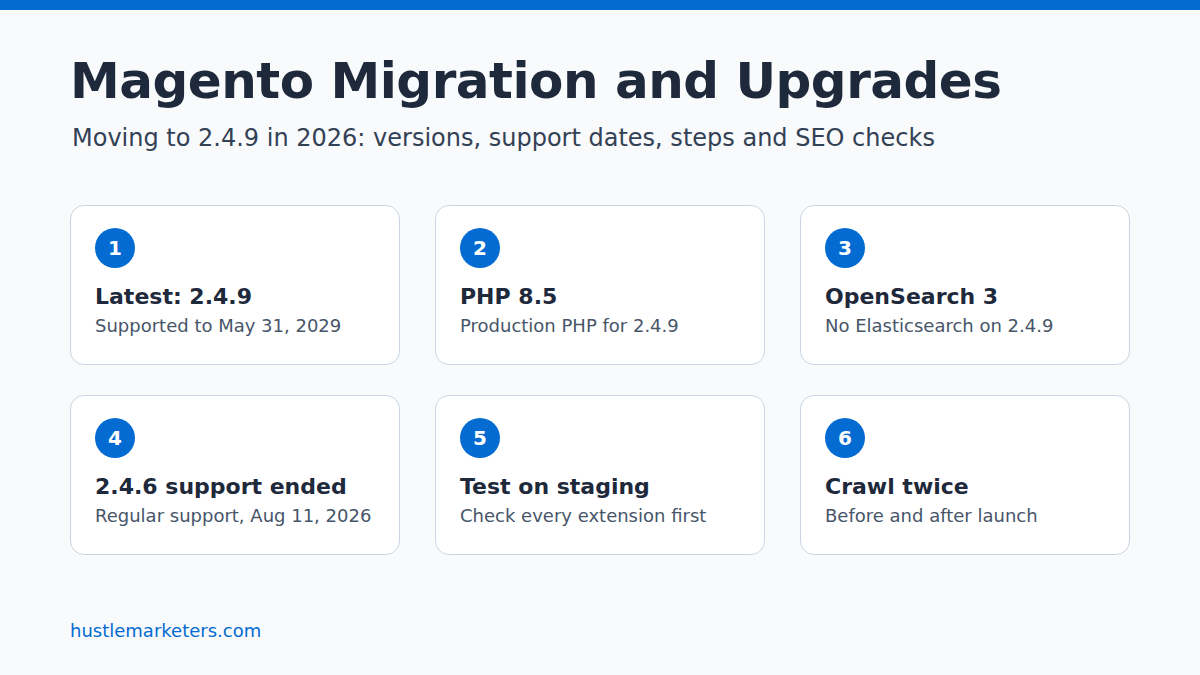
- Magento 2.4.9 has regular support until May 31, 2029, but staying on Magento means planning upgrades and applying security patches yourself, unless you use Adobe’s SaaS service.
Sources for each point are linked in the sections below.
What is the difference between Magento and Shopify?
Shopify is a hosted platform: Shopify runs the servers, the checkout and the software updates, and you pay a monthly plan plus payment fees. Magento is ecommerce software that you or your host usually run. Magento Open Source is free to download, and Adobe Commerce is the paid edition, with extra features and Adobe-hosted options.
Magento Open Source and on-premises Adobe Commerce run on servers that you or your host manage, and you control all of the code. With Adobe Commerce on cloud infrastructure, Adobe provides the hosting and you still control the code. Adobe Commerce as a Cloud Service is different: Adobe manages the core application, and merchants cannot modify core code.
Magento Open Source is published on GitHub under the OSL-3.0 license, and Adobe describes it as “A free eCommerce platform”. Adobe Commerce comes as on-premises software, as Adobe Commerce on cloud infrastructure, or as Adobe Commerce as a Cloud Service, a SaaS version that Adobe launched on June 25, 2025.
| Area | Magento (Open Source or Adobe Commerce) | Shopify |
|---|---|---|
| Who runs the servers | You or your host, except on Adobe’s cloud and SaaS options | Shopify, on every plan |
| Software cost | Open Source is free; Adobe Commerce is priced by quote | $39 to $399 a month on standard plans billed monthly; Plus from $2,300 |
| Upgrades and patches | Applied by your developers, except on Adobe’s SaaS service | Applied by Shopify |
| Code access | Full source code, except on Adobe Commerce as a Cloud Service | Themes, apps and Shopify’s APIs; no access to core code |
| Checkout changes | Fully editable in code on self-managed editions | Through checkout extensibility; the deeper options need Plus |
| B2B | B2B module in Adobe Commerce only | Up to 3 active B2B catalogs on Basic, Grow and Advanced; unlimited on Plus |
| Product variants | Built from attributes you define | Up to 2,048 variants and 3 options per product |
| URL structure | Configurable | /products/ and /collections/ fixed; handles editable |
| Multiple languages and countries | Websites, stores and store views in one install | Shopify Markets; Plus includes the main store and 9 expansion stores |
The sections below explain each row with its source. If you are already on Magento, our Magento SEO guide covers the settings that matter for search, and our Shopify SEO guide does the same for Shopify.
How much does Magento cost compared to Shopify?
Shopify publishes its prices: $39 to $399 a month on standard plans billed monthly, and Plus from $2,300 a month, plus payment and app fees. Magento Open Source is free to download, but you pay for hosting, extensions, development and upgrades. Adobe Commerce has no public price, because Adobe quotes it by pricing level, such as GMV and AOV tiers or an order limit.
Shopify’s prices below are from its US pricing page and Plus pricing page, checked October 3, 2026.
| Shopify plan | Price per month | Online card rate with Shopify Payments | Fee when you use a third-party payment provider |
|---|---|---|---|
| Basic | $39 billed monthly, $29 billed yearly | 2.9% + 30¢ | 2% |
| Grow | $105 billed monthly, $79 billed yearly | 2.7% + 30¢ | 1% |
| Advanced | $399 billed monthly, $299 billed yearly | 2.5% + 30¢ | 0.6% |
| Plus | $2,500 on a one-year term, $2,300 on a three-year term, or a variable platform fee for complex businesses | 2.25% + 30¢ | 0.2% |
Every plan can sell unlimited products. Plus includes the main store and 9 expansion stores, and each extra store costs $300 a month or a revenue share. Shopify does not publish the percentage or revenue level behind the variable Plus fee, so treat any figure you see for it on other sites as unconfirmed.
On the Magento side, Adobe’s Adobe Commerce pricing page shows “Get pricing” and no figures. Its on-premises product description says the “Pricing Level means the GMV and AOV tiers, Order Limit, or other pricing tier”.
License figures of about $22,000 to $125,000 a year appear on many comparison sites. They are third-party estimates, and Mirasvit’s 2021 comparison ties the low end to stores with up to $1 million in revenue. Ask Adobe for a quote rather than budgeting from them.
What else do you pay for on each platform?
The platform fee is rarely the largest cost. Budget for these as well:
| Cost | Magento | Shopify |
|---|---|---|
| Hosting and CDN | Paid separately, unless Adobe hosts it | Included |
| Theme | Hyvä has been free since November 2025; custom themes cost developer time | Free and paid themes, plus custom work |
| Extensions or apps | Paid extensions, often with yearly renewals | Apps, mostly billed monthly |
| Upgrades and patches | Developer time for each release and security bulletin | None for the platform |
| Payments | Your payment provider’s fees | Shopify Payments rates, or the provider’s fees plus Shopify’s third-party fee |
| Development | Usually higher, because more is built or changed in code | Theme and app work; custom apps for edge cases |
Upgrades are a cost Magento owners often underestimate. Agency price lists from AgentoSupport and IWD Agency, collected in our Magento upgrade guide, run from under $1,000 to $35,000 for a minor 2.4.x upgrade, depending on extensions and custom code.
Shopify’s own comparison page claims a 29% better total cost of ownership than Adobe Commerce, based on research Shopify commissioned. It is a vendor claim, so build your own estimate from your app list, extension list and developer rates.
Which is better for SEO, Magento or Shopify?
Neither platform ranks better by default. Magento gives you more control over URLs, robots.txt, canonical tags and redirects, but leaves more for you to configure, such as filter URLs and hreflang. Shopify handles sitemaps, canonical tags and hreflang for you, but fixes parts of its URLs and limits how redirects work. The setup decides results more than the platform.
The table compares the settings that most often decide rankings after launch. Magento rows come from Adobe’s Experience League pages, including the catalog configuration reference, URL rewrite documentation, SEO overview and site map guide. Shopify rows come from the Shopify pages linked in the sections below.
| SEO area | Magento | Shopify |
|---|---|---|
| URL structure | You set URL keys, an optional .html suffix and whether product URLs include the category path | Handles are editable; the /products/ and /collections/ segments are not |
| Redirects | 301 created automatically when a URL key changes, if that setting is on; custom rewrites in the admin | Redirect created automatically when a handle changes; URL redirects capped at 100,000 (20,000,000 on Plus) and only from broken URLs |
| Canonical tags | Admin settings for category and product canonical tags | Set by the theme; product URLs inside collections point to the /products/ URL |
| robots.txt | Edited in the admin | Edited through robots.txt.liquid, which Shopify calls an unsupported customization |
| Filter (faceted) URLs | No noindex setting for layered navigation; Adobe’s suggested robots.txt rules block URLs with query strings | Default rules block sorted URLs and tag combinations; some stores’ files, such as allbirds.com, also block URLs with two or more filter parameters |
| hreflang | No core setting found in Adobe’s documentation; added by extension or custom code | Added automatically for Markets domains and subfolders |
| XML sitemap | Built in; 2.4.9 adds a memory-optimized batch method for large catalogs | Generated automatically |
| Hosting and speed | Depends on your hosting, caching and theme | Hosted by Shopify; speed depends mostly on the theme and apps |
Can you change Shopify’s URL structure?
You can change the handle at the end of a URL, but not the folder in front of it. Shopify’s URL guide shows products at /products/[handle] and collections at /collections/[handle], and says Shopify creates a redirect automatically when you edit a handle. We found no Shopify setting to remove or rename the /products/ or /collections/ segments.
Magento gives you that control. You can include the category path in product URLs, add an .html suffix or leave both out. That flexibility is also a common source of duplicate URLs, which is why Magento’s canonical settings matter. On a move from Magento to Shopify, almost every category and product URL changes, so the redirect map carries the rankings.
Redirects work differently too. Shopify’s URL redirect help page says “You can redirect only from broken URLs”, and sets the cap at 100,000 redirects, or 20,000,000 on Plus. A URL that still loads a page cannot be redirected. On Magento, the URL Rewrites tool and the automatic redirect setting cover the same job, and Adobe’s documentation does not list a limit.
Does Shopify create duplicate product URLs?
Yes, but it handles them with canonical tags. A product linked from a collection can load at /collections/[collection]/products/[product] as well as /products/[product]. Shopify’s canonical URL article for partners says the canonical “is the default product page with no collection or variant selected”. Our Shopify SEO issues guide covers what to check when themes link to the longer URLs.
Magento has its own version of the problem. If product URLs include category paths, one product can have a URL for each category it sits in. Turning on the canonical tag settings for products and categories tells Google which version to index.
How do filtered navigation URLs compare?
Shopify blocks some filter URLs by default. Magento’s default robots.txt instructions, which Adobe lists in its SEO overview and the admin restores with Reset to Default, include Disallow: /*?, which blocks every URL with a query string, layered navigation filters included. Check which instructions your store actually uses.
Shopify’s robots.txt help page says the /collections/*+* rule stops filtered collection pages from being crawled, and /collections/*sort_by* does the same for sorted pages. Shopify’s native filters use filter.p. and filter.v. parameters, according to its filtering documentation.
The live robots.txt on allbirds.com, a Shopify store, also blocked URLs that combine two or more filters when we checked on October 3, 2026. A URL with one filter parameter, such as ?filter.v.option.color=red, does not match that line. A price range, or two values of the same filter, uses two parameters and does. Another large Shopify store we checked did not have the multi-filter line, so read your own robots.txt rather than assuming.
Magento’s layered navigation documentation has no setting to noindex filter pages. Beyond robots.txt, stores handle them with canonical tags or an SEO extension, which our layered navigation SEO guide walks through.
On Shopify you also cannot freely change robots.txt. The robots.txt.liquid template is allowed, but Shopify calls it “an unsupported customization” and says its support team can’t help with edits.
Which platform is better for international SEO?
Shopify is easier to set up, and Magento gives more control. Shopify’s Markets documentation says hreflang tags “are automatically created for every international domain or subfolder that you set up”, and you can turn them off.
Magento can run several websites, stores and store views in one install, and Adobe uses store views for languages. Product names, descriptions and meta data can be translated per store view, according to Adobe’s store localization guide.
We found no core hreflang setting in Adobe’s Magento documentation. Magento stores add hreflang with an extension or custom code that outputs the tags in the page HTML or the XML sitemap, two of the three methods Google lists in its localized versions guide.
Which platform is better for large or complex catalogs?
Magento has more room for complex catalogs. It supports several product types, attributes you define yourself and multiple websites and store views in one install. Shopify lets every plan sell unlimited products, but each product is capped at 2,048 variants and three options. Products with more option types have to be split or rebuilt with apps or metafields.
Shopify’s variants help page gives the per-product limits: “You can create up to 2,048 variants for a product” and “Each product can have up to three options.” A configurable Magento product with size, color, material and length needs a fourth option, so it cannot move across as one product.
Very large catalogs also hit Shopify’s creation limits. Shopify’s API rate limit documentation says that once a store has 50,000 product variants, no more than 1,000 new variants can be created per day through the Admin API. The variants help page gives a higher limit for app and CSV imports, so check which applies to your import method before planning a launch date.
Magento’s product types include simple, configurable, grouped, virtual, bundle and downloadable products, listed in Adobe’s product creation guide. The limit on Magento is performance rather than a fixed cap. Adobe’s catalog management best practices warn that “Configuring a large number of categories can affect performance”, so hosting, indexing and catalog design matter as the catalog grows. Our Magento speed optimization guide covers that side.
Which is better for B2B ecommerce, Magento or Shopify?
For straightforward wholesale, Shopify now covers more than it used to. Since April 2, 2026, Basic, Grow and Advanced include native B2B with up to 3 active B2B catalogs. Unlimited catalogs and catalogs assigned directly to companies still need Plus. Adobe Commerce has a dedicated B2B module, but it needs a separate license and is not part of Magento Open Source.
Shopify’s changelog of April 2, 2026 lists what the non-Plus plans now get: company profiles, payment terms, volume pricing, ACH payments (US only) and vaulted credit cards, with up to 3 active B2B catalogs assigned through Markets. It says unlimited catalogs for customer-specific pricing, direct catalog assignment to companies and locations, partial payments and deposits “remain exclusive to Plus”.
Adobe lists B2B as “Adobe Commerce only, requires a separate license” on its extensions and services page. The module’s B2B introduction covers company accounts, shared catalogs, quotes, requisition lists, quick order and purchase orders.
A distributor with many customer-specific price lists is the case where Adobe Commerce or Shopify Plus earns its cost. If you need negotiable quotes and requisition lists built in, Adobe’s B2B module has them, while Shopify’s B2B feature list offers draft orders and quick order lists instead. A brand with a single wholesale price list may not need either.
How much can you customize Magento compared with Shopify?
Magento Open Source and self-managed Adobe Commerce give developers the full source code, so almost any behavior can be changed, including checkout. On Adobe’s SaaS service, customizations run as separate apps instead. Shopify limits changes to themes, apps and its APIs. Shopify’s checkout is customized through checkout extensibility, and the deeper options, such as UI extensions on the information, shipping and payment steps, are only available on Plus.
Shopify’s old checkout.liquid file no longer works. Shopify’s changelog set August 13, 2024 as the date it stopped working for the information, shipping and payment pages. Its developer documentation says it was sunset for the thank you and order status pages on August 28, 2025, and that script tags on those two pages were sunset for non-Plus stores on August 26, 2026.
Shopify’s checkout customization page lists apps built with UI extensions for the information, shipping and payment pages, and custom apps built with Shopify Functions, as Plus-only. Apps with UI extensions for the thank you and order status pages work on every plan.
Magento’s freedom has a cost. Every custom module and extension has to be retested at each upgrade, and our Magento upgrade guide lists what broke most often on 2.4.9.
Some Adobe features are also not in Magento Open Source. Adobe says content staging “is available only in Adobe Commerce and is not available in Magento Open Source”. Its extensions page also lists Live Search and Product Recommendations as Adobe Commerce only. Page Builder has been in Open Source since 2.4.3, without its staging, preview and personalization features.
Which needs more maintenance and security work?
Magento does, unless you use Adobe’s SaaS service. On Magento Open Source and self-hosted Adobe Commerce, your developers apply upgrades and security patches and someone runs the servers. Shopify maintains its own platform, and Adobe says its SaaS service, Adobe Commerce as a Cloud Service, receives updates that are automatically deployed.
Adobe’s released versions page gives regular support until May 31, 2029 for 2.4.9, May 31, 2028 for 2.4.8 and May 31, 2027 for 2.4.7. Regular support for 2.4.6 ended on August 11, 2026.
Adobe’s knowledge base article on its September 8, 2026 security update, APSB26-138, says Open Source merchants can only download patches for 2.4.7 or later. A day earlier, Adobe published an urgent bulletin, APSB26-146, for a vulnerability exploited in the wild.
Adobe Commerce on cloud infrastructure takes part of that load. Its tech stack includes the Fastly CDN with DDoS protection. Upgrades and code are still your developers’ job. For version choices, upgrade steps and patch rules, see our Magento migration and upgrade guide.
How do Magento and Shopify compare for Google Shopping and ads?
Both can run Google Shopping, Performance Max and Meta catalog ads well. On Shopify, product data usually reaches Merchant Center through the Google & YouTube app, and the common problem is the same products arriving from more than one source. On Magento, feeds usually come from an extension or a feed tool, and the work is mapping your attributes to Google’s fields and keeping them fresh.
The platform choice changes where feed and tracking problems come from:
| Area | Magento | Shopify |
|---|---|---|
| Product feed | Feed extension or third-party feed tool; you map attributes such as GTIN, brand and Google product category | The Google & YouTube app or a feed app; duplicate data sources are the usual cause of repeated or returning products |
| Variants in the feed | Feed tools usually send each child of a configurable product as an item, grouped by item_group_id | Each variant is usually sent as an item; the 2,048 variant and 3 option limits shape what you can list |
| Conversion tracking | Tags placed in the theme, through Google Tag Manager or server side | Shopify’s customer events and pixels; script tags on the thank you and order status pages are sunset |
| Who fixes problems | Your developer or feed tool | The app developer or Shopify, with fewer options to change code yourself |
Our guides go deeper on each side: Magento product feeds, Shopify Merchant Center duplicates, Shopify server side tracking and Merchant Center errors.
If you change platform, protect the item IDs in your feed. Google’s product data specification says to use a stable ID for each product and, once assigned, “don’t change it”. The ID is used to track each product’s performance history in Merchant Center and Google Ads, and Google warns that changing it overwrites the product and its history. Most feed apps let you set the ID format, so match the old one before launch.
Should you choose Magento or Shopify?
Choose Shopify if you want predictable costs, no server or patch work and a team that can manage the store without developers. Choose Magento if your catalog, B2B rules, checkout or integrations need code-level control and you have developers to maintain it. If you already run Magento well, a supported version and stable traffic are reasons to upgrade rather than move.
| Your situation | Better fit | Why |
|---|---|---|
| Direct-to-consumer brand with standard products and a small team | Shopify | Hosted, published pricing, no platform upgrades or patches |
| Products need more than three option types or 2,048 variants | Magento | Shopify caps every product at three options and 2,048 variants |
| Wholesale with up to 3 price lists | Shopify Basic, Grow or Advanced | Native B2B on non-Plus plans since April 2, 2026 |
| Many customer-specific catalogs | Adobe Commerce or Shopify Plus | Adobe’s B2B module, or unlimited catalogs on Plus |
| Built-in negotiable quotes and requisition lists | Adobe Commerce | Part of Adobe’s B2B module; not in Shopify’s B2B feature list |
| Several countries and languages | Either | Shopify automates hreflang through Markets; Magento store views need hreflang added |
| Checkout or ERP logic that must live inside the platform | Magento Open Source or self-managed Adobe Commerce | Full code access, which Adobe’s SaaS service does not give; Shopify checkout changes go through extensions, many of them Plus-only |
| On Magento 2.4.7 or later, with developers and stable organic traffic | Stay and upgrade to 2.4.9 | A platform move changes almost every URL |
| On Magento 2.4.6 or older Open Source, with no developer support | Upgrade or move now | Out of regular support, and Adobe says Open Source merchants can only download patches for 2.4.7 or later |
If your answer is close, list your top 50 organic landing pages and your must-have features, then check how each platform handles them. That usually settles it faster than a feature checklist. Our platform-specific ecommerce SEO guide also compares Magento, Shopify and WooCommerce.
What changes when you move from Magento to Shopify?
Almost every URL, the way redirects work, customer logins and how complex products are structured. Shopify’s fixed URL segments mean category and product URLs change, so you need a redirect map within Shopify’s limits. Customer passwords cannot be imported by CSV, Shopify’s own migration app does not list Magento, and products with more than three options need restructuring.
- Redirects. Map every old URL that has traffic, links or rankings to its new equivalent. Shopify only redirects broken URLs, and the cap is 100,000 redirects outside Plus, so prioritize when your old URL list is larger.
- Customer accounts. Shopify’s customer import page says you “can’t migrate customer passwords from another online store using a CSV”, so imported customers are invited to create new ones.
- Data tools. Shopify’s Store Migration app lists Square, WooCommerce, Etsy, Wix, Amazon, eBay, Clover and Lightspeed, but not Magento. Magento moves use third-party migration tools or custom scripts.
- Timing. Google’s site move guidance says a small to medium site can take a few weeks for most pages to move, and to keep redirects for “generally at least 1 year”.
Our Magento to Shopify migration guide covers the redirect map, the launch checklist and what to check after launch, step by step.
Moving the other way, from Shopify to Magento, has the same URL problem in reverse, plus the hosting and maintenance work covered above. For the upgrade-or-move decision from a Magento store’s point of view, see the platform section of our Magento migration guide.
Hustle Marketers does not build stores or run platform migrations. We handle the search and ads side: the redirect map and SEO requirements before launch, crawl comparisons, feed and tracking checks, and monitoring after. Our Magento SEO consultant service covers that work before and after a move, and our Shopify SEO consultant service covers the store once it runs on Shopify.
How this comparison was researched
This page was rewritten on October 3, 2026. We checked every Shopify and Adobe price, limit and date against Shopify’s pricing, help, developer and changelog pages and Adobe’s Experience League, pricing and legal pages, all on October 3, 2026. Other dates and figures link to their own sources, and Google Search Central filled in the SEO rules.
We also read 15 comparison pages: the 11 top results for magento vs shopify and shopify vs magento, plus 4 more, including Shopify’s own comparison page.
Several of those pages carried outdated or wrong details: Shopify prices that do not match its pricing page, a Shopify Plus price of $2,000 a month, and third-party gateway fees of 0.5% to 2% where Shopify lists 0.2% to 2%. Where a page disagreed with Shopify or Adobe, we used the platform’s own page. Cost figures that no platform publishes are labeled as estimates with their source.
Update log, October 3, 2026: replaced the earlier comparison with verified 2026 prices and fees, Shopify’s April 2026 B2B change, Magento support dates to 2.4.9, an SEO controls table, catalog limits, checkout changes, a feeds and ads section and a decision table. Removed service claims for store builds and migrations, which Hustle Marketers does not offer.
Frequently Asked Questions
Is Magento better than Shopify for large ecommerce stores?
Which platform is better for SEO: Magento or Shopify?
How difficult is the Magento-to-Shopify migration?
Can Shopify handle large product catalogs?
How long does an ecommerce platform migration take?
Will migration affect SEO rankings?
Is Magento more customizable than Shopify?
Should growing ecommerce brands move from Shopify to Magento?