DeepSeek Rank Tracking: The Free Method Most Guides Say Is Impossible

Ishant
Published : October 6, 2026 at 2:30 pm
Updated : October 16, 2026 at 12:14 pm
Ishant
Search for free DeepSeek rank tracking and almost every guide tells you the same thing: you cannot track DeepSeek programmatically, because its API returns answers with no citations and no sources. Several of those guides ran tests to prove it.
The tests were real. The conclusion is wrong. They queried the wrong endpoint. We have not run these API calls ourselves; the method below is built from DeepSeek’s own documentation and reference client, and the research notes at the end say so again.
DeepSeek runs two separate API interfaces. The OpenAI-compatible one that everybody tests has no web search tool, so of course it returns no citations.
The Anthropic-compatible one is different. DeepSeek documents it on its own site and ships a reference client for it on its own GitHub, and it supports a server-side web search tool that returns structured blocks carrying the URL, title and publication age of every source used. That difference is the whole game. It turns DeepSeek visibility from something only a paid tool can show you into something you can measure yourself for the price of a few thousand tokens.
This page covers three things, in this order. First, the actual mechanics: which DeepSeek surface returns what, and how to query the one that gives you citations. Second, a free method you can run yourself this week, with the code. Third, the part the tool vendors leave out: DeepSeek’s referral traffic collapsed to essentially zero in September 2025 and has not recovered, which means for a lot of businesses the honest answer is to measure it once and move on.
We build and run AI visibility tracking for clients as part of our AI SEO work, and we have taken the opposite position on DeepSeek for most of them. The evidence for that is below, with sources.
What this page covers
The mechanics come first, because the free method depends on getting one technical detail right and almost nobody publishing on this topic has it right. The commercial question, whether DeepSeek is worth tracking at all, is answered further down with the referral data behind it. Jump to whichever you need:
What does “DeepSeek rank tracking” actually mean?
DeepSeek has no rankings. There is no position one, no SERP, no Search Console. When people say DeepSeek rank tracking they mean something closer to polling: you ask DeepSeek a set of buyer questions on a schedule, and you record how often it names your brand, how often it links you, and who it names instead.
The thing that trips people up is that “DeepSeek” is not one surface. It is at least three, and they behave so differently that a claim which is true of one is usually false of the others.
| Surface | How you reach it | Does it search the web? | Does it return source URLs? |
|---|---|---|---|
| Consumer app, Search mode on | chat.deepseek.com or the mobile app, with the Search toggle enabled | Yes | Yes, and generously. Nieman Lab’s testing found 20 to 50 sources per answer |
| Consumer app, Search mode off | Same app, toggle disabled | No. Answers come from training data only | No |
| OpenAI-compatible API | https://api.deepseek.com chat completions | No. There is no hosted search tool on this interface | No. This is the endpoint that produces the “zero citations” result |
| Anthropic-compatible API | https://api.deepseek.com/anthropic | Yes, via the native server-side web search tool | Yes, as structured web_search_tool_result blocks |
If a tool sells you “DeepSeek citation tracking” and does not tell you which of these four it queries, you cannot interpret the number it gives you. An app-side tracker and an API-side tracker measuring the same brand on the same day will disagree, and both will be reporting honestly.
This is the same distinction that matters for ChatGPT rank tracking and for Claude rank tracking, but it bites harder with DeepSeek because the gap between surfaces is wider.
Does DeepSeek cite sources, and how many?
Yes, and more than most, but only on the surfaces that retrieve. With Search mode on in the consumer app, DeepSeek is one of the most source-heavy assistants in the market, and independent testing puts it well ahead of ChatGPT on the number of sources it shows per answer. With Search mode off, it cites nothing at all.
Nieman Lab tested it against ChatGPT in February 2025 and found that prompting DeepSeek for original journalism “turned up at least 20 sources and as many as 50 sources” per answer, while ChatGPT “usually shared less than 15 sources in response to the same exact prompts”. TechRadar’s testing in the same window found DeepSeek pulling from more than 30 sources per question.
That generosity has a practical consequence for you. A wide citation set means the bar to being included is lower than on ChatGPT. Getting named in one of 40 sources is a far easier job than getting named in one of 12. If you are going to chase DeepSeek visibility at all, this is the reason it is winnable.
With Search mode off, DeepSeek cites nothing, because it is not retrieving anything. It is answering from training data, so your brand either exists in the weights or it does not, and no amount of publishing this quarter changes that answer this quarter.
On the API side the answer depends entirely on which interface you call, which brings us to the thing the rest of the internet has got wrong.
Why almost every guide says the DeepSeek API returns no citations
Here is the claim, in the words of the pages currently ranking for these keywords. One vendor benchmark published in May 2026 tested deepseek-v4-pro and deepseek-chat against api.deepseek.com and recorded “URL Citations: 0” and “Queries with Citations: 0/3” for both models.
Another guide, in August 2026, put it this way: the DeepSeek API supports tool calls, but the official documentation does not describe a hosted web search tool a developer can invoke without building the retrieval layer themselves.
Both statements are accurate about the OpenAI-compatible chat completions interface. Neither is accurate about DeepSeek as a whole, because DeepSeek ships a second interface, and that one does have hosted search.
What DeepSeek’s own documentation says
DeepSeek publishes an Anthropic-compatible API at https://api.deepseek.com/anthropic, authenticated with an x-api-key header. Its compatibility documentation includes a table of which content block types are supported. Two rows matter here:
| Content block type | DeepSeek support |
|---|---|
type="server_tool_use" | Supported |
type="web_search_tool_result" | Supported |
type="mcp_tool_use" | Not Supported |
type="document" | Not Supported |
server_tool_use and web_search_tool_result are the two block types that a server-side web search produces. DeepSeek lists both as supported. The MCP and document rows in the same table are marked Not Supported, which tells you the table is a real capability list and not boilerplate.
DeepSeek ships its own client for this
If the compatibility table alone is not convincing, DeepSeek maintains a package called deepseek-harness in its own GitHub organization, under packages/web/web-search-deepseek. Its documentation describes exactly how the mechanism works:
It calls DeepSeek’s Anthropic-compatible Messages API (
@deepseek-ai/dsh-web-search-deepseek, DeepSeek’s own repositoryPOST {baseURL}/messages) with the nativeweb_search_20250305server tool enabled, and maps the structuredweb_search_tool_resultblocks DeepSeek returns into the seam’s normalizedWebSearchResult.
The same document sets out what you get back, which is precisely the shape a rank tracker needs. Sources come from web_search_result items inside the web_search_tool_result blocks, mapping url, title and page_age. Snippets arrive separately as URL-keyed cited_text entries in a text block’s citations array. It also notes the default endpoint is https://api.deepseek.com/anthropic/v1, distinct from the chat completions base, and warns explicitly against reusing the chat completions base URL.
It is candid about the cost, too. DeepSeek exposes no dedicated retrieval endpoint, so one search costs a full model turn in latency and tokens rather than a cheap lookup. The package caps server-side searches per request with a maxUses setting that defaults to 5.
Why this matters for tracking
Put together, this means DeepSeek visibility is measurable from a script. You send a buyer question, DeepSeek runs its own searches server-side, and you get back a structured list of the URLs it consulted plus the answer text.
You can then check two things independently: whether your domain appears in the source list, and whether your brand name appears in the prose. Those are different outcomes and both are worth recording, which is a distinction we go into on citations versus mentions.
One honest caveat before you build on this. We verified the capability from DeepSeek’s published compatibility table and its own reference client, not by running the calls ourselves, because we do not hold a DeepSeek API key.
The documentation is primary and the client is DeepSeek’s own, so the evidence is strong. Even so, the first thing you should do with the script below is confirm the response shape against your own key before building reporting on top of it. If your first call returns no web_search_tool_result block, the search did not trigger, and the harness documentation treats that as an error rather than a result.
How to track DeepSeek visibility for free
This is the method. It is free in the sense that no tool subscription is involved and the token cost is measured in cents, not in the sense that someone hosts it for you. You need a DeepSeek API key and about twenty minutes.
Step 1: build your prompt set
Write 20 to 30 questions a real buyer would type, not keywords. “Best ecommerce SEO agency for Shopify stores” is a prompt. “ecommerce seo agency” is a keyword and will give you a definitional answer nobody buys from. Split them into three groups so you can read the results separately:
- Category prompts. “Who are the best [service] providers for [audience]?” These tell you whether you are in the consideration set at all.
- Problem prompts. “How do I fix [problem the client has]?” These are where a helpful page gets cited even when the brand is unknown.
- Brand prompts. “What is [your brand] and who is it for?” These tell you what DeepSeek believes about you, which is often the most alarming output of the whole exercise.
Include your buyers’ actual languages. DeepSeek’s user base is heavily weighted to China, so if you sell into APAC at all, running the same prompt in English and in Chinese will give you different brand sets, and only one of them is the one your buyer sees.
Step 2: run the prompts against the Anthropic-compatible endpoint
This script sends one prompt, enables the server-side web search tool, and prints both the sources DeepSeek consulted and whether your domain and brand appeared. It has no dependencies beyond requests.
import os, json, requests

API_KEY   = os.environ["DEEPSEEK_API_KEY"]
ENDPOINT  = "https://api.deepseek.com/anthropic/v1/messages"
MODEL     = "deepseek-v4-pro"        # or a claude-* name; DeepSeek maps it
YOUR_DOMAIN = "yourdomain.com"
YOUR_BRAND  = "Your Brand"

def run(prompt, runs=5):
    hits = {"domain": 0, "brand": 0, "runs": runs, "sources": []}
    for _ in range(runs):
        r = requests.post(
            ENDPOINT,
            headers={
                "x-api-key": API_KEY,
                "anthropic-version": "2023-06-01",
                "content-type": "application/json",
            },
            json={
                "model": MODEL,
                "max_tokens": 2048,
                "tools": [{
                    "type": "web_search_20250305",
                    "name": "web_search",
                    "max_uses": 5,
                }],
                "messages": [{"role": "user", "content": prompt}],
            },
            timeout=120,
        )
        r.raise_for_status()
        body = r.json()

        urls, prose = [], []
        for block in body.get("content", []):
            if block.get("type") == "web_search_tool_result":
                for item in block.get("content", []):
                    if item.get("type") == "web_search_result":
                        urls.append(item.get("url", ""))
            elif block.get("type") == "text":
                prose.append(block.get("text", ""))

        if not urls:
            print("  ! no web_search_tool_result block - search did not trigger")

        answer = " ".join(prose)
        if any(YOUR_DOMAIN in u for u in urls):
            hits["domain"] += 1
        if YOUR_BRAND.lower() in answer.lower():
            hits["brand"] += 1
        hits["sources"].extend(urls)
    return hits

PROMPTS = [
    "Who are the best Shopify SEO agencies for mid-size stores?",
    "How do I fix duplicate content on a Shopify collection page?",
]

for prompt in PROMPTS:
    h = run(prompt)
    print(f"\n{prompt}")
    print(f"  cited as a source : {h['domain']}/{h['runs']} runs")
    print(f"  named in the text : {h['brand']}/{h['runs']} runs")
    print(f"  distinct sources  : {len(set(h['sources']))}")
Two things to note in that code. It runs each prompt five times, because a single run of a non-deterministic model is an anecdote rather than a measurement. And it counts domain citations and brand mentions separately, because DeepSeek frequently names a company in prose without linking it, and if you only count links you will under-report your own visibility.
Step 3: log it somewhere you will actually look at
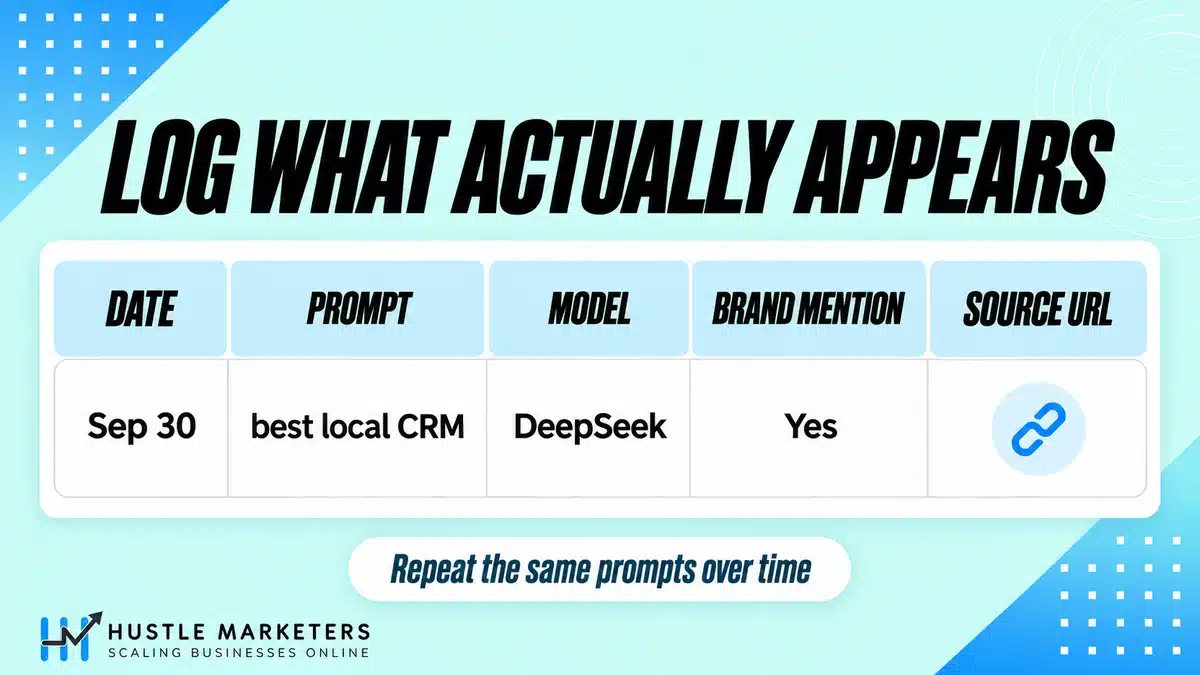
Write the output to a Google Sheet with one row per prompt per week: date, prompt, model name, runs, domain citation rate, brand mention rate, and the top three competitors named. The model name column is not optional, and the next section explains why.
Weekly is the right cadence for category prompts. Brand prompts change slowly enough that monthly is fine. If you are already producing monthly SEO reports for clients, this is a small addition to an existing report rather than a new deliverable.
What does it cost to run this yourself?
DeepSeek publishes its API pricing per million tokens, with an off-peak discount that is unusually steep. As of 29 September 2026:
| Model | Input, cache miss | Output | Off-peak input | Off-peak output |
|---|---|---|---|---|
deepseek-flash | $0.30 / 1M | $1.20 / 1M | $0.15 / 1M | $0.60 / 1M |
deepseek-v4-pro | $1.32 / 1M | $3.96 / 1M | $0.66 / 1M | $1.98 / 1M |
Work the arithmetic for a realistic tracking job. Thirty prompts, five runs each, is 150 calls a week. A search-enabled turn is heavier than a plain completion because the model reads the pages it retrieves, so budget generously: call it 8,000 input tokens and 1,000 output tokens per call. That is 1.2M input and 150k output tokens a week.
On deepseek-v4-pro at peak rates that is about $2.18 a week, or roughly $9.40 a month. Schedule the job off-peak and it halves to about $4.70 a month. On deepseek-flash the same job runs at about $2.30 a month at peak and about $1.20 off-peak. Compare any of those with the cheapest tool subscription that includes DeepSeek at all, and the gap is the entire argument for doing it yourself.
Those are our estimates from DeepSeek’s published rates and a token assumption, not billed figures. Run ten calls first and read your actual usage before you promise a client a number.
Which tools actually track DeepSeek, and what do they charge?
We checked 23 AI visibility platforms against their own pricing, features and documentation pages on 29 September 2026. Listicles were not accepted as evidence, because several of them turned out to be wrong.
Ten publish a model list that includes DeepSeek. Eleven publish a model list that does not. Two publish no model list at all.
The pattern is consistent and worth naming: DeepSeek is almost always a premium or enterprise engine, not a standard one.
| Tool | DeepSeek included? | Cheapest plan that includes it | Notes |
|---|---|---|---|
| Rankscale | Yes, all plans | $17/mo Essentials, billed yearly | Cheapest verifiable route in. DeepSeek costs 1 credit per query against 0.25 for most engines, so check the Essentials credit allowance before committing |
| LLMrefs | Claimed, not confirmed | $79/mo | The FAQ lists DeepSeek; the pricing card’s engine list omits it. Ask before buying |
| Trakkr | Yes, all plans | $100/mo Growth | Publishes an 8-model list including DeepSeek |
| AthenaHQ | Yes, Starter and up | $295/mo Starter | Has a genuine free tier, but DeepSeek is explicitly excluded from it |
| Evertune | Yes | $800/mo Pro | 11 models tracked, DeepSeek named |
| Profound | Enterprise, by request | Custom | The only vendor that states its access method: it queries the front-end experiences normal users see |
| Peec AI | Enterprise tier only | Not published | Starter, Pro and Advanced let you choose 3 models from a list that excludes DeepSeek |
| Writesonic | Enterprise only | Custom | The advertised $79 Starter tracks three engines and DeepSeek is not one |
| seoClarity | Yes | Not published | Demo-gated enterprise pricing |
| Goodie AI | Yes, dedicated page | Not published | Names DeepSeek-V3 and DeepSeek-R1 as the versions queried |
Tools commonly listed as DeepSeek trackers that are not
Three corrections worth making, because these appear in published comparison posts and each one could cost you a wasted subscription:
- Semrush. Its own knowledge base for AI Search Tracking says it tracks positions in ChatGPT Search, Google AI Mode and Gemini. DeepSeek is not supported, and the AI Toolkit’s coverage statement lists AI Overviews, AI Mode, ChatGPT, Perplexity and Gemini.
- Similarweb. Frequently listed as DeepSeek-capable. It is, but for referral traffic only. Its brand visibility product covers ChatGPT, Perplexity, Gemini and AI Mode. Measuring the traffic DeepSeek sends you and measuring whether DeepSeek mentions you are different products, and the listicles conflate them.
- Ahrefs Brand Radar, Otterly, Scrunch, Conductor, SE Ranking, Nightwatch, Knowatoa. All publish model lists. None includes DeepSeek.
One more transparency note. Nightwatch’s marketing page claims five engines, while its own help documentation says the models actually queried are ChatGPT 4o-mini and Claude 3.5 Haiku. That gap is not about DeepSeek, but it tells you how much weight to put on a marketing-page model list generally. We go through this in more depth on AI visibility tools.
Is “free DeepSeek rank tracking” a real thing?
As a hosted service, no. Not one of the 23 tools we checked offers an ongoing free tier that includes DeepSeek. Every free thing on offer is one of two shapes:
- A time-boxed trial. Seven to fourteen days, then DeepSeek is paid. Profound’s trial is narrower still: it covers ChatGPT, Gemini and AI Overviews only, so you cannot trial DeepSeek there at all.
- A one-off checker. Paste a domain, get a score from a handful of auto-generated prompts. Useful for a first look, useless for tracking, because tracking means the same prompts on the same schedule over time.
AthenaHQ is the only tool in the set with a permanent free plan, and DeepSeek is specifically excluded from it. The engine starts at $295 a month there.
So the honest answer to the keyword is this: free DeepSeek rank tracking exists, but you have to build it. The script in this page is the free version, and at roughly $1 to $9 a month in tokens it costs less than any trial you would otherwise be counting down. That is not a dodge, it is the actual state of the market in September 2026.
There is a tier of small vendors pricing DeepSeek from about $19 to $39 a month, below anything the established platforms offer. Some of them look reasonable. We have not tested them against a known brand and would not put them in a client recommendation without doing so, which is the same standard we would want applied to us.
Does DeepSeek send you any traffic?
This is the section the tool vendors leave out, and it is the one that should decide whether you do any of the above.
SE Ranking tracked 101,574 websites across 250 countries for 16 months, from January 2025 through April 2026. DeepSeek was, in their words, one of the more notable platforms in early 2025, holding a 0.37% share of AI traffic and ranking as the fourth biggest AI traffic source worldwide.
Then it stopped. Their finding is blunt: from September 2025 onward, DeepSeek’s referral traffic dropped to essentially zero across all regions. It is excluded from their 2026 platform share table for that reason.
Here is that table, so you can see what DeepSeek is missing from:
| Platform | Share of AI referral traffic, 2026 |
|---|---|
| ChatGPT | 74.78% |
| Gemini | 11.56% |
| Perplexity | 7.23% |
| Copilot | 3.51% |
| Claude | 2.62% |
| DeepSeek | Excluded, essentially zero since September 2025 |
A second dataset points the same way. Goodie’s May 2026 panel report groups Doubao, DeepSeek, Yuanbao, Kimi, Qwen and Grok together and says the six combined contribute well under 1% of the panel.
The download trend corroborates it. AppMagic data compiled by Business of Apps shows DeepSeek downloads falling from 83 million in Q1 2025 to 13 million in Q1 2026, an 84% decline across five quarters, against 173 million total downloads since launch. Active users did keep climbing to 130 million by late 2025, and about 32% of downloads came from China against 5% from the United States.
Read those two facts together and you get the real picture. DeepSeek has a large and genuinely active user base that is concentrated in China, and it sends almost nobody to Western websites. Both things are true, and most published advice picks whichever one supports the sale.
Why referral data under-reports, and why that does not rescue the case
A fair objection: DeepSeek often names a company without linking it, so referral analytics structurally miss part of the picture. That is true, and it is exactly why prompt sampling rather than GA4 is the right method. But under-reporting does not turn 0.37% into a channel. Perplexity and Claude have the same linking problem and still register 7.23% and 2.62% in the same dataset. Our guide on how to track brand mentions in Perplexity covers that engine on its own.
If you want the traffic side measured anyway, DeepSeek referrals arrive with no reliable referrer on most paths and will land in Direct in GA4, the same problem Claude referrals run into.
When should you not bother tracking DeepSeek?
Most of the pages ranking for this keyword are selling a subscription, so none of them answers this. We will.
Skip DeepSeek tracking, or run it once a quarter and no more, if all of these are true:
- Your buyers are in the US, UK, EU or Australia and you have no APAC presence.
- You do not sell to developers, who are the one Western segment where DeepSeek usage is meaningfully above baseline.
- You are not already tracking ChatGPT, Gemini and Perplexity properly. Those three are 93.5% of measured AI referral traffic between them. Getting them right beats adding a fourth engine at 0%.
- Your budget for AI visibility is one subscription. Spend it where the traffic is.
Take DeepSeek seriously if you sell into China or wider APAC, if your audience is technical, if you publish in Chinese, or if you are in a category where a competitor has clearly got there first and is being recommended by name.
There is also a defensive case that costs almost nothing. Run the brand prompts once, in both languages, and read what DeepSeek says about you. If it has you confused with another company or is repeating something outdated, that is worth fixing regardless of traffic, because the same wrong description tends to show up across models.
Does DeepSeek have a crawler you can allow or block?
No, and this is the most confidently wrong section of the published advice on DeepSeek. There is no DeepSeek user agent you can allow or block, because DeepSeek does not publish one. Guides that hand you a robots.txt snippet for it are giving you a rule that matches nothing. Here is what we could verify and what we could not.
DeepSeek does not publish a crawler user agent. One vendor’s documentation, updated April 2026, states it plainly: unlike GPTBot or ClaudeBot there is nothing to block in robots.txt, requests arrive without a named user agent string, and they are indistinguishable from regular browser traffic in your logs. It counts zero public user agents. A second independent source says the same.
Against that, bot directories list a string of the form DeepSeekBot/1.0 and cite deepseek.com/bot as the official source. We fetched that URL on 29 September 2026. It returns a 404. One of those directories concedes the point itself, noting that because DeepSeekBot publishes no verification method, any client can claim its identity and a log match is only a clue.
What that means practically:
- Do not write a robots.txt rule for
DeepSeek-Crawler. We have seen that exact snippet published in a guide. It is not a real user agent and the rule does nothing. - Do not buy “DeepSeek crawler tracking” as a feature. One vendor sells it on a landing page while its own documentation says DeepSeek publishes no user agent.
- If you want DeepSeek to be able to read your pages, the useful work is generic: server-side rendering, no login walls on public content, and clean structured data. That helps every retrieval system, which is the point of doing it.
How many runs before a DeepSeek result means anything?
One run is an anecdote. This is the most common mistake in DIY AI visibility work and it produces reports that swing wildly for no reason.
DeepSeek is non-deterministic, and with search enabled it is doubly so, because the retrieval step can surface a different source set each time before the model has written a word. Ask the same question twice and you can get a different list of companies.
The practical rule we use, and the one the more careful vendors prescribe, is five runs per prompt in a fresh context each time, and reporting a rate rather than a position. “Cited in 3 of 5 runs” is a measurement. “Ranked third” is a fiction, because there is no ranking to be third in.
Five is a working default rather than a statistically derived number, and nobody in this market has published the variance data that would justify a specific figure. If you want to set your own, run one prompt twenty times in a week and count how many distinct brand sets come back. That tells you how noisy your category is, and you size your run count from there.
Keep the search mode fixed and recorded. A prompt run with search on and a prompt run with search off are different experiments, and averaging them produces a number that means nothing.
What happens to your tracking when DeepSeek ships a new model?
Your trend line breaks, and if you have not recorded the model name alongside each result you will not be able to tell whether your content moved or the model did. DeepSeek has shipped five model events since April 2026, which is fast enough that most tracking charts of any length cross at least one of them.
DeepSeek’s own changelog shows five model events in five months: the V4 preview on 24 April 2026, V4-Flash public beta on 31 July, V4-Pro general availability on 13 August, V4-Flash-Vision-Exp on 21 August, and V4.1-Flash on 10 September. The changelog also notes that legacy model names are now temporarily routed to V4.1 Flash, which means a script you wrote in June may silently be querying a different model today.
Two consequences:
- A visibility chart that crosses a release date is not a trend. If your score jumps in the week of a model launch, the likeliest explanation is the model, not your content.
- Log the model name with every single result. If you are calling a legacy name and DeepSeek reroutes it, the model column is the only thing that will tell you your baseline moved underneath you.
Annotate release dates on the chart before a client asks. It is a five-minute job and it prevents the conversation where you have to explain a 40% swing you did not cause.
Is it safe to send client prompts to DeepSeek?
Worth raising before you set this up for a client rather than after. DeepSeek processes data on servers in China, and that is a procurement question for anyone in a regulated sector, working with a public body, or handling anything covered by a data processing agreement.
For most agency tracking work the exposure is low, because what you are sending is a public buyer question and a brand name, not customer data. But three practical rules:
- Send no client data. Prompts should be the questions a stranger would type. Never paste account details, unreleased campaign information, or anything under NDA into a tracking prompt.
- Tell the client. Add one line to the scope document saying DeepSeek queries are processed outside the EU, UK or US. If that is a problem, you have found out cheaply.
- Use a separate API key for tracking, not one shared with anything that touches client content.
None of the tracking tools we checked raises this. It is the first thing an enterprise buyer asks.
What should you actually measure?
Four numbers, and the important part is reporting them per prompt group rather than blending them into a single score. Category, problem and brand prompts behave differently, and a blended figure hides which one moved. These are the four we put on a client report, in the order we read them:
| Metric | What it is | Why it matters |
|---|---|---|
| Citation rate | Runs where your domain appears in the source list, over total runs | The only one that can send traffic. Also the hardest to move |
| Mention rate | Runs where your brand is named in the answer text, over total runs | Moves earlier than citation rate and is what buyers actually read |
| Share of voice | Your mentions over all brand mentions in the same answers | The competitive number. Rising on its own means little if three rivals rose faster |
| Answer accuracy | Whether what DeepSeek says about you is correct | Ignored by almost every tool and often the most urgent thing on the report |
Blending those into one score is how tool dashboards produce a number that goes up while nothing useful has happened. Keep them separate and the report tells you what to do next.
How this compares with tracking ChatGPT, Claude and Perplexity
The honest summary is that DeepSeek is the easiest of the four engines to get cited by and the least valuable citation to hold. Everything else follows from that. Here is how the four compare on the measures that decide where your tracking budget goes:
| DeepSeek | ChatGPT | Claude | Perplexity | |
|---|---|---|---|---|
| Share of AI referral traffic, 2026 | Essentially zero | 74.78% | 2.62% | 7.23% |
| Sources per answer with search on | 20 to 50 | Usually under 15 | Moderate | High, and always shown |
| Hosted web search on the API | Yes, Anthropic-compatible interface only | Yes | Yes | Yes |
| Published crawler user agent | None | GPTBot, OAI-SearchBot | ClaudeBot, Claude-SearchBot | PerplexityBot |
| Tool coverage | 10 of 23 platforms, mostly enterprise tier | Universal | Common | Universal |
| Priority for a Western B2B brand | Low | Highest | Medium | Medium |
The short version: DeepSeek is the easiest of the four to get cited by, because it pulls so many sources, and the least valuable to be cited by, because it sends nobody. If you are prioritizing, ChatGPT first, then Perplexity, then Claude, then this.
Frequently asked questions
Does DeepSeek have rankings like Google?
No. There is no position, no SERP and no Search Console. What you can measure is how often DeepSeek names you and how often it cites your domain across repeated runs of the same prompts. Any tool reporting a DeepSeek “position” has invented it.
Does the DeepSeek API return citations?
It depends which interface you call. The OpenAI-compatible chat completions API has no hosted web search tool and returns no citations, which is why several published tests found zero. The Anthropic-compatible API at https://api.deepseek.com/anthropic supports the native web search server tool and returns structured web_search_tool_result blocks containing source URLs, titles and page age.
Which DeepSeek surface is my tracking tool querying?
Most vendors do not say, and you should ask. Profound is the only one we found that states its method outright, querying the front-end experiences normal users see. Goodie names the model versions it queries. Everyone else treats DeepSeek as one undifferentiated surface, which it is not.
Is there a genuinely free DeepSeek rank tracker?
Not as a hosted service. Every free option among the 23 tools we checked is either a seven to fourteen day trial or a one-off checker. The only real free method is running the prompts yourself against the API, which costs roughly $1 to $9 a month in tokens depending on model and schedule.
Does DeepSeek have a crawler I should allow in robots.txt?
There is nothing verifiable to allow or block. DeepSeek publishes no crawler user agent, and the URL that bot directories cite as the official source returns a 404. Writing a rule for DeepSeek-Crawler, as one popular guide suggests, does nothing.
How often should I run DeepSeek tracking?
Weekly for category prompts, monthly for brand prompts, five runs per prompt each time. More often than weekly mostly measures model noise rather than your progress.
If I rank well on Google, will DeepSeek cite me?
Not automatically, but it helps. DeepSeek with search on is doing retrieval, so pages that are crawlable, well structured and actually answer the question have a real advantage. The overlap is partial, not guaranteed, and the fastest way to find out is to run the prompts.
Should I optimize for DeepSeek differently from ChatGPT?
The underlying work is the same: be genuinely useful, be crawlable, be clearly attributed. The differences worth acting on are that DeepSeek pulls far more sources per answer, so inclusion is easier, and that its audience skews heavily to China, so language coverage matters more than it does elsewhere.
Can I track DeepSeek mentions in Google Search Console?
No. Search Console covers Google Search only. DeepSeek provides no equivalent, and because it often names brands without linking them, GA4 will not capture the full picture either. Prompt sampling is the only method that sees it.
Is DeepSeek worth tracking for a US or UK business?
Usually not as a priority. DeepSeek’s referral traffic has been essentially zero across all regions since September 2025, while ChatGPT, Gemini and Perplexity account for 93.5% of measured AI referrals between them. Run the brand prompts once to check DeepSeek is not saying something wrong about you, fix it if so, and spend the recurring budget on the engines that send traffic.
Why did my DeepSeek visibility jump without me doing anything?
Almost certainly a model release. DeepSeek shipped five model events between April and September 2026, and legacy model names are now rerouted to V4.1 Flash. Log the model name with every result and annotate release dates on the chart.
Is it safe to send client brand prompts to DeepSeek?
For public buyer questions, generally yes. But DeepSeek processes data on servers in China, so disclose it in the scope document, never send client data or anything under NDA in a prompt, and use a dedicated API key for tracking.
How this page was researched
Everything on this page was checked on 29 September 2026 against a primary source wherever one exists, which for the central claim means DeepSeek’s own documentation rather than a third-party summary of it. Where a vendor’s marketing page and its own documentation disagreed, we used the documentation and said so. The specific sources:
- The Anthropic-compatible API capability comes from DeepSeek’s published compatibility table and from the
web-search-deepseekpackage in DeepSeek’s harness repository. Both are DeepSeek’s own. - Pricing and the model release timeline come from DeepSeek’s pricing page and its changelog.
- Referral traffic figures come from SE Ranking’s 16-month study of 101,574 websites, published 18 June 2026, cross-checked against Goodie’s May 2026 panel report.
- Download and active user figures come from Business of Apps, last updated 16 July 2026, attributed to AppMagic.
- Source-count comparisons come from Nieman Lab’s testing in February 2025 and corroborating TechRadar testing in the same window.
- Tool coverage was verified on each vendor’s own pricing, features or documentation pages. Third-party listicles were not used as evidence, and where a listicle disagreed with a vendor page we went with the vendor.
What we did not do: we did not run the API calls ourselves, because we do not hold a DeepSeek API key. The capability is documented by DeepSeek in two independent places and the reference implementation is DeepSeek’s own, so we are confident enough to publish the method, but we have flagged it above rather than implying a test we did not run. If you run it and the response shape differs, tell us and we will correct this page.
We also could not verify two statistics that circulate widely on this topic: a claim that 34% of US internet users use AI search daily attributed to a SparkToro Q1 2026 survey, which does not appear in SparkToro’s published 2026 study, and a claim that 22% of Google top-10 results appear as DeepSeek citations attributed to a BrightEdge 2026 analysis, which we could not locate. Both are repeated in currently ranking pages. Neither is used here.
Dates and prices on this page are point-in-time. AI visibility tooling changes monthly and we re-check this page quarterly.
Getting DeepSeek tracking set up
If you want this running without building it, we set up AI visibility tracking across DeepSeek, ChatGPT, Gemini, Claude and Perplexity as part of our AI SEO work, including the prompt set, the weekly run, and a report that separates citation rate from mention rate instead of blending them into one number.
We will also tell you if DeepSeek is not worth the line item for your market, which is the answer for a fair number of the businesses that ask. Get in touch and we will look at your category first.