Outdoor Marketing Agency for Camping and Outdoor Gear Brands

Ishant
Published : November 4, 2026 at 6:23 pm
Updated : November 5, 2026 at 4:50 am
Ishant
You sell tents, sleep systems, cookware or other outdoor gear online, and you are weighing whether to hire an outdoor marketing agency. This guide covers what a good agency does on each channel, the Google and Meta rules that catch outdoor stores out, when camping demand peaks, what agencies charge, and what to ask before you sign. It uses real account data from a UK camping equipment brand we run Google Ads and Meta Ads for.
Summarize this article with:
Quick Answer: what does an outdoor marketing agency do, and is it worth hiring one?
An outdoor marketing agency runs the paid and organic channels that bring gear buyers to your store: Google Shopping and Performance Max, the Merchant Center product feed, Google Search, Meta ads and SEO. It is worth hiring one when feed gaps, ad policy problems and missed seasonal peaks cost you more in lost sales than the monthly fee.
Key Observations
- For gear brands, Google Shopping usually does most of the selling. In our UK tent brand account, Standard Shopping took 72 percent of Google Ads spend from April to September 2026 and returned 17.46 per £1.
- A few hero products carry most outdoor catalogs. Three tents brought in 47 percent of that account’s product-level purchase value.
- Meta does not allow ads that promote non-culinary knives, pepper spray or explosives, including fireworks. Google Ads names fighting knives, assisted-opening knives and throwing axes as not allowed.
- In England and Wales it is illegal to sell knives and axes to anyone under 18, and the advertising regulator expects knife ads to be aimed at adults.
- UK camping is a summer business: about 68 percent of one booking platform’s 2022 holidaymakers stayed in June, July or August.
- Hustle Marketers™ charges $600 to $800 per platform a month for PPC management, month to month, and you keep ownership of your ad accounts.
| Channel | What the agency does | Outdoor-specific trap |
|---|---|---|
| Google Shopping and Performance Max | Runs product image ads for tents, packs and sleep systems | Hero products starved by one campaign for the whole catalog |
| Merchant Center feed | Fixes titles, specs, categories and identifiers | Weight, capacity and season rating missing from titles |
| Google Search | Captures brand and gear searches | Paying for campsite, hire and jobs searches |
| Meta ads | Runs product, video and remarketing ads | Knives and bladed tools are not allowed in ads |
| SEO | Builds category pages and buying guides that rank | Pages not ready before the spring rush |
Want to know where your own store is losing sales? Get Free Audit Worth $500
In this guide
- What an outdoor marketing agency does on each channel
- Google and Meta rules for outdoor products
- When camping demand peaks
- What an outdoor marketing agency costs
- Questions to ask before you hire
- Getting recommended in ChatGPT and Google AI Mode
- Client example: UK camping equipment brand
- Outdoor brands and businesses we work with
- Why choose Hustle Marketers or Ishant Sharma
- FAQs
- Next step
What does an outdoor marketing agency do on each channel?
An outdoor marketing agency manages the channels that turn gear searches and scrolls into orders. For online outdoor stores that usually starts with Google Shopping, because a camper comparing tents wants to see the product, the price and the specs side by side:
- Google Shopping and Performance Max for product image ads
- Merchant Center for the product feed behind those ads
- Google Search for brand and specific gear searches
- Meta ads for product launches, video and retargeting
- SEO for category pages and buying guides
- Microsoft Ads for extra Shopping and Search reach at lower volume
Google Shopping and Performance Max: where do most outdoor gear sales come from?
For most gear brands, product image ads bring in most of the paid revenue. In the UK camping equipment account in our camping equipment PPC case study, Standard Shopping returned 17.46 and Performance Max 18.37, while non-brand Search returned 9.10.
The setup matters more than the campaign type. One Performance Max campaign across the whole catalog lets low-value items take budget from tents and sleeping bags. In that account, a tents-only Performance Max campaign returned 22.67, and the three tents returned 27.12 in the products report. Give your hero products their own campaign and budget, and use custom labels for margin tiers to keep the rest in check.
Merchant Center feed: why do specs decide which searches you show for?
Google builds Shopping and Performance Max ads from your product feed, so the feed decides which searches a tent or sleeping bag can show for. Outdoor buyers search by spec: how many people a tent sleeps, its packed weight and its season rating. If those details are not in the feed, the product cannot match those searches.
| Feed attribute | Google’s rule | How to use it for outdoor gear |
|---|---|---|
| Title | Up to 150 characters, and shoppers usually see the first 70 or fewer | Put product type, capacity, season rating and weight near the start |
| Product highlight | At least 2 and up to 100 highlights, 150 characters each, 4 to 6 recommended, no keywords, prices or promotions | Short factual lines such as packed weight or pitch time |
| Product detail | Section, attribute and value format, and only confirmed values | Specs such as hydrostatic head, berth and packed size |
| GTIN | Submit it if the manufacturer assigned one; own-label products generally do not have one | Own-brand gear without GTINs should send brand and MPN instead |
Sources: Google Merchant Center Help pages on title, product highlight, product detail and GTIN, read on 4 November 2026.
The same feed also powers free product listings, which bring in organic Shopping clicks you do not pay for. Our guides to product feed optimization and free listings versus paid Shopping ads cover both.
Google Search: which outdoor searches are worth paying for?
Search works best for your brand name, product names and specific gear searches. Generic camping searches pull in a lot of people who are not buying gear. Add these as account-level negatives in phrase match, so a miss in one campaign does not matter:
| Negative keyword | Why block it | Risk to check |
|---|---|---|
| jobs, careers, ranger | Job seekers, not buyers | Low risk |
| hire, rental, rent | People renting gear for one trip | Keep if you rent gear |
| campsite, campsites near me, pitch | Looking for a place to camp | Do not block “pitch time” searches |
| second hand, used | Looking for marketplaces | Keep if you sell refurbished stock |
| glamping, pods | Looking for accommodation | Low risk for gear stores |
| diy, how to make | Want to build their own | Low risk |
| free | Free campsites and freebies | Do not block if “free delivery” searches convert |
Start new Search campaigns on exact match and open them up once the account has conversion data. Our guide to Performance Max versus Search covers how the two work together.
Meta ads: what do Facebook and Instagram add for camping gear?
Meta ads reach campers before they search, which helps with product launches and seasonal stock. In our UK camping account, Meta returned 12.93 from April to September 2026. A campaign for a single tent did best at 25.61, a product video campaign returned 13.49, and remarketing had the lowest cost per purchase at £7.39.
Two cautions. Meta’s reported sales use its own attribution window, so compare them with your store’s orders. And Meta’s weapons policy covers knives and bladed tools, which matters if your catalog includes them (see the ad rules below).
SEO: how does it fit with paid ads?
SEO builds the category pages and buying guides that rank without a cost per click, such as tent collections by size or season and sleeping bag guides by temperature rating. It is slow, so start well before the spring rush. Good category pages also help paid ads, because a landing page that answers spec questions converts more of the clicks you pay for.
Microsoft Ads: is Bing worth it for outdoor gear?
Microsoft Ads can import your Google Shopping and Search campaigns, so it is a low-effort extra channel once Google is working. Volume is smaller than Google, and Microsoft also runs its own Merchant Center for Shopping. Treat it as a second step, not a starting point.
Conversion tracking: how do you know which ads actually sell?
Every report is only as good as the tracking behind it. Check that your main purchase action is the only primary conversion, that enhanced conversions are on, and that you know each platform’s attribution window. Google and Meta can both claim the same order, so never add their figures together as revenue. Our guide to why Google, Meta and GA4 report different ROAS explains the gap.
Which Google and Meta ad rules affect outdoor and camping products?
Most camping gear is fine to advertise. The problems start with bladed items, sprays and anything that looks like a weapon. Here is what the platforms’ own policy pages say, read on 4 November 2026:
| Product | Google Ads and Shopping | Meta ads |
|---|---|---|
| Fighting knives, switchblades, balisongs, push daggers, assisted-opening knives | Not allowed (named in the policy) | Not allowed |
| Throwing axes | Not allowed (named in the policy) | Not allowed: covered as a bladed weapon |
| Camping, hunting and utility knives | Not named; judged on whether the knife is designed or promoted to injure an opponent | Not allowed: the policy covers “non-culinary knives” |
| Pepper spray | Not allowed (named in the policy) | Not allowed (named in the policy) |
| Fireworks and other explosives | Not allowed in Shopping for fireworks that explode | Not allowed: explosives include fireworks |
| Tents, sleep systems, cookware, chairs, poles | Allowed | Allowed |
Sources: Google Ads Other weapons policy, Google Merchant Center Dangerous products policy and Meta’s Weapons, ammunition or explosives standard. Google lists its examples as non-exhaustive, so a product not on the list can still be disapproved.
What does UK law add for knives and axes?
In England and Wales, it is illegal to sell or deliver knives, other bladed products and axes to anyone under 18. Folding pocket knives with a cutting edge under 3 inches (7.62 cm) are an exception.
Under the Offensive Weapons Act 2019, delivering bladed products to a home address is an offense unless the seller has taken the required precautions, and packages must be marked as age-restricted. This is from the Chartered Trading Standards Institute’s Business Companion guide, last reviewed in March 2026.
The UK advertising regulator also expects knife advertisers to show they took all reasonable steps to aim their ads at people aged 18 and over. That was the finding in a 2022 ASA ruling on kitchen knife ads. If you sell knives or axes in the UK, set every ad to adults only and show the product as a tool.
How do you keep the rest of the store advertising?
- Exclude bladed items and sprays from the feed you send to Shopping and Performance Max, or from those campaigns.
- Send ads to landing pages and collections that do not feature restricted items.
- Keep knives, axes and sprays out of Meta catalogs and creative, including lifestyle shots.
- Read every policy warning. Google says it warns at least 7 days before it suspends an account for this policy.
When does demand for camping gear peak in the UK and US?
Camping gear sells in spring and summer, and the decision to go is often last minute. Pitchup, a UK campsite booking platform, says about 68 percent of its 2022 holidaymakers had their UK stays in June, July or August. Its busiest day was the late August bank holiday weekend, and 44 percent of its bookings were made within 10 days of arrival (Pitchup).
Our UK client’s Google Ads data shows the same curve from the selling side:
| Month (2026) | Clicks | Purchase value | ROAS |
|---|---|---|---|
| April | 9,231 | £27,959.62 | 18.16 |
| May | 9,718 | £29,068.63 | 18.70 |
| June | 7,920 | £35,671.53 | 28.30 |
| July | 12,970 | £54,803.13 | 16.21 |
| August | 14,939 | £70,711.99 | 15.28 |
| September | 14,114 | £55,040.93 | 16.49 |
What this means for your ad plan:
- Raise budgets before the peak, not during it. Campaigns need data when demand arrives, and in that account summer spend was budget-limited.
- Expect ROAS to fall as you buy more of the season. Return per £1 dropped from 28.30 in June to 15.28 in August while purchase value doubled. Judge that against your break-even ROAS, not your best month.
- Use seasonality adjustments only for short events. Google says they are ideal for events of 1 to 7 days and may not work well for more than 14 days (Google Ads Help). Use them for a bank holiday weekend or a heatwave, not the whole summer.
- Plan for end-of-season and January sales. UK camping shoppers on forums such as Mumsnet talk about waiting for August to October clearance and January sales, so promotions and stock clearance need their own plan.
In North America, the 2026 KOA Camping and Outdoor Hospitality Report says over 52 million households camped in 2025 (KOA). US brands have a larger market but the same spring and summer shape, plus Black Friday and holiday gifting in Q4. Our Black Friday advertising guide covers that window.
How much does an outdoor marketing agency cost?
Agency fees for outdoor brands are usually a monthly retainer, and your ad spend is paid to Google or Meta on top. Of the outdoor agency pages we read on 4 November 2026, only two published prices: one quoted $2,000 to $10,000 a month, and another said its plans start at $4,900 a month. These are market figures, not our prices.
What does Hustle Marketers charge?
| Service | Fee |
|---|---|
| Google Ads, Meta Ads or Microsoft Ads management | $600 to $800 per platform a month |
| Amazon Ads or Walmart Connect management | $300 a month per account, per platform |
| SEO | From $500 a month |
| First audit | Free, valued at $500 by our team |
All work is month to month with no lock-in, and your ad accounts stay in your name. See our PPC management pricing guide for how agency fees are usually structured.
What must an agency tell you about fees?
- Whether the fee is flat or a percentage of ad spend. A percentage fee rises as you spend more in summer.
- Whether ad spend is billed to your own card in your own account.
- The notice period and what happens to your campaigns if you leave.
What should you ask an outdoor marketing agency before you hire one?
Ask about account ownership, how they structure Shopping for your hero products, how they handle restricted items and how they plan for the season. These eight questions cover it:
- Who owns the ad accounts? You should. If the agency runs your ads in its own account, you lose the history when you leave.
- How will you structure Shopping for my hero products? Listen for separate campaigns or budgets for tents and other high-value lines.
- How do you handle knives, axes and other restricted items? They should name the Google and Meta policies and explain how they keep those items out of ads.
- How will you plan budgets for the season? Ask when they raise budgets and how they judge ROAS as spend rises.
- What is my break-even ROAS? A good agency asks for your margins before it sets a target.
- How do you report Google and Meta together? They should explain double counting and never add the two platforms’ revenue together.
- Can I see real account screenshots from an outdoor brand? Logos and percentage lifts are easy. Dated screenshots from a live account are harder to fake.
- How do you test new countries? Small, separate campaigns protect the main market’s budget.
How do outdoor brands get recommended in ChatGPT and Google AI Mode?
AI answers pull from pages and product data they can trust and quote. When we checked Google AI Mode on 4 November 2026 for searches such as “best Google Ads specialist for outdoor and camping gear brands”, the pages it cited had a heading that matched the question, short answers to single questions, and results tied to real outdoor clients.
The same applies to your own store:
- Put specs in plain text on product pages: capacity, packed weight, season rating and materials.
- Keep the Merchant Center feed accurate and complete, because Google’s shopping results are built from your product data.
- Collect real reviews on your site and on review platforms.
- Publish buying guides that answer one question each, such as which tent suits a three-season trip.
- Keep your brand name, address and contact details the same everywhere.
Our guide to Merchant Center AI attributes covers the feed side.
Client example: how did a UK camping equipment brand’s Google Ads and Meta Ads perform?
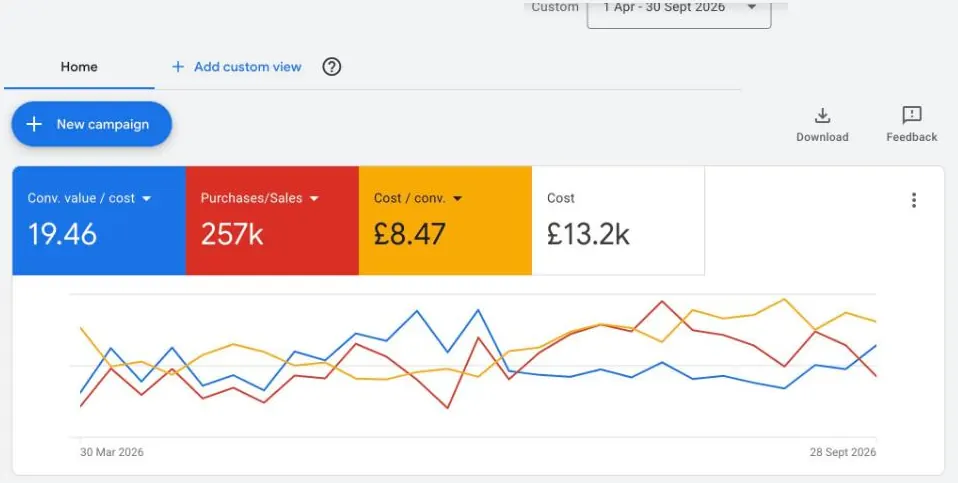
The client is a UK camping equipment brand selling lightweight tents, sleep systems and camp cookware online. Our work is covered by an NDA, so we do not name the brand. Hustle Marketers runs its Google Ads and Meta Ads. From 1 April to 30 September 2026:
 Hustle Marketers™
| Metric | Google Ads (all campaigns) | Meta Ads |
|---|---|---|
| Ad spend | £15,702.30 | £5,382.93 |
| Purchases | 1,657.72 | 411 |
| Purchase value reported | £273,255.84 | £69,612.15 |
| ROAS | 17.40 | 12.93 |
| Cost per purchase | £9.47 | £13.10 |
What did the account structure look like?
- Standard Shopping, which took 72 percent of Google Ads spend.
- A tents-only Performance Max campaign, first live in July, which returned 22.67.
- A second Performance Max campaign for selected products, and a small non-brand Search campaign.
- On Meta: interest prospecting, remarketing, a product video campaign and a single tent campaign. Small tests for Norway, Germany and the Netherlands returned 0.57 and were switched off.
The client rated the work 5.0 out of 5 in a verified review on Clutch. The full breakdown, including products, months and caveats, is in the camping equipment PPC case study.
Which outdoor brands and businesses has Hustle Marketers worked with?
Our outdoor work covers gear brands, adventure travel and marine services. Each one has a published case study:
| Client | Business | What we run | Case study |
|---|---|---|---|
| UK camping equipment brand (name withheld under NDA) | Lightweight tents, sleep systems and camp cookware, sold online | Google Shopping, Performance Max, Search and Meta Ads since April 2026 | Camping equipment PPC case study |
| KiliDestination Adventures | Safari and adventure tour operator in Arusha, Tanzania | SEO across the US, Australian and German markets, plus Google and Meta Ads, since September 2025 | Tanzania safari SEO case study |
| Nautical Marine | Boat repair and maintenance in Florida | Google Ads and Facebook Ads | Nautical Marine case study and our marine marketing agency guide |
All three clients rated Hustle Marketers 5.0 out of 5 in reviews on Clutch.
Why choose Hustle Marketers or Ishant Sharma for outdoor brand marketing?
Hustle Marketers is run by Ishant Sharma, a Google Ads specialist who has worked in digital marketing since 2013 across Google Ads, Microsoft Ads and SEO. We are a Google Partner, Meta Business Partner and Microsoft Advertising Partner, with Clutch Award wins in 2023, 2024 and 2026 and 591+ reviews across platforms. Our team is based in Zirakpur, India, and works with clients worldwide.
- Real outdoor results. We run Google Ads and Meta Ads for a UK camping equipment brand, with the data shown above.
- Shopping and feed first. We treat the Merchant Center feed as part of the ads, because for gear it decides which searches you show for.
- Policy awareness. We keep restricted items out of campaigns so the rest of your store keeps advertising.
- Seasonal planning against your margins. Budgets rise before the peak and are judged against your break-even ROAS.
- Your accounts, no lock-in. Month to month at $600 to $800 per platform, with ad accounts in your name.
Our ecommerce PPC management and Google Shopping ads agency pages explain how we work with online stores in more detail.
Outdoor marketing agency FAQs
What is an outdoor marketing agency?
An outdoor marketing agency is a marketing firm that works with brands selling outdoor gear, apparel or experiences. For ecommerce brands, the core work is Google Shopping, the Merchant Center feed, Google Search, Meta ads and SEO, planned around the camping and hiking seasons and the ad rules for bladed and restricted items.
What do outdoor marketing agencies charge?
Published outdoor agency prices we found ranged from $2,000 to $10,000 a month, with one starting at $4,900. Hustle Marketers charges $600 to $800 per platform a month for PPC management, month to month with no lock-in. Ad spend is separate and is paid to Google or Meta directly.
Is Google Ads or Facebook ads better for camping gear?
Google Shopping usually comes first, because it reaches people already searching for gear. In our UK camping account, Google Ads returned 17.40 and Meta Ads 12.93 from April to September 2026. Meta works well for launches, video and remarketing alongside Google.
Can I advertise camping knives on Google or Meta?
On Meta, no: its weapons standard does not allow ads that promote non-culinary knives. Google Ads does not name camping knives, but it does not allow knives designed or promoted to injure an opponent, or assisted-opening designs. In the UK, knife and axe ads should be aimed at adults only.
When should outdoor brands increase their ad budget?
Raise budgets in spring, before the summer peak, so campaigns have data when demand arrives. In our UK account, clicks rose from 9,231 in April to 14,939 in August. Keep seasonality adjustments for short events such as bank holiday weekends.
What ROAS should an outdoor gear store aim for?
Aim above your break-even ROAS, which is 1 divided by your profit margin before ads. A 40 percent margin breaks even at 2.5. Our UK camping account returned 17.40 on Google Ads, but your target should come from your own margins and shipping costs. Our ROAS calculator works it out.
Do I need a specialist outdoor agency or a general ecommerce agency?
You need an agency that knows Shopping, feeds and seasonal budgets, and understands the policy limits on bladed products. Ask for real screenshots from an outdoor or camping account. Niche experience matters less than proof that they have run gear campaigns well.
Do you work with outdoor brands outside the UK?
Yes. Hustle Marketers works with ecommerce brands worldwide from our team in India, including the US, UK and Australia. All platforms are managed online, and we report in your currency.
Next step
If you sell tents, sleep systems or other outdoor gear and want to know where your ads and feed are losing sales, start with a free audit. We review your Google Ads, Merchant Center feed and Meta account and show you what to fix first.