FAQ Schema Markup: Keep It, Remove It, or Ignore It?

Ishant
Published : October 9, 2026 at 1:30 pm
Updated : October 7, 2026 at 5:17 am
Ishant

Google stopped showing the FAQ rich result on May 7, 2026 and deleted the FAQPage documentation on June 15, 2026, per its own changelog. For most sites the answer is ignore it. Leave your FAQ schema markup where it is, and remove it only in three cases: the questions are not on the page, two plugins emit it twice, or nobody owns it anymore.
Key Observations
This page is not an install guide. It is the decision you need once the markup is already live.
- Google removed the FAQ rich result on May 7, 2026, for every site, with no carve out left for health or government pages.
- If your site was not one of those narrow types, your markup earned nothing from 2023 onward, which kills the traffic story before it starts.
- Adding FAQPage markup today produces no rich result, and Google documents no other benefit for it.
- FAQPage is still a valid schema.org type, live at V30.1 dated September 16, 2026. The type did not die, the Google feature did.
- Removing the JSON-LD cannot break your accordion, because the script block and the visible questions are separate things.
- The real removal triggers all predate May 2026: hidden questions, duplicate output and content drift.
What this page answers, in order
Start with the decision section if you only have a minute. Go to the removal section if you have already decided to strip it. The middle sections exist because the two most common questions, whether you lost traffic and whether the markup helps AI answers, both have answers you will not like.
Every claim below names its source. Where the research could not confirm a settings path, this page says so rather than guess.
What is FAQ schema markup, and what exactly changed
FAQ schema markup is a block of JSON-LD code that labels the questions and answers on a page as a schema.org FAQPage. Until May 2026 that label made a page eligible for an expandable FAQ listing in Google results. Google switched the listing off and then deleted the guide describing it.
That is also the plain answer to what FAQ schema means. You will see it called FAQ structured data or FAQPage structured data. Same type, same code, three names.
The history matters for one reason. In August 2023 Google cut the feature back to a narrow set of well known, authoritative government and health sites. Every other site kept the code and stopped getting the result. That detail decides most of what follows.
Google’s documentation changelog carries two entries, and they are the load bearing facts here. The first, dated May 8, 2026:
“This feature will no longer appear in Google Search starting May 7, 2026.”
Google, documentation updates changelog
The second, dated June 15, 2026, explains why there is no Google page left to read on the subject:
“Removed documentation for the FAQ rich result feature.”
Google, documentation updates changelog
Google did not mark the page deprecated and leave it up. It took the page down, and the URL that hosted the FAQ guide now lands on the changelog.
Three layers, three different answers
Most confusion here comes from treating the schema.org vocabulary, the Google feature and Google’s parsing as one thing. They are three layers, in three states.
| Layer | Status | Source |
|---|---|---|
| schema.org vocabulary | FAQPage is still defined, with no deprecation notice, at V30.1 dated September 16, 2026 | schema.org/FAQPage |
| Google rich result | Not shown to any site since May 7, 2026 | Google changelog |
| Google documentation | Deleted on June 15, 2026. The features gallery lists 25 types and FAQ is not one | Google features gallery |
| Whether Google still parses it | Open. Google documents nothing either way | No source exists |
So “FAQ schema is dead” is half right. The Google feature is gone, the type is alive and still parseable. For the wider picture of which types still earn something, read our guide to structured data for SEO.
Did HowTo go too
Yes, in effect. Google publishes no HowTo guide and lists no HowTo feature. This page gives no date for that removal, because Google’s changelog carries no HowTo entry and no date could be verified. HowTo earns nothing today, exactly like FAQ.
Should you keep, remove or ignore FAQ schema markup
Ignore it, in most cases. Google’s own line on this, as reported by Search Engine Roundtable, is permissive rather than directive. Strip the markup only for a reason that would have applied before May 2026 anyway: the questions are not visible on the page, two plugins emit the block twice, or nobody owns it.
Here is the quote that settles it. John Mueller of Google, on Bluesky, quoted by Search Engine Roundtable on May 11, 2026:
“No need to change anything, but if you did it for search, you can remove the markup if you want.”
John Mueller, quoted by Search Engine Roundtable
It grants permission and asks for nothing. No deadline exists, and nobody at Google has asked site owners to clean this up.
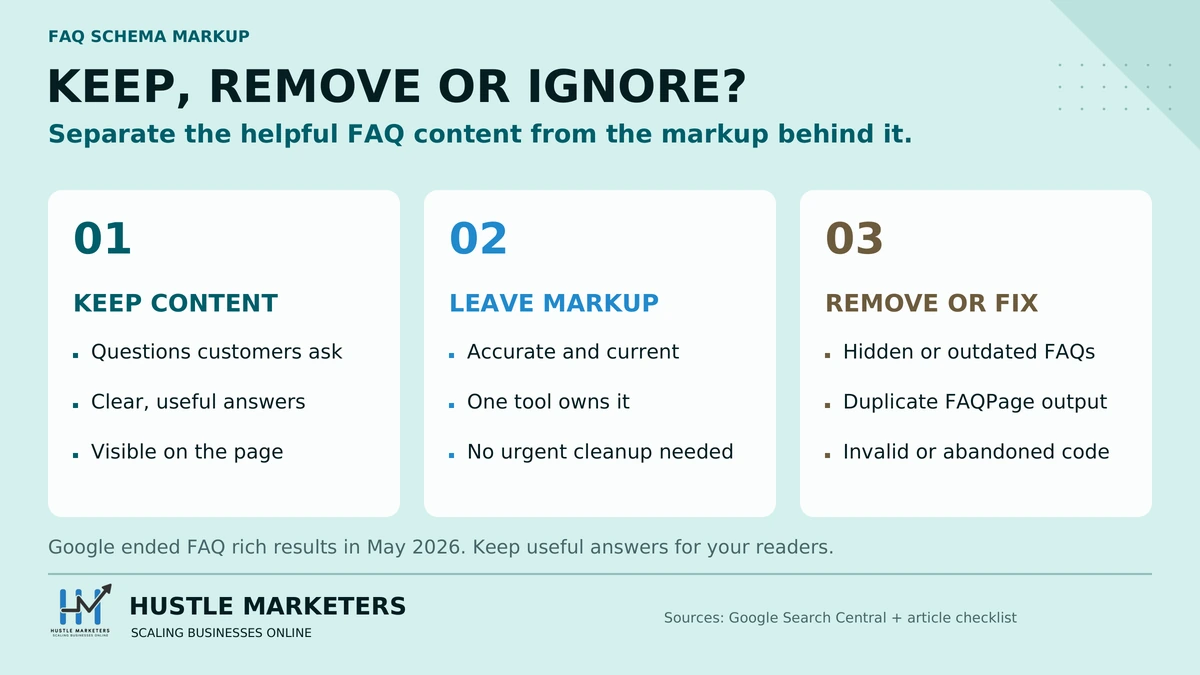
The decision, by situation
Stop at the first row that describes your site. Every trigger in the remove rows is a content or hygiene problem, and none is the deprecation itself.
| Your situation | Do this | Why |
|---|---|---|
| Questions are visible, one plugin emits the markup, the setup is stable | Leave it | No upside left, but no cost either. Removal is unpaid work |
| The questions exist only inside the JSON-LD and readers never see them | Remove it | It breaks Google’s visible content rule, which still applies |
| Two plugins emit FAQPage on the same URL | Remove one | Duplicate entities on one URL were a defect before May 2026 and still are |
| Nobody owns the markup and the page content has moved on | Remove it | Abandoned markup describes a page that no longer exists |
| Your FAQ JSON-LD is invalid, which is common on Elementor accordions | Remove it | It produced nothing while the feature was live, so removal is free |
| You were about to add FAQPage markup to a new page | Do not bother | No rich result for any site, and no other documented benefit |
Is there any reason left to keep it
One, and it is an argument rather than evidence. Search Engine Land raised it on May 8, 2026, the day after the change:
“Other search engines may be able to continue to process it and use it for their own purposes.”
Note the word “may”. No engine documents FAQPage behavior of its own. Treat it as a reason not to spend a weekend deleting things, not a reason to add more.
Is there any harm in leaving it
Almost none, with one caveat people skip. Google’s structured data policies still apply to any markup a page carries, whether or not a feature consumes it. The rule that catches FAQ markup is this one:
“Don’t mark up content that is not visible to readers of the page.”
Google, structured data policies
The worst case is narrow. Google documents that a structured data manual action costs a page “eligibility for appearance as a rich result” and not its ranking. For FAQ markup there is no eligibility left to lose.
What does FAQ schema markup actually do now, and what replaces it
Nothing you can point at. No rich result, no reporting line in Search Console, no documented ranking effect and no documented AI benefit. All that survives is the general statement in Google’s structured data intro, that markup gives search engines explicit clues about a page.
Nothing maps onto it either, so distrust any page offering a tidy replacement. This research established no migration path, because none is documented. What replaced the FAQ rich result in that slot is unresolved here, so this page will not guess. For the working list of what still earns something, use our technical SEO checklist.
How to find which tool is emitting the markup
Work out which tool writes the block before you delete anything. Both failed removals in this research failed at this step, not at the removal step. Open the page source, search for FAQPage, then read the class attribute on the script tag holding it.
In our audits this is the whole job. Once you know the emitter, the fix is a two minute toggle or a one line filter. Get it wrong and the markup reappears on the next load.
The two ways this goes wrong
The first case sits on Rank Math’s own support desk. A user ran the correct bulk removal across 67 posts and still had FAQ schema on every one, because the markup came from Elementor. Rank Math support stated the limit plainly.
“if the FAQ Schema markups are added by Elementor then we can’t remove them from our plugin.”
Rank Math support, support ticket
The second is worse. A Rank Math free user disabled the Schema module, removed the templates, installed removal plugins and purged every cache. Schema kept appearing site wide, and that ticket closed unresolved. Neither user had a diagnosis, but both had a procedure.
A diagnostic table you can run in five minutes
| What you see in the page source | Most likely emitter | Next step |
|---|---|---|
| One FAQPage block, and the script tag’s class names your SEO plugin | That SEO plugin | Use its path in the next section |
| Two FAQPage blocks on one URL | Two tools, usually an SEO plugin plus a page builder | Turn one off, not both |
| Markup survives after you disable the SEO plugin’s schema module | A page builder widget, a theme template or hard coded JSON-LD | Check the accordion widget, then the templates |
| A visible FAQ block and no FAQPage in the source | Nothing. The block never emitted schema | Stop. There is nothing to remove |
| Markup on a URL with no FAQ content visible anywhere | A site wide block in a layout, header or root template | Remove it. This is the case that matters |
That fourth row catches more sites than people expect. All in One SEO support conceded in 2023, replying to a review titled “Misleading FAQ feature”, that the free block is not treated as a FAQ by search engines without the Pro version. Plenty of sites have a block, no output and nothing to do.
Two plugins on one page, and which to turn off
Rank Math’s knowledge base names three causes for a duplicate FAQPage field and gives a path for each. Its rule of thumb is the one to keep:
“You should only have one plugin generating your FAQ Schema.”
Rank Math, duplicate FAQPage field guide
Pick the one you can control and turn the other off. On a URL that also carries Article or Product markup, the wider problem is duplicate entities, which our entity SEO guide covers properly.
Which testing tool still reads FAQPage
Use the Schema Markup Validator, not the Rich Results Test. The Rich Results Test only reports features Google can render, and FAQ is no longer one. A validator run by schema.org still parses FAQPage, because the vocabulary still defines it. These two tools answer different questions.
Google documents the validator’s scope in one sentence, and the last four words are the ones people miss:
“Validate all Schema.org-based structured data that’s embedded in web pages, without Google feature specific warnings.”
Google, structured data documentation
| Tool | Does it read FAQPage | What a clean result proves |
|---|---|---|
| Schema Markup Validator | Yes | Your syntax matches the vocabulary. Nothing about Google |
| Rich Results Test | No | Which Google features your page can earn, and FAQ is not on that list |
| Structured Data Testing Tool | Retired | Nothing. Google moved generic validation to the schema.org validator |
| Search Console | No FAQ report exists | Covered in the Search Console section below |
If a guide still sends you to the Structured Data Testing Tool, it has not been touched since 2021. Treat the rest of its advice with the same suspicion.
One trap, because it is the most common misreading here. A clean validator result is no evidence that Google will show anything, since the validator leaves Google feature warnings out by its own description. People read green ticks as eligibility, and for FAQPage nothing sits behind the tick.
My FAQ markup fails validation. Should I fix it
Not for Google. Fixing invalid FAQPage markup buys a valid description of something no Google feature consumes. If the questions are visible and you like having the markup, repair it for tidiness. If they are not visible, delete the block and save the work.
How to turn FAQPage output off, tool by tool
There is no single switch, in any tool. Each plugin hides the control somewhere different, two of the big four have no FAQ specific control at all, and page builders emit their own copy regardless of your SEO plugin. Identify the emitter first, then use only the path that matches it.
Every path below comes from the vendor’s own documentation or a named support reply. Where the research could not confirm a path, this page says so instead of guessing.
Rank Math
The best documented of the four, and the only one with a removal snippet aimed at the FAQ block itself.
| Route | Confirmed path | Scope and limits |
|---|---|---|
| Remove the FAQ block schema in code | Add remove_filter( 'rank_math/schema/block/faq-block', [ RankMath\Schema\Block_FAQ::get(), 'add_graph' ] ); to your theme’s rank-math.php file | FAQ block only. From Rank Math’s FAQ block guide |
| Delete it in the block editor | Rank Math SEO icon, then the Schema icon, then the delete icon beside FAQ Schema, then delete the matching shortcode block from the content | One post at a time. The classic editor route runs through the Rank Math SEO meta box |
| Bulk removal | Posts, tick the posts you want, Bulk actions, Edit, then set the Schema type to None | Rank Math PRO only, and it removes only schema Rank Math created |
| Kill all Rank Math JSON-LD | add_filter('rank_math/json_ld', '__return_empty_array'); | Lower confidence, and far wider than you want. It came from an automated support bot on an unresolved ticket |
Yoast SEO
Yoast has no FAQ off switch, and that is the finding rather than a gap in this research. Yoast support said so to a user with hundreds of FAQ blocks:
“There’s no feature to convert the Yoast SEO FAQ blocks to pure HTML.”
Yoast Plugin Support, WordPress.org support forum
What Yoast does document is broader:
“If you return false or an empty array on the wpseo_json_ld_output filter, you disable all Yoast SEO’s schema output.”
Yoast, schema API documentation
| Route | Confirmed path | Scope and limits |
|---|---|---|
| Disable all Yoast schema | add_filter( 'wpseo_json_ld_output', '__return_false' ); | Removes every Yoast graph piece, not just FAQ. One user reported no effect and support referred them to paid help |
| Per block filters | Yoast documents wpseo_schema_block_<block-type> and wpseo_pre_schema_block_type_<block-type> | The correct surgical route in principle. The block-type slug for the Yoast FAQ block is NOT CONFIRMED anywhere in this research, so verify it before writing the filter |
| Graph pieces filter | wpseo_schema_graph_pieces adds or removes pieces from the graph | Documented, but this research confirmed no FAQ specific piece name |
| The practical route | Delete the Yoast FAQ block and rebuild the questions as ordinary headings and paragraphs | Tedious at volume, and the only route with no unknowns in it |
Do not guess the block-type slug. If it is wrong the filter runs against nothing, you see no change, and you will blame the filter.
All in One SEO
One confirmed filter, supplied by All in One SEO’s own Plugin Support with a working conditional. It is page scoped rather than type scoped.
| Route | Confirmed path | Scope and limits |
|---|---|---|
| Disable schema conditionally | add_filter( 'aioseo_schema_disable', 'aioseo_disable_schema_posts' ); with your own conditional in the callback | From AIOSEO Plugin Support. Disables matching requests, not one type |
| Vendor documentation | All in One SEO documents how to add FAQ schema and gives no removal path at all | Its FAQ schema doc was modified August 14, 2026 and still describes the August 2023 position |
| Check before you act | Look for FAQPage in the page source first | On the free version the block was never recognized as a FAQ, so there may be nothing there |
Elementor and other page builders
The most common culprit in the support threads, and the one with no global control. Elementor Plugin Support put it on the record in January 2026:
“At the moment, Elementor does not include a global setting that completely disables all schema markup across the site.”
Elementor Plugin Support, WordPress.org support forum
So you go widget by widget. The free Accordion widget carries a FAQ Schema toggle of its own, and if Rank Math is active you will find a second control named Add FAQ Schema Markup on the same widget.
- Open Posts or Pages, then Edit with Elementor.
- Go to Elements, then General, then the Accordion widget.
- Turn off either FAQ Schema, which belongs to Elementor, or Add FAQ Schema Markup, which belongs to Rank Math.
- Click Update, reload the live page, then search the source for FAQPage again.
Where that is not enough, Elementor support named the fallback: filter Elementor’s rendered output and strip the schema before it reaches the front end, through PHP in a child theme or a snippets plugin.
One inversion worth knowing first. Elementor support has twice confirmed a bug where that toggle emits JSON-LD with a blank text field inside acceptedAnswer, in a thread on the Accordion widget and again in a report in August 2025. No fix date was given.
Schema Pro
One documented deletion route, and it is scoped to uninstalling the plugin rather than to removing a type.
| Route | Confirmed path | Scope and limits |
|---|---|---|
| Delete Schema Pro’s data | Settings, Schema Pro, Plugin Settings, enable Delete Data on Uninstall, then Save Changes | Removes Schema Pro’s database entries when you uninstall the plugin. From Schema Pro’s own documentation |
| Remove one FAQ schema only | NOT CONFIRMED | No page in this research documented a per type FAQ removal path inside Schema Pro. Deleting the individual schema in the plugin is the obvious place to look, but nothing verified it |
Can you remove it across hundreds of URLs
Partly, and only inside one tool. Rank Math PRO’s bulk edit is the single documented mass route, it touches only schema Rank Math created, and Yoast has no conversion feature. Templated output is easier: if the block lives in a layout or root template, one edit removes it everywhere. That is also where the worst markup lives.
What happened to the FAQ report in Search Console
The FAQ enhancement report is gone, and so is the FAQ search appearance filter. Google’s Search Console help page lists the rich result report types it supports, and neither FAQ nor HowTo appears on that list. There is no setting to switch back on and no archive view left behind.
Here is the supported list, from Google’s own help page. Reproducing it beats describing the hole, because the practical question is what you still have:
- Breadcrumbs, Datasets, Discussion forum, Education Q and As, Events, Hotels
- Image metadata, Job postings, Math solvers, Merchant listings, Practice problems
- Product snippets, Profile pages, Q and As, Recipes, Review snippets
- Subscribed content, Vacation rentals, Videos
That list comes from Google’s documentation on rich result reports. Note that Q and As survives while FAQ does not, which trips people up constantly. Product snippets and Merchant listings survive too, so unlike this page, our product schema markup guide and our local business schema guide remain implementation guides.
What exactly did Google drop, and when
Search Engine Land quoted Google’s Search Console notice on May 8, 2026. This is reporting of Google’s words rather than a page you can still read on Google’s site, so take it at that strength:
“We will be dropping the FAQ search appearance, rich result report, and support in the Rich results test in June 2026.”
Google’s Search Console notice, quoted by Search Engine Land
An independent agency post recorded the same three items on May 11, 2026. API support followed in August 2026 on the same reporting.
Is this a one off or a pattern
A pattern, and knowing that makes the next one less alarming. In September 2025 Google dropped six structured data types at once, and Search Engine Roundtable recorded the mechanics:
“these types will be removed from Search Console rich result reporting, the Rich Result Test, and the list of Search appearance filters”
Search Engine Roundtable, September 2025
Same three surfaces, one year earlier. When Google retires a feature, the reporting goes with it.
Can you still export your historical FAQ data
No. That window closed in June 2026, and this is the part nobody wants to deliver. One agency post spotted the deadline while it was still open: “Export your historical FAQ rich result data from Search Console before June 2026, so the baseline is preserved for any future before-and-after CTR analysis,” wrote Passionfruit on May 11, 2026.
Almost nobody did it. Most sites now have no pre removal FAQ baseline, which is why the next section has no numbers.
Did anyone actually lose traffic
Nobody has shown any. Five pages published after the change were opened for this research to look for before and after data, and not one carries clicks, impressions or click through rate from any site spanning May 7, 2026. There is also a reason to expect nothing.
That reason is the most useful sentence anyone has said about this change. John Mueller of Google, on Bluesky, quoted by Search Engine Roundtable:
“If a site had the markup & wasn’t one of those types, it was already being ignored.”
John Mueller, quoted by Search Engine Roundtable, May 11, 2026
Follow that through. If you are not a well known authoritative government or health site, your markup stopped producing results in 2023, not 2026. Mueller made the scope explicit:
“It was only used for a tiny set of site types (as documented), so for most, this doesn’t result in changes in Search.”
John Mueller, quoted by Search Engine Roundtable
Glenn Gabe, quoted in the same article, described how it looked from outside. FAQ snippets went from the results for the government and health sites that still had them. For everyone else, nothing was left on screen to go.
So why do people think they lost traffic
Because a dated announcement and a traffic dip in the same month look like cause and effect, and almost never are. A Shopify thread from 2023 shows the pattern: a merchant added FAQPage markup on the 13th, saw Google Ads collapse on the 14th and 15th, and connected the two. An experienced responder noted that nobody had reported that interaction before.
Two things make the traffic question unanswerable rather than merely unanswered. Most sites no longer have a Search Console baseline, and a May 2026 dip sits in the same window as unrelated Google updates.
Does FAQ schema still help rankings
The FAQ schema SEO question splits into two, and conflating them is what makes most guides on this topic confusing. Eligibility for a rich result and ranking in web results are separate mechanisms. Google documents the first and has never documented the second.
The closest Google comes to a ranking statement sits in its structured data policies, and it points the other way from what most guides imply. A structured data manual action costs a page “eligibility for appearance as a rich result”, and Google states directly that it does not change how the page ranks.
So: no documented ranking effect before May 2026, none after it, and now no eligibility either. One May 2026 post suggested that sites relying on FAQ rich results might see lower click through rates, and credited that suggestion to a publication rather than a dataset. Every traffic claim here looks like that.
Does FAQ schema markup earn AI citations
There is no good evidence that it does. Google documents no AI benefit for FAQPage markup, the loudest study behind the claim is correlational and its own reporter says so, and the counter evidence points the other way. The mechanism people assume is at work is probably not the mechanism.
This matters more than the rich result question now, because the AI claim is what keeps FAQ schema on agency checklists. Ask for the source when you see it. Usually there is none.
Where the 41 percent against 15 percent figure comes from
You will see it everywhere: pages with FAQ schema cited 41 percent of the time against 15 percent without. Signals traced the figure to Relixir, a GEO software vendor, across 50 domains, around the Gemini 2.0 rollout in 2025. It compared pages carrying schema against pages without it, rather than the same pages before and after.
The person who traced it is clear about what that means:
“It is correlational, not a controlled before-and-after test.”
Dimitry Apollonsky, Signals, June 6, 2026
His own reading of the data is the position this page holds, and it explains the gap without granting the markup any power:
“FAQ schema marks pages that already have good question-and-answer content, and the content is doing the work.”
Dimitry Apollonsky, Signals
Neither the Relixir study nor the Search/Atlas study below was opened directly for this research. Both are cited to the pages reporting them, which is the honest strength of that evidence.
Is there evidence pointing the other way
Yes, and more than the confident guides suggest. An SE Ranking analysis found pages with FAQ schema averaged 3.6 citations in ChatGPT responses against 4.2 for pages without, as reported by Ziptie. A December 2024 Search/Atlas study found no correlation between schema coverage and citation rates, reported by Passionfruit with no numbers attached.
Do language models read your JSON-LD as data or as text
This is the question that dissolves the debate, and nobody in the ranking ten covers it. An experiment attributed to Williams-Cook in February 2026 put an address only inside invalid JSON-LD, with no copy in the visible page. Both ChatGPT and Perplexity returned that address.
“LLMs tokenize all HTML text, including <script> blocks” but “do not semantically parse or validate the JSON-LD structure.”
Reported by Ziptie, on an experiment attributed to Williams-Cook
Take that at its real size. It is a single page test, not a study. But if it holds, a JSON-LD block affects an AI answer because it is text on the page, not because it is valid structured data. Your markup being correct would be irrelevant.
That one mechanism explains every correlation here without giving the schema any status. A page with good visible questions gives a model the same text with or without a script block wrapped around a copy of it.
What the vendors claim, against what the evidence shows
Yoast’s May 2026 recap carries the hedge in its purest form:
“This doesn’t mean the FAQ schema is useless; it may still help with AI responses or future search features.”
Yoast, May 2026 SEO update recap
Nothing sits behind “may still help”. Set it against three independent pages holding the opposite position, one dismantled figure, one slight negative and one mechanism finding. Google documents no such benefit either.
None of that makes question and answer content worthless for AI answers. The content earns the citation and the markup does not. That distinction drives our answer engine optimization approach, and our AI search optimization work starts with the visible page. For the theory, read our semantic search guide.
FAQPage or QAPage: which type fits your page
Neither, for most pages, and Google’s one clear instruction sits on the page about the other type. FAQPage was built for pages whose main purpose is questions and answers. QAPage was built for pages where users post a question and others answer it. Your FAQ section is usually neither.
Here is the instruction, on Google’s QAPage documentation:
“Don’t use QAPage markup for FAQ pages or pages where there are multiple questions per page.”
Not one of the ten ranking guides quotes or applies that line. Q and As still has a Search Console report, so the distinction matters for a genuine community question page.
My FAQs are one section of a longer page. Is FAQPage even correct
Probably not, and this is a hole in the specification rather than a mistake you made. An open issue on schema.org’s own tracker proposes a new FAQSection type as a WebPageElement subtype, for question and answer content forming part of a page instead of the whole of it.
The issue states the false choice publishers have faced all along. You either:
“declare FAQPage and lie about what the page is” or “skip schema on the FAQ section entirely.”
schema.org issue 4816, open
Most people who marked up an FAQ section on a service or product page picked the first option, because the second felt like leaving value on the table. The value was never there. One publisher explains why they never took the type up:
“which is why we never adopted the FAQPage schema.”
robertmaier, schema.org issue 4816
Nearly all of their question and answer content sits inside other editorial content. The issue’s author goes further and attributes the deprecation “in significant part” to years of FAQPage misuse the specification never gave publishers an alternative for. That is a claim made in that issue, not an established fact.
Why do people still say it is limited to government and health sites
Because that was true from August 2023 until May 2026, and the correction has not spread. In January 2026 working practitioners were asking each other on Local Search Forum whether the type was deprecated except for government bodies. On May 18, 2026, eleven days after full removal, a Shopify community reply still diagnosed a missing FAQ result as the 2023 restriction.
Can FAQPage and Article coexist on one URL
Yes, and that answer has sat on WebmasterWorld since 2022, where someone asked the graph question plainly and got a sensible reply. You can describe the article part and the FAQ part of a page in the same markup, as that thread set out. The risk is ending up with two FAQPage entities on one URL because two tools both decided to help.
Do the old usage rules still matter
Yes, with a different job. Visible content, one answer per question and no promotional use were eligibility rules: follow them and you might get the rich result. With no rich result they become content quality rules, and the visible content rule stays enforceable through Google’s structured data policies.
Will removing the markup break anything
No, and the reason is structural rather than reassuring. The JSON-LD block and the visible accordion are separate things that happen to describe each other. Deleting the script tag cannot collapse your accordion, change your layout or remove a single question a reader can see.
The cleanest statement of that comes from an unlikely place: a plugin whose only job is restyling the Yoast FAQ block into an accordion. Its documentation, on a plugin with 3,000-plus active installs, says the schema sits in the header, then adds the part that matters, on its directory listing:
“it doesn’t have to do anything with the appearance of the FAQ section.”
FAQ Schema Block to Accordion, WordPress plugin directory
So the question that stops most people touching this has a short answer. Nothing visible changes. You lose a description of content, and that description was going nowhere.
Should the FAQ content itself stay on the page
Yes, if readers use it. This is the editorial decision hiding behind the technical one, and the markup has no bearing on it. A good FAQ section earns its place by answering what buyers actually ask. Drop it only if it exists for search engines, which you can test in a minute:
- Do the questions match what customers ask, or what a keyword tool suggested?
- Does anyone open them, in your scroll or click data?
- Would you put those answers in an email to a customer?
- Are the questions on the page at all, or only inside the script block?
The two real removals, and why they happened
Two people publicly deleted FAQPage markup in September 2026, in merged pull requests. Neither mentions the deprecation. Both cite the visible content rule, which is the most interesting single finding in this research pass.
The first had a FAQPage block in a root layout, so every page emitted six questions that appeared on none of them. The stated reason:
“Google expects FAQ markup to describe questions visible on that page.”
Merged pull request, September 25, 2026
The second removed a homepage FAQPage block for the same reason, stated even more plainly:
“Remove the homepage FAQPage JSON-LD because its nine questions and answers are not present in user-visible homepage content.”
Merged pull request, September 5, 2026
Read those together and the framing of this topic shifts. The deprecation is not a reason to remove anything. Hidden questions, duplicate output and content drift are, and all three were reasons to remove before May 2026 as well.
What if your markup was invalid anyway
Then removal is free and you can stop deliberating. A large population of Elementor sites has been emitting FAQPage JSON-LD with an empty answer field, a bug Elementor support has confirmed twice with no fix date. Those pages produced nothing while the feature was live, so there is nothing to weigh.
To spend the cleanup time on markup that still earns something instead, our restaurant schema guide and our Magento schema guide cover types Google still documents and reports on.
Has your plugin vendor told you the truth
Two of the four big WordPress schema tools have acknowledged the change, two have not, and one of the two that did holds three different positions across three of its own pages. That is not a gotcha. It is the reason to check a page’s modification date before trusting its FAQ advice.
| Vendor | Acknowledged May 2026 | What its own pages say |
|---|---|---|
| Yoast | Yes, on the FAQ block product page | Accurate there, wrong in the May recap, recommending FAQPage as an opportunity in the June recap |
| Rank Math | Yes, twice | Correct on substance, vague on dates, and still listing a voice search benefit on the same page |
| All in One SEO | No | Its FAQ doc was modified August 14, 2026 and still gives the August 2023 announcement as the status |
| Schema Pro | Nothing found | No FAQ notice in anything this research opened, though it publishes deprecation notices for other types |
Yoast holds three positions
The accurate one is on the FAQ block product page, and it is the clearest vendor statement found anywhere:
“Google retired the FAQ rich result from Search in May 2026.”
Yoast, FAQ block product page
Two weeks after the change, its May recap acknowledged the removal and repeated the superseded 2023 carve out in the same sentence:
“Google has stopped supporting FAQ rich results in search, though they may still appear for certain sites, like medical or government pages.”
Yoast, May 2026 recap, May 22, 2026
Its June recap, published on July 1, 2026, sixteen days after Google deleted the documentation, recommends the type as an untapped opportunity:
“Explore less common schema types, like FAQPage, HowTo, or Event to stand out.”
Yoast, June 2026 recap, July 1, 2026
Three pages, three positions, and the most accurate sits where a customer is least likely to read it. That does not make Yoast a bad plugin. It makes roundup posts a bad status source.
Rank Math acknowledges it and keeps a stale claim
Rank Math states the change on the same knowledge base page that carries the removal snippet:
“Google reduced support for the FAQ Schema in 2023 and ended support for it in 2026.”
Rank Math, FAQ block knowledge base
Correct, if undated. Its blog version states the deprecation and still lists eligibility for voice search actions further down the same document.
All in One SEO has said nothing
Its FAQ schema documentation was last modified on August 14, 2026, three months after the feature stopped appearing and two months after Google deleted the guide. The only status line it offers is this:
“Google announced changes to when they might display FAQ rich results in August 2023.”
All in One SEO, FAQ page schema documentation
A vendor’s own instruction page, touched after the feature died, still describing a three year old position. So check any FAQ schema instruction against one date: May 7, 2026. If the page predates it and does not name the removal, its advice describes a Google that no longer exists. Apply that to this page too.
Short answers to the common questions about FAQ schema markup
This FAQ block carries no FAQPage markup, deliberately: a page arguing that the markup earns nothing has no business emitting any of its own. You are reading these answers without it. Each one repeats a decision made earlier, in a line, for anyone who scrolled straight here.
Is FAQ schema markup dead?
The Google feature is dead. The type is not. FAQPage still exists in the schema.org vocabulary and generic validators still parse it.
Do I need to remove my FAQ schema?
Not unless the questions are invisible to readers, two plugins emit it, or nobody owns it anymore.
Will removing it hurt my traffic?
No. Unless you are a well known government or health site, Google was already ignoring the markup before May 2026.
Does FAQ schema help with AI search?
There is no evidence that it does. No engine documents a benefit, the loudest study is correlational, and the counter evidence points the other way.
Is FAQPage still valid in schema.org?
Yes. It is defined with no deprecation notice at V30.1, dated September 16, 2026.
Can I still test FAQ schema?
Yes, with the Schema Markup Validator. The Rich Results Test dropped FAQ support, so it tells you nothing about this type.
Should I use FAQPage or QAPage?
Neither, for most pages. Google says not to use QAPage for FAQ pages, and FAQPage only fits a page that is all questions.
Should I keep the FAQ section itself?
Yes, if readers use it. Keep it for the buyer questions it answers, and delete it only if it was built for a crawler.
If you want someone to run the attribution pass and the cleanup across a large site, that work sits inside our SEO packages. To keep it in house, our roundup of AI SEO tools covers what is worth pointing at a site audit.
Summarise this article with: