Best AEO Tools in 2026: Verified Prices and What the Platforms Actually Report

Ishant
Published : October 16, 2026 at 2:30 pm
Updated : October 14, 2026 at 7:21 am
Ishant
An AEO tool tracks whether AI answer engines mention or cite your brand. The useful ones run a set of prompts against ChatGPT, Perplexity, Gemini, Claude and Google AI features on a schedule, then report how often you appear. Prices in this guide run from 17 to 800 dollars a month, and the cheapest tiers are cheap because they track very little. Five of the best known tools publish no price at all.
Key Observations
- We read 15 competing “best AEO tools” lists in full. Nine of them are published by a company that sells a competing AEO tool, and all nine rank their own product first.
- Those 15 lists name 55 different tools between them. Twenty seven of those tools, 49 percent of the 55, appear on exactly one list and nowhere else in the 15 we read on October 2, 2026.
- The lists contradict each other on price constantly. Profound appears at three different prices across them, plus one list that gives none, a spread of roughly six times. Most of the disagreement is one plan quoted on two billing cycles.
- Every price in this guide was read on the vendor’s own pricing page on October 2, 2026, and the date is on every row.
- Google’s Generative AI performance report gives impressions only. It covers AI Overviews and AI Mode together and does not report clicks. No tool can read that split from Google either, because Google does not publish it.
- Bing Webmaster Tools publishes AI citation data, including Citation Share, free. We did not find it mentioned on any of the 15 lists.
- We did not test these tools hands on. We verified prices and platform documentation. Four of the 15 lists claim testing outright and several more imply it, and none of them publishes a test method, a prompt set or results.
What is an AEO tool, and what can one actually measure?
An AEO tool measures whether AI answer engines mention your brand. It runs a list of prompts against those engines on a schedule. It records which brands and sources appear in each answer. That becomes a visibility score, a share of voice figure and a citation list.
That sentence contains the whole limitation of the category, and it is worth sitting with before you spend anything.
No AI platform publishes brand visibility data. OpenAI does not. Perplexity does not. Anthropic does not.
There is no API that tells you how often ChatGPT mentioned your company last month. So every number these tools show you is one of two things: a sample the vendor generated by querying those systems itself, or clickstream data bought from browser extension panels.
It is not platform reported data, and no amount of dashboard polish changes that. A tool that runs 50 prompts a day against ChatGPT is showing you the results of 50 prompts, extrapolated. That can still be useful. It is not the same as Search Console.
Answer engine optimization itself is the broader practice. If you want the strategy rather than the software, start with our answer engine optimization guide. This page is only about the tools.
AEO tools, GEO tools and AI visibility tools are mostly the same category
The labels are used interchangeably by vendors and by the lists that rank them. Answer engine optimization, generative engine optimization and AI visibility all describe tracking and improving how AI systems represent your brand. Where the lists differ is what they let into the category.
Some of the 15 lists we read include content optimization software such as Clearscope, MarketMuse and Surfer as AEO tools. Others include technical crawlers such as JetOctopus and Botify. One list publishes a threshold that explicitly excludes tools by name. There is no shared definition, which is one reason the lists disagree so much.
For this guide, an AEO tool is software whose main job is measuring or improving brand presence in AI generated answers. Content optimization software is a different category and we cover it in AI SEO tools.
What do AEO tools actually cost in 2026?
Published entry prices run from 17 dollars a month, on annual billing only, up to 800 dollars a month, and five of the best known tools publish no price at all. Every figure below was read on the vendor’s own pricing page on October 2, 2026. Where a vendor shows a different monthly and annual rate, both are given.
| Tool | Entry plan | Published price | Verified |
|---|---|---|---|
| Rankscale | Essentials | 17 USD per month, annual only (list 20) | Oct 2, 2026 |
| Otterly.AI | Lite | 29 USD per month, 25 on annual | Oct 2, 2026 |
| Ahrefs Brand Radar | Custom Prompts | From 50 USD per month. AI Visibility Index 199 per month | Oct 2, 2026 |
| Knowatoa | Starter | 59 USD per month | Oct 2, 2026 |
| Nightwatch | Starter | 79 EUR per month, not USD. AI tracking included on every plan, 50 prompts on Starter | Oct 2, 2026 |
| Writesonic | Starter | 79 USD per month billed annually | Oct 2, 2026 |
| SE Ranking AI Search | Add-on | Plus 71.20 annual or 89.00 monthly, on top of Core at 103.20 or 129 | Oct 2, 2026 |
| Semrush AI Visibility Toolkit | Base | 99 USD per month, per domain, 25 prompts | Oct 2, 2026 |
| Trakkr | Growth | 100 USD per month, or 1,000 per year on the vendor page | Oct 2, 2026 |
| Scrunch AI | Starter | 250 USD per month annual, 300 month to month | Oct 2, 2026 |
| Goodie AI | Core (brands) | 399 USD per month. Agency Growth 275, billed quarterly or annually | Oct 2, 2026 |
| AthenaHQ | Essential, then Starter | Essential free with 25 USD of credit and 300 credits, then Starter 295 USD per month | Oct 2, 2026 |
| Evertune | Pro | 800 USD per month | Oct 2, 2026 |
| Profound | Trial | Free 7 day trial, 50 prompts. No public paid price | Oct 2, 2026 |
| Peec AI | Starter | No numeric price renders on the pricing page | Oct 2, 2026 |
| Conductor | Essentials, Growth | No public pricing, demo only | Oct 2, 2026 |
| BrightEdge | Not named | No public pricing, contact only | Oct 2, 2026 |
Three things in that table matter more than the numbers
The spread, the silence and the add-ons. Each one changes what you will actually pay.
First, the 47 times spread between the cheapest and dearest published price is not a quality gap. It is a volume gap. Rankscale at 17 dollars and Evertune at 800 dollars are not doing the same amount of work.
The most recommended tools are the ones that will not tell you the price
Second, five widely recommended tools publish no price at all. Profound and Peec AI are the two most named tools in the whole set, on 13 of the 15 lists each. Neither publishes a figure. Nor do AirOps, Conductor or BrightEdge.
You cannot learn what any of them costs without talking to sales. So every price quoted for them in a listicle came from somewhere other than the vendor.
Some vendors charge the AI tracking on top of a base subscription
Third, check whether the AI capability is included or sold on top. SE Ranking prices AI Search as an add-on over its Core plan, and Semrush prices its AI Visibility Toolkit per domain alongside the main subscription, so the headline figure understates what you will pay.
Nightwatch is the useful counter example. Its own pricing page states that AI tracking is included on every plan and is not an upsell, with 50 AI prompts on the 79 EUR Starter. Several competing lists describe Nightwatch as an add-on model. On the vendor’s own page, it is not.
Why do the best AEO tools lists disagree on price?
Mostly because they quote one plan on two different billing cycles without saying which. Of the 15 lists we read, not one separates monthly from annual pricing consistently, and only one comes close. The rest publish a single number, and because vendors advertise the annual rate in large type and the monthly rate in small type, different writers pick up different figures.
Here is what that looks like in practice.
| Tool | Prices found across the 15 lists | What the vendor’s own page said on Oct 2, 2026 |
|---|---|---|
| Profound | 99 USD on seven lists, 82.50 on one, 499 Lite on one, no price on Profound’s own blog | No public paid price. Free 7 day trial, 50 prompts |
| Writesonic | 39, 79, 199 and 249 | Starter 79 billed annually |
| AthenaHQ | Free, 95, 245 and 295 | Essential free with 25 USD credit and 300 credits, Starter 295 |
| Scrunch AI | 250, 300, 300 to 500, and 100 Explorer | Starter 250 annual, 300 month to month |
| Ahrefs Brand Radar | Free on one list, 199 on three, 398 on one | Custom Prompts from 50, AI Visibility Index 199 |
| Otterly.AI top tier | 489 on four lists, 989 on one | Premium 489 monthly, 422 annual. The 989 figure is not on the vendor page |
The Profound row is the one to look at hardest. Seven separate lists state a price of 99 dollars a month for a product whose vendor publishes no paid price at all. We traced the 99 dollar figure in circulation to a competitor’s comparison page, not to Profound. If you are budgeting from a listicle, you are budgeting from a number the vendor never published.
A second cause is that nobody dates a price. Four of the 15 lists carry a blanket “prices current as of” line somewhere on the page. None attaches a verified date to an individual row, and none records what changed since last time. In a category where vendors are repricing every few months, an undated price table is a guess with a table border around it.
That is why every row in our table above carries its own verification date, and why we will restate it rather than quietly editing numbers.
Who publishes the other lists, and what do they sell?
Nine of the 15 lists we read are published by a company that sells a competing AEO tool. All nine rank their own product first. A tenth is a personal blog whose author works for one of the vendors, and it also ranks that vendor first.
| Publisher type | Count of 15 | What it means for the ranking |
|---|---|---|
| Sells a competing AEO tool | 9 | All nine place their own tool at number one |
| Vendor employee personal blog | 1 | Ranks their employer first |
| Sells an AEO or GEO service, not a tool | 3 | Rankings vary, one ranks a tool no other list names |
| No AEO product or service | 2 | One is media with paid vendor placement, one is an analyst selling benchmarking |
This is not an accusation of dishonesty. Publishing a comparison that includes your own product is normal, and two of the vendor published lists disclose it clearly. One states in plain text that it publishes the comparison and is listed first. Another names two categories where competitors beat its own product, which is the best disclosure in the set.
But two of the nine never mention the conflict anywhere on the page. And the practical effect across the whole set is that the “consensus” you see when you read five of these lists is not independent agreement. It is nine vendors each voting for themselves, plus a shared second tier that everyone copies from everyone else.
For what it is worth: Hustle Marketers sells no AEO tool and takes no affiliate commission on anything named here. Six of the 15 sell no AEO tool, but of those, three sell an AEO service and one monetizes vendor placements.
What does Google actually report about AI Overviews and AI Mode?
Impressions only, with AI Overviews and AI Mode combined into one figure. Google’s Generative AI performance report does not give you clicks, click through rate, average position or the queries that triggered the impression. Per Google’s own help documentation read on October 2, 2026, it rolled out worldwide on August 31, 2026, carries the usual 1,000 row limit, and excludes Search Labs experiments.
This single fact governs the whole category, so it is worth being precise about it.
In that report, Google defines impressions as “how many times links to your site were shown to a user in a generative AI feature on Google Search”. It lists AI Overviews and AI Mode together as the capabilities covered. There is no documented way to separate them.
Separately, in the main Performance report, clicks and position for those features are counted, but they are folded into the Web search type where you cannot isolate them. Google’s documentation on impressions and clicks states that “Clicking a link to an external page in the AI Overview counts as a click”. It also states that “An AI Overview occupies a single position in search results, and all links in the AI Overview are assigned that same position”.
Put those together and you get an awkward reality that we did not see stated correctly on any of the 15 lists. You can have the AI impressions without the clicks, or the clicks without knowing they came from AI. You cannot have both at once, and you cannot pull AI Overviews apart from AI Mode at all.
Which means that when a tool shows you a dashboard separating AI Overview performance from AI Mode performance, it is not reading that from Google. It is inferring it from its own sampling.
That may be a reasonable inference. It is not a measurement. We go deeper on this in AI Overviews trackers.
Which free data should you set up before you buy anything?
Three first party sources, all free, all reporting on your own property rather than sampling. Set these up before you spend a dollar on a tool, because they are the only AI visibility numbers you will get that are not a vendor’s estimate.
Bing Webmaster Tools publishes AI citation data, including citation share
This is the most useful thing in this guide, and we did not find it mentioned on any of the 15 competing lists we read.
Microsoft’s AI Performance report entered public preview on February 10, 2026. It covers Microsoft Copilot, AI generated summaries in Bing, and selected partner integrations. It reports Total Citations and page level citation activity.
On June 16, 2026 Microsoft added Citation Share. Microsoft defines it as the share of citations your site receives out of all citations shown for that same grounding query. So it is a per query share, not a site wide one. Like the wider report, it is still in preview.
That is a first party share of voice metric, from the platform, at no cost. It covers Copilot and Bing rather than ChatGPT and Perplexity, so it is not a complete picture. But it is real data about your own site, which is more than any paid tool can offer for the engines it samples.
Search Console’s Generative AI performance report
Impressions only, as covered above, and combined across AI Overviews and AI Mode. Limited, but it is Google’s own count of how often your links appeared, and it is free.
The ChatGPT referral parameter in your own analytics
OpenAI’s publishers and developers FAQ says ChatGPT automatically adds utm_source=chatgpt.com to referral URLs. That shows up in your analytics as ordinary referral traffic. It tells you nothing about mentions you did not earn a click from, and nothing about how often you appeared. But it is a real click from a real person, which is the thing most AEO dashboards cannot give you.
Neither Perplexity nor Anthropic publishes an equivalent brand visibility or citation feed. Perplexity routes citation insight to publishing partners through a third party program rather than offering it openly.
What does Google say about tools that promise AI ranking?
Google’s own guide to optimizing for generative AI features, last updated July 10, 2026, tells readers to “Be wary of third-party tools that promise ranking success or claim to use ‘internal’ Google metrics”. The same page says that “optimizing for generative AI search is optimizing for the search experience, and thus still SEO”.
Two other lines from that guide are worth knowing, because a good deal of AEO advice contradicts them directly. Google states that “You don’t need to create new machine readable files, AI text files, markup, or Markdown”, and that “There’s no requirement to break your content into tiny pieces for AI to better understand it”.
There is also a question about how AI rank tracking data is gathered that the category does not discuss. Google’s spam policies, updated August 28, 2026, define machine generated traffic as “sending automated queries to Google”, and state that this “includes scraping results for rank-checking purposes or other types of automated access to Google Search conducted without express permission”.
Any tool reporting your position inside AI Overviews or AI Mode has to get that from somewhere, and Google does not supply it. We are not going to accuse a named vendor of anything.
The practical step is simpler. Ask the vendor, in writing, how it obtains that position data, and whether it holds express permission from Google for automated access. No vendor page we read answered the question. It is a fair thing to require before signing.
The AEO tools worth knowing, and what each one is for
These are ordered by how often they appear across the 15 competing lists, not by preference. Two of them, Trakkr and Knowatoa, appear on none of the 15. They are here because their pricing checked out and they undercut most of the named set.
There is no hands on test behind this, so nobody gets a gold medal. What follows is what each tool is for, what it costs on its own pricing page, and what to check before buying.
| Tool | Lists naming it | Entry price, verified Oct 2, 2026 | Best suited to |
|---|---|---|---|
| Profound | 13 of 15 | No public price, 7 day trial | Enterprise brands with budget and a procurement process |
| Peec AI | 13 of 15 | No price renders on the pricing page | Agencies, per the review base |
| Scrunch AI | 12 of 15 | 250 annual, 300 monthly | Mid market brands wanting multi engine coverage |
| Semrush AI Visibility Toolkit | 12 of 15 | 99 a month, per domain | Teams already paying for Semrush |
| Ahrefs Brand Radar | 11 of 15 | From 50, Index at 199 | Teams already paying for Ahrefs |
| Otterly.AI | 8 of 15 | 29, 25 on annual | Small brands testing the category cheaply |
| AthenaHQ | 8 of 15 | Free Essential tier, then 295 | Brands wanting a free start before committing |
| Conductor | 7 of 15 | Demo only | Enterprise with an existing Conductor contract |
| Writesonic | 7 of 15 | 79 billed annually | Teams wanting content generation and tracking together |
| AirOps | 7 of 15 | No public price, quoted on task volume | Content operations at scale |
| Goodie AI | 6 of 15 | 399 brands, 275 agency Growth on quarterly or annual | Agencies wanting a managed layer |
| SE Ranking AI Search | 6 of 15 | Add-on from 71.20 on top of Core | Teams already on SE Ranking |
| Nightwatch | 5 of 15 | 79 EUR, AI tracking included on all plans | Rank tracking teams adding AI coverage |
| Trakkr | Not named on any of the 15 | 100 monthly or 1,000 yearly | Small teams wanting a flat annual price |
| Rankscale | 3 of 15 | 17 on annual only | The cheapest serious entry point |
| Knowatoa | Not named on any of the 15 | 59 | Budget tracking of Google plus ChatGPT only |
A note on the long tail
The 15 lists name 55 distinct tools between them, and 27 of those are named by exactly one list, a 49 percent single mention rate across the set we read on October 2, 2026.
Some of those are genuinely new products. Most are the publisher’s own tool, or a tool the publisher has a relationship with. Treat a tool that appears on one list and nowhere else as unproven rather than undiscovered.
Evertune, at 800 dollars a month
The most expensive published price in the set. It is aimed at brand teams who want model level analysis rather than prompt tracking. At that price the question is not whether the product is good, it is whether anyone in your organization will act on the output weekly. If the answer is no, a 29 dollar tool produces the same amount of unactioned data for a fraction of the cost.
Which tool is cheapest per prompt tracked?
Not the one with the lowest price. Entry plans differ enormously in what they let you track, and once you normalize for that the cheap to expensive order changes completely.
Published allowances on entry tiers vary widely at broadly similar prices, per each vendor’s own pricing page read on October 2, 2026.
Otterly’s Lite plan tracks 15 prompts. Semrush’s Base plan tracks 25. Ahrefs bundles 5 prompts into its Lite tier, 10 into Standard and 20 into Advanced. Conductor sells AI Search Credits by the year rather than the month, which makes a monthly comparison meaningless without doing the arithmetic yourself.
The units are not comparable across vendors, and that is the real problem. Prompts per day, credits per month, checks per month and credits per year all appear in this category, and no competing list converts them to a common basis.
Before you buy, work out one number: the monthly cost divided by the number of prompts you will actually track. Then do it again for the plan above, because the step up is often cheaper per prompt than the entry tier by a wide margin. A tool that looks expensive at the entry price is frequently the cheapest once you need 100 prompts rather than 15.
Also check what a prompt means to that vendor. Some count one prompt per engine, so tracking a single question across five engines consumes five of your allowance. Others count it once. That difference alone can be a five times swing in real capacity.
Which AI engines does each tool actually cover?
Coverage varies by tier, not just by tool, and almost nobody publishes a grid that shows both dimensions. Of the 15 lists we read, one has an engine grid covering four engines, with no tier dimension at all. Only one of the 15 lists gives Claude coverage a column of its own.
Specific things we verified on vendor pages on October 2, 2026 that the lists do not tell you:
- Writesonic covers ChatGPT, Gemini and AI Overviews below its Enterprise tier. Perplexity and Claude are not included at the lower tiers.
- Knowatoa’s Starter plan covers Google and ChatGPT only.
- Semrush’s Base plan is priced per domain, so a second brand is a second subscription.
The practical advice is short. Write down the engines that matter to your buyers before you shortlist, then check each engine against the specific tier you intend to buy, not the vendor’s feature page. If most of your customers research on ChatGPT, a tool with excellent Perplexity coverage and weak ChatGPT coverage is the wrong tool at any price. Our per engine guides cover what is trackable on each: ChatGPT, Perplexity and Claude.
What should an agency ask before buying?
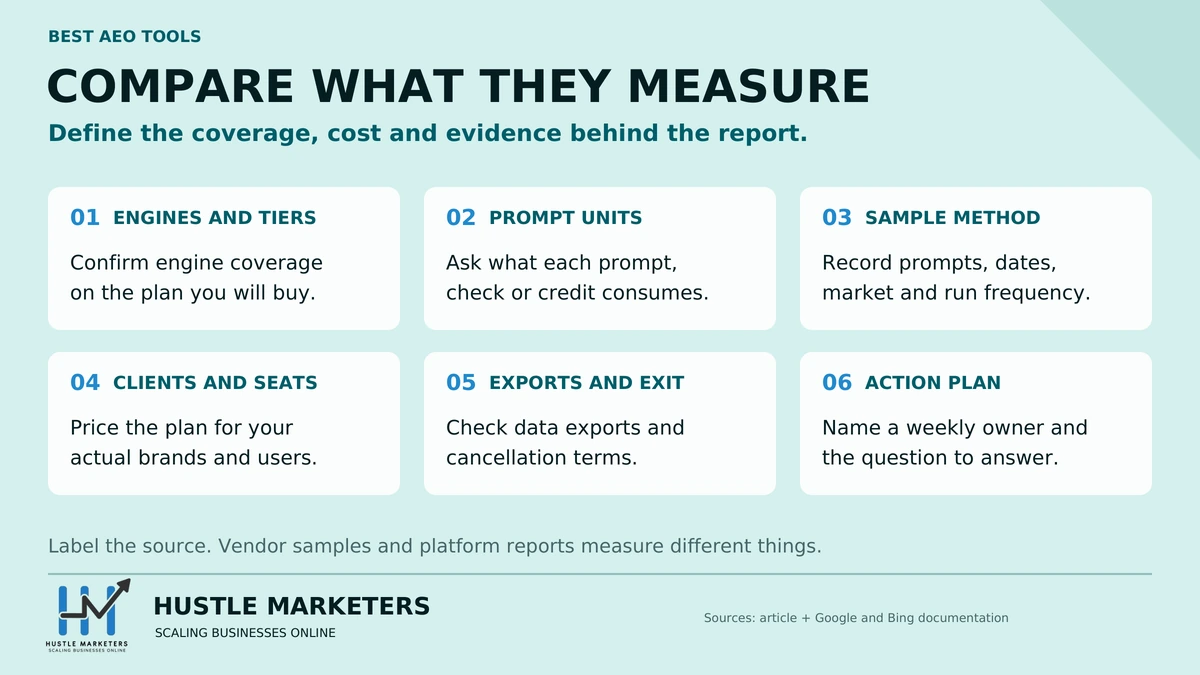
Five questions, none of which the competing lists answer, and all of which decide whether the tool is affordable across a client base rather than for one brand.
- What is the cost per client? Several vendors price per domain or per brand. A tool priced at 99 dollars per domain becomes 1,980 dollars a month across 20 clients, on the vendor’s own per domain terms. Ask for the per brand rate at your actual client count, in writing.
- How many seats are included, and what does an extra seat cost? Agencies need account managers, analysts and sometimes the client in the same dashboard.
- Is there white label or client facing reporting? If you cannot put a client’s logo on it, you will be rebuilding the report by hand every month.
- What is the contract minimum, and is the annual price locked for the term? Several vendors in this category have repriced within a year.
- What happens to your data on downgrade or cancellation? Can you export your prompt history and your citation log, and is there API access to your own data? Not one of the 15 lists covers data portability, and it is the question that hurts most when you want to leave.
Buyer reviews flag the same gap in this category: prompt grouping. In the G2 reviews we read on October 2, 2026, SE Ranking users asked for the ability to group prompts by market, intent, audience or campaign. If you run multiple clients or multiple markets, ask specifically whether prompts can be segmented, because flat prompt lists stop scaling fast.
One review on G2 for Conductor notes that credit costs add up quickly once you are running the full five engine set, which is the same warning in a different shape. Our agency SEO tools guide goes through seats, exit terms and cost at 5, 15 and 30 clients in more detail.
Can any AEO tool prove a business result?
We looked for a documented case where an AEO tool was shown to produce a measurable business outcome, and did not find one. That absence is a finding, not an oversight, and it is the thing we would want to know before spending 800 dollars a month.
What we did find is a recurring complaint that optimization scores and actual citations move independently. In an Indie Hackers discussion from April 2026 with 84 upvotes and 45 comments, the author describes building an AEO audit and reports that “ChatGPT still didn’t cite me”. The same author writes “Score went up. Citations didn’t.” One reader’s response puts the problem precisely: “The optimization layer and the citation layer are decoupled.”
There are also sourced doubts about the data underneath prompt volume figures. A January 2026 analysis by Fabian Jaeckert calls prompt search volume “pseudo-accuracy that is strategically massively prone to errors”. He concludes it is “currently not a reliable control variable”. The figures, he notes, rest on “clickstream data from browser plugins” measuring “a very small, non-representative section”.
On where that clickstream comes from, The Register reported in September 2025 on a Profound sales email claiming “access to 150+ million real user conversations” gathered through “clickstream data where a user has opted in”. The article quotes Lee Dryburgh raising the privacy question directly. We are reporting what was published, not endorsing the characterization.
And on reproducibility, an agency review of the category published in September 2026 cites a SparkToro experiment finding “less than 1% chance that ChatGPT and Google’s AI will give users the same list of brands in two separate answers”. If the same engine rarely repeats itself, a single visibility score is a snapshot of one sample, not a stable measurement.
None of this means the tools are worthless. It means you should buy one to answer a specific question, with a date by which you will decide whether it answered it.
The closest we have come is revenue tracking. Boostifai, which we use for AI visibility work, tracks organic conversions and sales alongside its AI metrics, so SEO and AI visibility work can be judged on revenue the way ads are judged on ROAS. It still needs the same date-bound test as above: decide what result you expect and by when.
Its AI Insight module covers the usual AEO metrics and goes further on sentiment than most tools here: a visibility score out of 100, a sentiment score for each of ChatGPT, Gemini, Claude and DeepSeek with the reasoning behind it, and an average across them. Check that model coverage against the engines that matter to you. Plans start at EUR 147 a month (checked 14 October 2026).
Who should not buy an AEO tool?
Four groups should not buy one yet, and together they are most of the people currently being sold a subscription. A paid tool will not help if any of the following is true of you.
- Anyone who has not set up the free first party data yet. If Bing Webmaster Tools AI Performance and the Search Console Generative AI report are not configured, you are paying for estimates while ignoring measurements.
- Anyone without the capacity to act weekly on what the tool reports. A dashboard nobody opens is the most expensive report in marketing.
- Anyone whose buyers are not using AI search to find their category yet. Check your own analytics for ChatGPT referrals first. If there are none and your category is not one people research conversationally, the spend is premature.
- Anyone buying it to prove AI visibility to a client without explaining the sampling. If you present vendor estimates as platform data, you will be asked a question you cannot answer. Our reporting integrity standard covers how we handle that.
How we handle this at Hustle Marketers
We sell no AEO tool and take no affiliate commission on anything named on this page. That is worth saying because nine of the 15 lists we read are published by companies selling a competing tool, and all nine rank their own product first.
Our approach with clients is to set up the free first party sources first, because they are the only numbers that come from the platforms themselves.
Bing Webmaster Tools gives citation share for Copilot and Bing. Search Console gives generative AI impressions. Analytics gives ChatGPT referral clicks. Those three cost nothing and come from the platforms themselves rather than from a vendor sample.
A paid tool comes in only where a client needs coverage of engines nobody reports on, mainly ChatGPT, Perplexity and Claude. That data gets labeled as sampled in every report. A vendor visibility score is never presented as though it were a platform measurement, and no share of voice figure goes into a report without a source behind it.
If you want the strategy side rather than the software, our generative engine optimization and AI SEO pages explain how we work. If you want to improve the underlying content, improving brand visibility in AI search and structured data are the practical starting points.
Frequently asked questions
What are AEO tools?
AEO tools track whether AI answer engines such as ChatGPT, Perplexity, Gemini, Claude and Google AI features mention or cite your brand. They work by running a set of prompts against those engines on a schedule and recording which brands and sources appear in the answers.
What is the difference between AEO tools and GEO tools?
In practice, nothing. Answer engine optimization and generative engine optimization are used interchangeably by vendors and by the lists that rank them. Some lists also fold in content optimization software and technical crawlers, which is one reason the lists disagree on which tools belong in the category.
Are there free AEO tools?
There are free tiers, and there is free first party data, and they are not the same thing. AthenaHQ publishes a free Essential tier with 25 USD of credit and 300 credits, and Profound offers a 7 day trial with 50 prompts. Separately, Bing Webmaster Tools, Google Search Console and your own analytics give you real platform data at no cost, which is where we would start.
How much do AEO tools cost?
Published entry prices ran from 17 dollars a month on annual billing up to 800 dollars a month when we checked vendor pricing pages on October 2, 2026. Five widely recommended tools, Profound, Peec AI, AirOps, Conductor and BrightEdge, publish no price at all.
Can any tool tell me my ranking inside ChatGPT?
Not from OpenAI. OpenAI publishes no brand visibility or ranking data and no API for it. Any ChatGPT ranking figure you see is a vendor’s own sample of prompt responses, or clickstream data bought from browser panels. The only official ChatGPT signal is the utm_source=chatgpt.com parameter on referral clicks, which appears in your analytics.
Does Google Search Console show AI Overviews separately from AI Mode?
No. The Generative AI performance report covers both together and reports impressions only, with no clicks, no click through rate, no position and no queries. Clicks and position for those features are counted into the Web search type of the main Performance report, where they cannot be isolated.
Does Google endorse any AEO tool?
No. Google’s guide to optimizing for generative AI features, updated July 10, 2026, tells readers to be wary of third party tools that promise ranking success or claim to use internal Google metrics.
Do I need special files or markup for AI search?
Google says no. Its AI optimization guide states that you do not need to create new machine readable files, AI text files, markup or Markdown, and that there is no requirement to break content into tiny pieces. Google frames optimizing for generative AI search as still being SEO.
Which AEO tool is best for agencies?
That depends on your client count more than on features, because several tools are priced per domain. Work out the cost per client at your actual client count, then check seats, white label reporting, the contract minimum and whether you can export your own data on cancellation. Those five answers will narrow the list faster than any feature comparison.
Why do different AEO tools give different numbers for the same brand?
Because each one is running its own sample. There is no shared source of truth to check against, so two tools asking different prompts, at different times, with different engine coverage, will produce different answers. An agency review published in September 2026 cites a SparkToro experiment putting the chance that ChatGPT and Google’s AI return the same brand list in two separate answers at under 1 percent.
Should I buy an AEO tool in 2026?
Buy one if you have already set up the free first party data, you have a specific question the free data cannot answer, and someone will act on the output weekly. If any of those three is missing, wait.
Sources, and how we researched this
What we did. Fifteen competing “best AEO tools” pages were read in full on October 2, 2026, with every tool named and every price claimed logged. Pricing was then verified against each vendor’s own page on the same day.
Platform documentation from Google and Microsoft came from the source rather than from secondary summaries. Practitioner commentary came from review sites, practitioner blogs and public forums.
What we did not do. We did not run a hands on test of these tools, and we have not bought them all to compare their outputs on a controlled prompt set.
Four of the 15 pages we read claim testing outright, and several more imply it in a title or an aside. None publishes a test method, a prompt set or results. We would rather tell you the limits of our method than pretend to a test we did not run.
Prices change. Every price on this page carries the date we read it. If you are reading this well after October 2026, check the vendor’s page before budgeting.
What we checked ourselves, and what we found while doing it
This guide is the output of a day of first party verification rather than a summary of other lists, so here is exactly what that involved and what broke along the way.
- We read 15 competing lists end to end and logged every tool named and every price claimed, which produced 55 distinct tool names and the contradiction table above.
- We then opened 18 vendor pricing pages directly. Five published no price. Several vendor URLs were wrong or dead on the day: one pricing page returned a server error, four returned 404 and one redirected to a different domain, so the figures in our table come from the pages that actually resolved, and we have said which did not.
- We found that one widely cited vendor publishes two different entry prices on two of its own comparison pages while showing no price on its actual pricing page, which is a useful warning about how firm any of these numbers are.
- We read the Google and Microsoft documentation directly rather than trusting secondary summaries, which is how we found that Bing publishes citation share free, something we did not see raised on any of the 15 lists.
In client work we set these free sources up first as a matter of routine, and we label sampled vendor data as sampled in every report we send. We are not publishing client visibility figures here, because a single agency’s results would not tell you anything reliable about how a tool will perform for you.
Primary sources
- Google Search Central, Generative AI performance report, support.google.com, read October 2, 2026.
- Google Search Central, impressions, position and clicks, support.google.com, read October 2, 2026.
- Google Search Central, AI features and your website, developers.google.com, read October 2, 2026.
- Google, guide to optimizing for generative AI features, developers.google.com, updated July 10, 2026, read October 2, 2026.
- Google, spam policies for web search, developers.google.com, updated August 28, 2026, read October 2, 2026.
- Google Search Central, Search generative AI control, support.google.com, read October 2, 2026.
- Microsoft Bing Webmaster Tools, AI Performance report public preview, announced February 10, 2026, blogs.bing.com, read October 2, 2026.
- Microsoft, Citation Share and related additions to AI Performance, June 16, 2026, blogs.bing.com, read October 2, 2026.
Commentary and review sources
- Fabian Jaeckert on prompt search volume, jaeckert-odaniel.com, January 5, 2026.
- The Register on Profound’s clickstream data sourcing, theregister.com, September 29, 2025.
- Indie Hackers discussion on AEO audits and citations, indiehackers.com, April 28, 2026.
- Position Digital on testing AI visibility tools, citing a SparkToro experiment, position.digital, updated September 16, 2026.
- G2 review pages for Peec AI, Semrush, Conductor, Scrunch AI and SE Ranking, g2.com, read October 2, 2026.
Vendor pricing pages
Pricing for Rankscale, Otterly.AI, Knowatoa, Nightwatch, Writesonic, Semrush, Trakkr, SE Ranking, Ahrefs, Scrunch AI, AthenaHQ, Goodie AI, Evertune, Profound, Peec AI, AirOps, Conductor and BrightEdge was read on each vendor’s own domain on October 2, 2026.
Related guides
- Answer engine optimization: the full guide
- AI visibility tools: verified prices and the accuracy problem
- AI SEO tools: verified prices and what the evidence shows
- AI Overviews trackers: what Google reports
- Google AI Overviews optimization
Want help deciding whether you need one of these at all?
We will look at your current AI visibility using the free first party sources, tell you what they already show, and say plainly whether a paid tool would add anything for your business. No tool resale, no affiliate links.