Search Engine Marketing Agency: What SEM Covers and What It Costs

Ishant
Published : October 10, 2026 at 10:30 am
Updated : October 7, 2026 at 6:19 am
Ishant
A search engine marketing agency manages your visibility in search results, through paid ads, organic SEO, or both. The scope depends entirely on which definition the agency uses, and the two definitions in current use are different services at different prices. Ask which one you are buying before you compare quotes.
Search engine marketing has a definition problem, and the problem costs money.
Hire an agency believing SEM means paid plus organic, when the agency means paid only, and you will spend three months wondering why nobody is writing content. Believe it means paid only when the agency means both, and you will wonder why half the retainer went on things that never show up in Google Ads.
Neither side is lying. The term carries both meanings in current use, and almost nobody states which one they mean before the contract is signed.
So this page starts by settling the definition, in public, with sources. Then it covers what the work involves and what six published sources say it costs.
After that come the operational details that decide whether the money works.
- Brand bidding against your own organic listing.
- Negative keyword governance, and the limits Google publishes on it.
- The search term to content workflow.
- What happens to your ads inside AI Overviews, where you cannot opt out and cannot report separately.
- How to measure paid and organic together without counting the same conversion twice.
On this page
Eighteen sections. The definition and the cost come first, then the operational detail that decides whether the spend works, then what to ask before you sign.
Is SEM the same as PPC, or does it include SEO?
Both, depending on who is writing, and the industry has not settled it. Search engine marketing originally covered paid and organic search together. Most of the trade press now uses it to mean paid search only. Both usages are current, which is why the term has to be defined before it can be bought.
Where did the disagreement come from?
From 2001, and two sources independently name the same origin. Bruce Clay’s explainer on SEM, published March 27, 2021 and last modified August 21, 2023, records it this way: “When Danny Sullivan spoke about SEM back in 2001, he used it as a catch-all to describe all efforts that encouraged website traffic from search engine results pages, including paid and organic search initiatives.”
Search Engine Journal dates the shift to the same point. In its piece defining SEM, SEO and PPC, Sam Hollingsworth wrote on May 16, 2024: “Once upon a time, in the halcyon days of the early internet (that is, circa 2001), SEO referred to a part of SEM. But, as the language and nuance of web marketing shifted, search engine marketing came to refer to a specific type of digital marketing.”
So the umbrella meaning is the original one, and the paid only meaning is the drift. Neither side is misusing the term. They are using it from different points in its history.
Which sources say which?
We checked five publishers and one major buyer platform. They split three ways, and the split is real rather than a matter of loose wording.
| Source | Position | In their own words |
|---|---|---|
| Search Engine Land, guide to pay per click marketing | SEM includes SEO | “SEM is an umbrella term that encompasses PPC but is not limited to only this form of advertising.” And: “SEM is both paid and unpaid, PPC, or organic traffic (SEO).” |
| TechTarget, Tim Murphy, March 24, 2025 | SEM includes SEO, but usage has drifted | “SEM is an umbrella term for any strategy organizations use to increase their search engine visibility.” And: “While SEM includes SEO, people typically use the term in reference to paid advertising.” |
| Bruce Clay, March 27, 2021, modified August 21, 2023 | SEM excludes SEO | “The short answer is no. SEM and SEO are now two different roles.” Definition given: “a digital marketing strategy that utilizes paid advertisements to increase a business’s visibility in search engine results pages (SERPs).” |
| Search Engine Journal, Sam Hollingsworth, May 16, 2024 | SEM excludes SEO | “The bottom line is this: SEO is not a component of SEM.” |
| Optimizely optimization glossary | SEM excludes SEO | “it now refers almost exclusively to paid search advertising.” Also: “Search engine marketing is also alternately referred to as paid search or pay per click (PPC).” |
| G2 category taxonomy | Files paid under SEM | The PPC services breadcrumb reads “Inbound Marketing Services > Search Engine Marketing (SEM) Agencies > PPC Agencies”, so a major buyer platform treats PPC as a subset of SEM |
Sources read and quotes checked at source on September 29, 2026. Optimizely’s glossary entry and the Search Engine Land guide do not display author names or dates, so none are claimed for them. Full citations: Search Engine Land, TechTarget, Bruce Clay, Search Engine Journal, Optimizely.
Which definition does this page use, and why does it matter to your invoice?
We use the umbrella definition. On this page, and in the service it describes, search engine marketing means organic search and paid search planned, run and measured as one channel, because the two share the same query data, compete for the same result page, and cannibalize each other when nobody is looking. Our technical SEO agency page covers the technical side of that organic work.
We state it in public rather than in a proposal because the definition is the scope, and the scope is the price. An agency selling SEM as paid only and an agency selling SEM as paid plus organic are selling two different things at two different costs. A buyer comparing those quotes side by side is comparing nothing at all.
So if you are collecting quotes right now, ask each agency which definition it uses. The answer changes every number that follows.
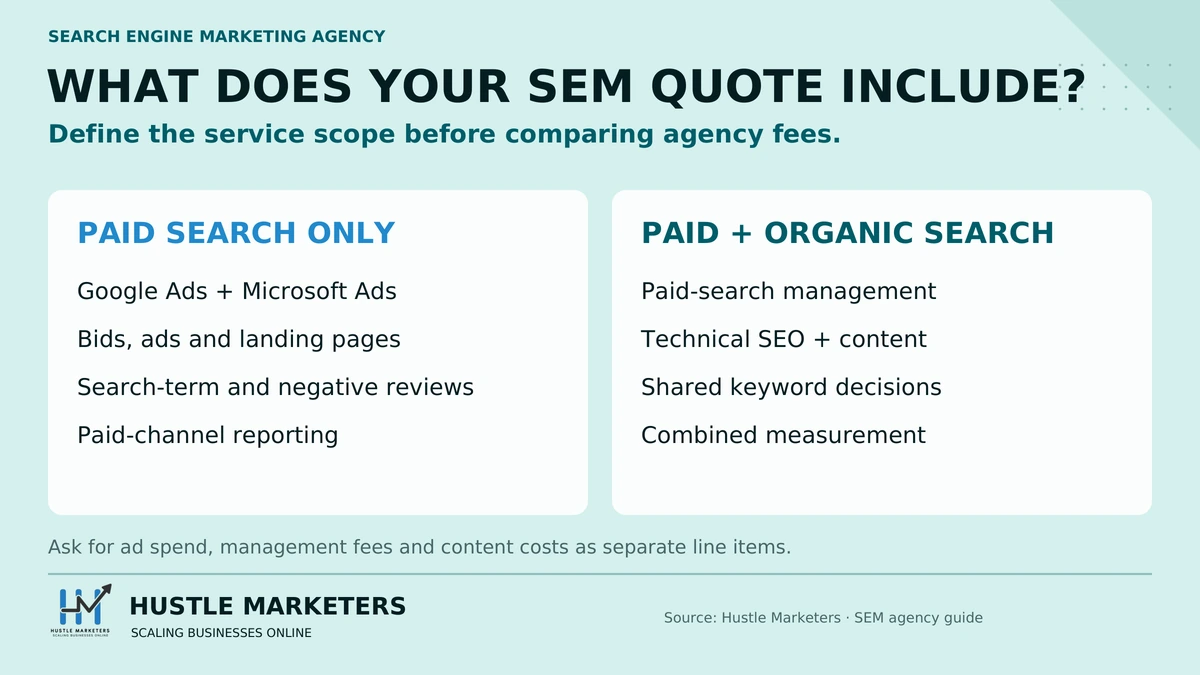
| Question | SEM as paid only | SEM as paid plus organic (what we mean) |
|---|---|---|
| What gets managed | Google Ads, Microsoft Ads, Shopping, Performance Max | All of that, plus technical SEO, content and internal linking |
| Who owns keyword research | Paid team, for bidding | One shared list, split by whether paid or organic should own each term |
| Who sees the search terms report | Paid team only | Shared, because it is the cheapest content research there is |
| What happens to a term you rank first for | Usually still bid on | Deliberate decision, documented, revisited quarterly |
| Typical reporting | Platform metrics: impressions, clicks, CPC, conversions, ROAS | Blended: total non brand search revenue and cost across both |
| Where it fails | Paid keeps paying for demand organic already captures | Slower to show movement, because organic is slower |
If you want the two halves separately rather than combined, we sell them separately: PPC agency services and SEO agency services. This page is for the case where you want them run as one thing by one team.
What does a search engine marketing agency actually do?
Under the umbrella definition, the work splits into five jobs. Paid only agencies do the first three.
Job one: decide which queries are worth buying and which are worth earning
Every commercial query has two possible routes: pay for the click today, or build the page and earn it over months. Most accounts never make that decision explicitly. They build a keyword list for Google Ads, build a separate keyword list for SEO, and discover eighteen months later that both lists contain the same forty terms and the paid budget has been subsidizing pages that already rank.
The decision rule we use is boring and it works.
- Paid owns the query when it converts, when intent is immediate, when we are not in the top three organically, or when we need data fast.
- Organic owns it when volume is high but intent is early, when the CPC is out of proportion to the value, or when we already rank and a paid click buys a visit we would get anyway.
- Both only when we can state why. Usually that means a competitor is bidding on the term and the paid listing is defending position rather than buying traffic.
Our method for the paid side is in the Google Ads keyword research guide, and the terms with volume that almost never deserve a bid are covered in the most searched keywords analysis.
Job two: build the account structure the keyword decisions imply
Structure follows the decision, not the other way round. We split campaigns where budgets need protecting from each other, not where it looks tidy in a screenshot.
- Brand gets its own campaign, so its cheap conversions do not flatter the numbers on everything else.
- Non brand high intent gets its own campaign, so it never loses budget to broad research terms.
- Shopping and Performance Max each get their own container, because their reporting and their negative keyword behavior both differ from Search.
The bidding decisions that sit on top of that structure changed in 2026, and the detail is in the bidding strategies guide. Whether a campaign is genuinely constrained or just reporting a status is covered in limited by budget.
Job three: control what you are not paying for
This is the part that separates an account that improves from an account that merely spends. It has its own section further down, because the mechanics have limits that are easy to miss.
Job four: turn the query data into pages
A search terms report is a list of things real buyers typed, with a cost attached to each one. It is the best content brief generator available and most agencies throw it away every month. The workflow is below.
Job five: make the two halves measurable in one place
Paid reports in Google Ads, organic reports in Search Console and analytics, and the two systems count differently. Without a blended view you can improve both channels and still not know whether the account got better. The measurement section covers what we do about that and what we refuse to do, which is set out in full in our reporting integrity standard.
Does running Google Ads help your organic rankings?
No. Google states it plainly: “Advertising on Google has no impact on your organic or natural ranking in the search results; the two are completely separate.”
That sentence sits in Google’s advertiser guide to working with third parties, on the same page where it warns advertisers what to watch out for.
We are putting that near the top of a page selling combined SEO and paid search, because the opposite claim is one of the most common things said in this category and it is not true. Paying for ads does not lift your rankings. Pausing ads does not drop them. Anyone telling you otherwise is either mistaken or counting on you not to check.
The same page also closes off the reverse version of the myth: “Third parties can’t remove your business from the natural or organic search results on Google.com.”
So why run them together at all?
For three reasons that have nothing to do with a ranking boost.
- Shared query data. The search terms report is a list of things buyers actually typed, with a cost and a conversion rate attached. That is the best content research input available, and it comes from the paid side. Organic keyword tools estimate. The search terms report records.
- Avoided overlap. When two teams work separately, nobody notices that the paid budget is buying clicks on terms where the site already ranks first. One team notices, because it is looking at both.
- Blended measurement. A combined view of total search revenue against total search cost answers the question the business is actually asking. Two separate channel reports do not.
That is the honest case for combining them. It is about efficiency and measurement, not a ranking mechanism. If an agency tells you the two channels lift each other, ask which of those three effects they mean.
What does a search engine marketing agency cost?
Percentage of ad spend runs from 5 percent to 20 percent across the five sources we checked, and flat fees from $500 to $10,000 a month once the flat part of hybrid retainers is counted, the widest figures coming from the Google Ads Help Community and Search Engine Journal. No two sources agree. The table below gives every figure with its author, its date and a link.
| Published figure | Model | Source (all read September 29, 2026) | Date shown |
|---|---|---|---|
| “between 5% and 15%” | Percentage of ad spend | Navah Hopkins, Product Liaison at Microsoft, in Search Engine Journal | April 26, 2025 |
| “Typically 10-20% of your monthly budget” | Percentage of ad spend | Aric Whiteley, Co-founder and Managing Director, Lockhern Digital, in Search Engine Land | None shown |
| “typically around 8-10% of the total spending” | Percentage of ad spend | Silver Product Expert, Google Ads Help Community | March 28, 2024 |
| “the typical ad agency is paid 10-20% of the ad spend” | Percentage of ad spend | Diamond Product Expert, Google Ads Help Community | February 4, 2020 |
| “a ‘retainer’ for services and then charge a percentage of spend (running 10-15%)” | Retainer plus percentage | WebmasterWorld | August 18, 2025 |
| “$500 to $2,500 per month” | Flat part of a hybrid fee, plus a percentage | Navah Hopkins, Search Engine Journal | April 26, 2025 |
| “$2,500 to $10,000 per month” | Flat rate | Navah Hopkins, Search Engine Journal | April 26, 2025 |
The Search Engine Land article displays no publication date, so we cite the author and his role and claim no date for it. Google Ads Help Community threads are linked in the table and were read on September 29, 2026.
Why do the published ranges disagree, and which one applies to you?
Because percentage of spend is not one model, it is a sliding scale that tracks account size, and no source says which end of the market it is describing. The forum’s founder gave the most honest version of the answer on WebmasterWorld: “It varies wildly. Some charge by the hour of work, and others have a flat fee.”
The useful move is to stop comparing percentages and convert each quote into a monthly fee, then ask whether that fee buys enough hours. Fifteen percent of $2,000 is $300 a month, and nobody manages an account properly for $300 a month.
Which is why the Search Engine Journal column is blunt about the floor: “Budgets under $2,500/month: Consider managing PPC in-house…”
That is the most useful sentence in any of the five sources and it is advice against buying the service. Our own position is the same, and there is a middle option a Diamond Product Expert named in a Help Community thread on whether to hire a manager: “A one-off optimisation could be all you need, rather than ongoing management.” Below the floor, that is usually the right purchase.
The same expert offered a pricing heuristic worth quoting because it is memorably cynical and roughly matches what we see: “cheap – you get what you pay for / mid – works out best / expensive – you pay for a lot of talk but get the same results.”
Channel by channel costs beyond search management, including what different budget levels actually buy, are collected in our advertising costs breakdown. Indian market pricing specifically is in the India agency guide.
How much of your budget actually reaches the auction?
Less than the number on your invoice, and the gap depends entirely on the billing model. This is the question buyers ask most often and get answered least. We found it asked on WebmasterWorld in March 2025 in these words: “With a budget of, say, 10k : After pay taxes + agency charges me for the service (on average). How much of that initial 10k really left for ads?” The first substantive reply came five months later.
Here is the arithmetic, which nobody in this category publishes. The three models produce very different media budgets from the same total spend.
| Model | What you pay in total | What reaches the auction | Where the rest goes | Basis |
|---|---|---|---|---|
| Flat fee, you pay Google direct | $10,000 media plus $1,500 fee | $10,000 | Fee is separate and visible | Example fee, for illustration |
| Percentage of spend at 12%, fee on top | $10,000 media plus $1,200 fee | $10,000 | Fee is separate and visible | Arithmetic on a 12% fee |
| Percentage of spend at 12%, all in | $10,000 total | About $8,929 | About $1,071 fee, deducted from the same pot | Arithmetic on a 12% fee |
| All in with tax on the fee | $10,000 total | About $8,741 | About $1,049 fee plus about $210 tax on the fee | Worked split posted on WebmasterWorld, December 24, 2025 |
| Agency bills you for clicks | $10,000 to the agency | Unknown to you | Not verifiable without account access | See Google transparency requirements |
The last row of arithmetic comes from a WebmasterWorld member’s worked split, posted December 24, 2025: “from 10,000 all-in, with a 12% fee and 20% VAT on the fee, you’re left with about 8,741 for media, 1,049 as the fee, and 210 VAT”. We checked it and it balances. Tax treatment varies by country, so read that row as a shape rather than your numbers.
The point of the table is not the percentages, it is the last row. If an agency bills you for ad clicks rather than Google billing you, you cannot verify the split at all. That is why Google’s transparency requirements oblige a third party to “report the exact amount charged by Google, exclusive of any fees that you charge.” Two numbers, separately. If you are only ever shown one, ask for the other.
You can sanity check what a media budget should buy with our budget calculator, and work backwards from a target cost per acquisition with the CPA calculator.
What is the minimum budget where an agency makes sense?
Nobody publishes a real answer, so here is ours with the reasoning shown. Asked directly in the Google Ads Help Community what the monthly minimum should be, a Diamond Product Expert replied: “No idea. Google Ads is an auction based advertising system that is highly adaptive to most any budget.” He is right that the auction has no minimum. That does not answer whether paying a manager is worth it.
Two published numbers are useful. Search Engine Journal’s guidance, quoted earlier, is “Budgets under $2,500/month: Consider managing PPC in-house…”
Google itself uses a small advertiser threshold in its transparency requirements: “If 80% or more of your customers spend less than $1,000 USD (or local currency equivalent) per month on Google Ads or AdWords Express, you’re required to share that disclosure notice with all customers.”
That second figure is a compliance threshold, not advice, and no source we found connects the two. The connection is still informative. Google treats sub $1,000 monthly advertisers as a category needing extra protection, and the trade press puts the in-house line at $2,500.
Between those two numbers is where agency management starts to pay for itself. Below $1,000 a month it almost never does, and a Diamond Product Expert names the honest alternative for that range: “A one-off optimisation could be all you need, rather than ongoing management.”
Why does paying an agency a percentage of your ad spend create a problem?
Not for the reason the industry usually gives. The common claim is that percentage pricing pushes agencies to inflate your budget. We went looking for practitioners actually complaining about that and found none. The complaint people do make is the opposite one: percentage pricing pays an agency the same whether or not it does the work.
No need to be fraudulent when they can make money from not putting much work in.
Diamond Product Expert, Google Ads Help Community, January 17, 2023
That is from a thread started by an advertiser trying to verify his agency’s spend, who had reached this point: “I spent $35K with them collectively, to gain 4 registered users and no sales.” The fee had been earned regardless.
The trade press version of the critique is closer to the inflation argument. In Search Engine Journal, Navah Hopkins, Product Liaison at Microsoft, wrote: “If an agency makes more money simply because you’re spending more on ads, there’s less incentive for them to optimize your budget efficiently.” Note the actual claim there is reduced incentive to optimize, not active inflation. That is the same point the community makes, phrased more carefully than the version you usually hear.
Is there a case for percentage pricing?
Yes, and it is worth stating because we do not use the model. A Diamond Product Expert made the argument in a thread on management fees, comparing percentage of spend with percentage of revenue: ad spend is “far easier to determine and not something the business or you can fudge”, whereas with revenue share “Many businesses do not reveal this type of specifics to the ad agency.”
So percentage of spend is auditable in a way that revenue share is not. That is a real advantage. It is just not an advantage to you rather than to the agency, and a flat fee against a written scope is auditable too.
What about performance based pricing?
The Search Engine Journal column flags the catch, which buyers often miss because performance pricing sounds like the fix: it “often means the agency retains account ownership.” If the agency owns the account, leaving means starting from zero on conversion history, audiences and learning periods. The ownership section below covers why that is close to irreversible.
So what do we charge?
A flat monthly fee set against a defined scope, reviewed when the scope changes rather than when the spend changes. If the budget doubles and the work genuinely doubles, the fee should move, and we will say so and explain what changed. If the budget doubles and the work does not, it should not. For the organic side priced on its own, see our SEO packages.
The ad account stays in your name and your billing, always. We work inside it with access, we do not own it. If you leave, you keep every conversion action, every audience and every historical row, and you do not need our permission for any of it. The same applies to the white label PPC and white label SEO arrangements we run for other agencies.
We are not publishing a price on this page, and it would be dishonest to pretend that is because prices vary. It is because scope varies, and a number without a scope beside it is a lead magnet rather than a price. What we will do is send a scoped fixed fee in writing after a call, before any work starts.
What are the warning signs when you are comparing agencies?
The Search Engine Land guide publishes four, and we quote all four because they are good ones and because two of them describe things we have had to fix in accounts we inherited.
- “Guaranteed results: No agency can guarantee specific PPC results.”
- “Lack of transparency: You should have access to your ad accounts and full visibility into performance.”
- “Cookie-cutter strategies: Every business is unique. Beware of agencies that use the same approach for all clients.”
- “No focus on tracking: They aren’t serious about results if they don’t emphasize accurate tracking and reporting.”
The same source frames the access question as two questions worth asking out loud in a sales call: “Do they provide full access to the ad accounts, or do they keep you in the dark?” and “Can you see your ad performance whenever you like?”
We would add a fifth. Ask whether any result they show you has a date range attached to it. A percentage increase with no start date, no end date and no baseline is not evidence.
What is your agency required to tell you about your ad spend?
More than most clients realize, and more than most agencies volunteer. Google publishes binding rules for third parties who buy and manage ads on someone else’s behalf. Here is what those rules actually say, quoted from Google.
Start with your basic entitlement. The advertiser guide states: “At a minimum, you have the right to know the number of clicks, impressions, and the total cost of your Google ads.”
A report has to contain more than that. The transparency requirements say a third party must “report the exact amount charged by Google, exclusive of any fees that you charge” and that “you must include data on costs, clicks, and impressions at the Google advertising account level.”
Fees are covered too. The same page requires third parties to “inform new customers in writing before each first purchase and disclose the fee on all customer invoices.” Disclosure is an obligation, not a courtesy.
Your account identifier is also yours to ask for: “Google requires that you provide your customers with the customer IDs for their Google Ads or AdWords Express accounts when requested.” A refusal is against Google’s stated requirements.
Even the delivery method is specified. Third parties must “Share your Google advertising cost and performance reports in a way that makes it easy for your customers to access the reports, such as by email or via your website.”
| What Google requires | Where it is published | How to check it in one minute |
|---|---|---|
| Clicks, impressions and total cost, at minimum | Advertiser guide to third parties | Ask for last month’s figures for all three. Compare to the invoice. |
| The exact amount Google charged, separate from agency fees | Transparency requirements | Ask what Google charged and what the agency charged, as two numbers. |
| Cost, clicks and impressions at Google account level | Transparency requirements | Ask for the report at account level, not a dashboard summary. |
| Fee disclosed in writing before the first purchase, and on every invoice | Transparency requirements | Look at your invoice. Is the management fee itemized? |
| Your customer ID on request | Transparency requirements | Ask for it. A refusal is the answer. |
| A separate Google Ads account for each end advertiser | Google third-party policies | Ask whether your campaigns sit in an account of your own. |
What about the “we cannot share that, it is a shared account” answer?
That answer describes a policy violation. Google’s third-party policies state: “Google requires that you use a separate account for each end-advertiser that you manage.”
The same page gives a performance reason as well as an administrative one. Pooling advertisers “can result in Quality Scores that inaccurately represent any one advertiser’s performance”, and “This may also restrict ad delivery within auctions.”
So if you have been told your data cannot be separated because your campaigns live in a pooled account with other clients, two things are true at once. Your reporting is being limited, and the structure causing it is not permitted. The advertiser guide puts the requirement in the plainest terms: “The third party agency must set up a separate Ads account for you to represent you fairly.”
Which promises should make you walk away?
Google names two directly. On positions, the advertiser guide states: “It’s not possible to guarantee a specific ad position on Google.com search results pages.” On budgets, it lists this risk: “Deceptive pricing: The agency may not use the correct advertising budget as agreed with you. Make sure that you get an official copy of your agreement in writing.”
Anyone guaranteeing you a specific ad position is promising something Google says cannot be promised. That is not aggressive sales, it is a claim about a system that does not work that way.
Who owns your ad account, and what happens if you leave?
Whoever accepted the Google Ads terms of service owns the account, and it is not necessarily the person paying the bills. This is the most expensive thing on this page to get wrong, because unlike a bad campaign it usually cannot be undone.
The clearest illustration we found sits in the official Google Ads Help Community. An advertiser writes: “We pay for the ad spending but they don’t give access.”
Another member suggested that paying Google directly would settle it. The advertiser replied: “We don’t pay the agency for the Google Ads spending part. We pay directly to Google.” He was still locked out.
A Diamond Product Expert states the test in a separate thread on establishing ownership: “The owner of the account is the entity who/which accepted Google TOS (clicked I agree).”
He then separates the two roles: “Google sees that user who accepted the TOS as the owner and the ‘paying profile’ on the account as a separate entity.”
Two things follow from that. Paying Google directly does not make the account yours. And once it is not yours, the community verdict on recovery is blunt.
In the first thread, a Diamond Product Expert wrote: “There isn’t much you can do if they won’t give you access.” In a third thread about an agency refusing to hand over, a Platinum Product Expert put it as: “but if the agency run ads for the client from their own account. .then you cannot take it..”
What does the correct setup look like?
One rule, stated in a Help Community thread on agencies withholding access by a Diamond Product Expert: “Always create the account yourself, then permit the agency to access it via their MCC (manager’s account), so you can revoke their access (not the other way round).”
The same reply extends it past Google Ads, which is the part almost nobody covers: “Also ensure that Google Analytics, Tag Manager and any other tools used, are not in the agency’s ownership.” Losing the ad account is bad. Losing the ad account plus the analytics property plus the tag container plus the conversion actions is a rebuild.
This is how we work and we will put it in writing before starting. You create the accounts, you hold billing, you stay the owner, and we get access through our manager account which you can revoke without asking us. It applies to Google Ads, Microsoft Advertising, Analytics, Tag Manager and Search Console.
What should you do before you switch agencies?
- Log in to Google Ads yourself, today, before any conversation about leaving. Confirm you can sign in without going through the agency.
- Check your access level. Look for admin, not read only, and check whether your own email is listed.
- Ask for your customer ID in writing. Google requires it be provided on request.
- Check Analytics, Tag Manager and Search Console ownership separately. Each one is its own account.
- Export what you need before notice is given: search terms for the last twelve months, conversion action settings, audience definitions and the full change history.
- Confirm billing is in your name and paid to Google, not reimbursed to the agency.
If any of those checks fails, find out now rather than during a handover. A dashboard is not access. A client in the thread above discovered exactly this: “They gave the client access to a proprietary dashboard with limited reports, but the client didn’t realize they weren’t actually accessing their Google account.”
Should you bid on your own brand name if you already rank first for it?
This is the most common place where running SEO and paid as separate teams quietly wastes money.
When the two channels report separately, brand search looks excellent in both. Paid shows a low cost per acquisition, because people searching your name convert. Organic shows high rankings and traffic. Neither report shows that some of the paid spend bought clicks that were already yours.
The most obvious waste is paying for clicks on terms you already rank for organically. If your page already holds position one, test whether the paid click adds anything before you keep funding it.
Running SEO and PPC side by side is not the same as having one search strategy. Without a shared view of brand terms, the two channels can end up paying for each other’s clicks.
When is bidding on your own brand worth it anyway?
Note the wording in the quote. A reasonable argument for not bidding, not a rule against it. The honest answer is that it depends on what else is on the result page, and the only way to know is to look at your own result page for your own brand name, today, logged out.
| What you see on your brand search | What it means | What we would do |
|---|---|---|
| Your organic listing first, no competitor ads | Nobody is taking the click | Reduce or pause brand bidding, then watch for competitors moving in |
| Competitor ads above your organic listing | The click is contested and you are second visually | Keep bidding, and treat the cost as defense rather than acquisition |
| Your own ad above your own organic listing, nothing else | You are likely paying for a click you would get free | Test pausing, measure total brand sessions rather than paid conversions |
| Affiliate or reseller ads on your brand name | Someone is arbitraging your own demand | Check your affiliate terms first, then bid |
| An AI Overview occupying most of the screen | Your organic position matters less than it used to | See the AI Overviews section below, because the reporting changes |
The point is not the answer, it is that the decision gets made deliberately, written down, and looked at again each quarter. In most accounts we inherit, nobody ever made it. Brand bidding was switched on during setup years ago and has been renewing itself ever since because its cost per acquisition looks good in isolation.
What do practitioners actually say about it?
Both sides, with specifics. The argument against is not mainly about the click cost, it is about what brand conversions do to your reporting. An advertiser in the Google Ads Help Community put it precisely: “I know own-brand searches are quite cheap, but they make the campaigns look like they are performing a lot better than they actually are.” His preference was simple: “i prefer them getting the organic hit instead.”
That is the sharpest version of the problem. Brand terms convert because the person already decided. Mixing them into a non brand campaign makes the whole campaign look efficient and hides whether the money spent on acquisition is working. Separating brand into its own campaign is not tidiness, it is the only way the other numbers mean anything.
The argument for is about competitors, and it comes with economics. In a thread from an advertiser being outranked on his own brand name, the opening complaint was: “Its costing hundreds of dollars and we’re still appearing below them.”
A Diamond Product Expert answered with both the tactic and its crudeness: “The usual response is to bid high enough to be in #1 and hope they go away.” He also gave the reason it usually works. A competitor bidding on your brand “would commonly pay 10x more per click than you, due to the substantially worse quality score.”
That asymmetry is the real case for defensive brand bidding. You are cheap on your own name and they are expensive on it, so holding the position is affordable for you and painful for them. The same expert notes the starting position though: “Google is fine with competitors bidding on your brand.”
Does a trademark complaint work?
Sometimes, and inconsistently. The advertiser in that thread reported both outcomes: “I filed a trademark dispute yesterday and Google has already responded … I had filed a complaint about the same ad back in May that went nowhere.” Worth filing, not worth relying on as the only defense. Bidding is the control you hold; the complaint is the one you request.
Balance worth keeping in view. In a thread asking whether paid was cannibalizing organic, a Product Expert Alumni defined the term as “paid search ads taking away existing revenue from organic”, then added: “There are plenty of scenarios where paid and organic work great together.” Which situation you are in is answerable with your own data, not with a rule.
How do you test it without risking the revenue?
Do not switch brand campaigns off and watch the paid conversions disappear, because they will, and that proves nothing. The question is whether total brand demand moved, not whether paid captured it. Run it as a proper experiment with a holdout, measure total sessions and total revenue from brand queries across both channels, and give it long enough to clear the noise. The mechanics of splitting traffic properly are in the Google Ads experiments guide.
How do you stop paying for searches you never wanted?
With negative keywords managed at account level first, campaign level second, and reviewed on a schedule rather than when someone notices a bad month.
Account level matters more than it used to, for a mechanical reason. Google’s documentation on account level negative keywords states they “enable you to exclude search terms from campaigns serving on search and shopping inventory” and that “These include all search and shopping inventory in Search, Performance Max, App, Shopping, Smart, and Local campaigns.”
Performance Max is the key word there. An advertiser in the Google Ads Help Community ran into it directly: “I use a Performance Max-campaign, and from what i understand, i cannot enter negative keywords on a campaign level on those.” That limit has since gone: Google now lets you add negative keywords to a specific Performance Max campaign. Account level is still the one list that reaches every campaign type at once.
What are the limits nobody mentions?
| Limit or behavior | What Google publishes | What it means for you |
|---|---|---|
| Account level cap | “A limit of 1,000 negative keywords can be excluded for each account.” | Account level is a governance layer for broad waste themes, not a dumping ground |
| Match types available | “You can select the specified match type between broad, phrase, or exact match types.” | Use phrase and exact for anything near your money terms |
| Close variants | “Negative keywords won’t match to close variants or other expansions.” | Plurals, misspellings and variants each need their own entry |
| The plural trap | Negative broad match “-house” blocks “red house” but “it could serve on ‘blue houses'” | Add singular and plural separately, every time |
| Long queries | “Your ad might still show when someone searches for a phrase that’s longer than 16 words, and your negative keyword follows that 16th word.” | Very long queries can slip past a correct negative |
| Content keywords are separate | “Excluded content keywords apply to all campaigns running on YouTube or Display Networks.” | A different mechanism with its own 1,000 cap. Do not confuse the two |
The plural example is Google’s own, from its page on fixing negative keyword issues: “This means an ad wouldn’t be eligible to serve on ‘red house’ but it could serve on ‘blue houses’.” The close variant line and the 1,000 cap are from the account level negative keywords documentation.
That third row is the most commonly held wrong belief in paid search. Positive keywords expand to close variants. Negative keywords do not. An account that blocks “free” and assumes it has also blocked “for free” and “freebie” is still paying for two of the three.
What is the risk of getting account level negatives wrong?
Bigger than at campaign level, because the block applies everywhere at once. The clearest cautionary case we found is the thread above, where an advertiser added his own brand name as an account level negative to stop paying for brand clicks, then reported: “However, since then all conversions have dropped to 0.”
A Diamond Product Expert explained the mechanism with a worked example worth repeating: “if I blocked ‘sophie’s dog grooming’, then I could be stopping anything for dog and/or grooming coming through, such as ‘dog grooming’ or ‘dog grooming near me’.”
Treat that as a warning rather than the rule. Google’s own documentation says a negative broad match keyword blocks a search only when the search contains all of its words, in any order. The real damage comes from a one word brand name, or a brand made of everyday words, added as a broad negative at account level, where it blocks every search containing those words.
The same reply flags a second order effect almost nobody warns about: “You have also ‘turned off the tap’ for Conversion data, so you may also need to amend your Bid Strategy.” Over blocking does not just cost traffic. It starves the bidding model of the conversion data it needs, and the damage outlasts the fix.
So the practical rule is narrow. Use phrase or exact match for brand terms at account level, never broad, and check the search terms report before and after every account level addition.
Our full method, including the match type traps and a starter list, is in the negative keywords guide, and the keyword wrapper tool will format a list into the match types before you paste it in.
How do you turn search terms into SEO content?
By reading the search terms report as a research document rather than a cleanup queue. Most accounts open it once a month, add some negatives, and close it. The same report is a record of the exact words buyers used, with cost and conversion data attached, which is more than any keyword tool can tell you.
Google’s documentation describes the distinction precisely: “A search term is a word or set of words a person enters when searching on Google or one of our Search Network sites. A keyword is a word or set of words that Google Ads advertisers can add to a given ad group so that your ads are targeting the right audience.” One is what people did. The other is what you guessed.
What does the workflow look like month to month?
- Pull the search terms report for the last 30 days, with cost, clicks, conversions and conversion value.
- Sort by cost with zero conversions. These are your negative keyword candidates, handled as above.
- Sort by conversions. Any term converting well that is not an exact match keyword gets promoted.
- Now the part most accounts skip. Filter for question shaped and research shaped terms: how, what, why, best, vs, near me, cost, alternative. These rarely convert on a paid click and are usually negatived away.
- Those terms are your content briefs. A question that costs you money in paid because the intent is too early is exactly the question an organic page should answer.
- Map each one to a page: a new article, a new H2 on an existing page, or an FAQ entry. Write it down so the same term does not generate a second brief next month.
- Six months later, check whether the organic page ranks. If it does, revisit whether you still need to bid on the paid version.
Step five is the whole point of running the two channels together, and it is only possible if the same team sees both. Step seven closes the loop back to the brand bidding decision above.
Why does the report not show every search term?
Because Google withholds low volume terms. The documentation states the report contains “data on the search terms that were used by a significant number of people” and that “Some search terms that don’t have enough query activity are omitted from the search terms report in order to keep with our standards on data privacy.”
So the report is a sample, not a census, and the gap is largest exactly where long tail content opportunities live. Treat it as the highest quality input you have rather than the complete picture, and pair it with Search Console query data for the organic side.
One practical note from the same page: “you can’t add keywords or negative keywords directly from the report” in the keyword view, so plan on exporting rather than working inline.
Can you see how your ads performed inside AI Overviews?
No, and Google says so directly. There is no segmented reporting for ads shown inside AI Overviews, you cannot opt out of appearing there, and you cannot target the placement. Any agency offering you AI Overview ad reporting is offering something that does not exist.
Every statement below is quoted from Google’s own page about ads and AI Overviews.
| Question | What Google publishes |
|---|---|
| Which of my ads can appear there? | “Text and Shopping ads from existing Search, Shopping and Performance Max campaigns are eligible to show within the AI Overviews.” |
| Where can they appear? | “Ads are eligible to show above or below the AI Overview in all 200+ markets where AI Overviews are available.” |
| Can I opt out? | “No, you can’t opt out of serving ads in AI Overviews.” |
| Can I target the placement? | “No, you can’t directly target ad placements in the AI Overviews.” |
| Can I report on it separately? | “Google Ads currently doesn’t offer segmented reporting when ads show within Search AI Overviews.” |
| Where does the spend appear then? | “Yes, ads in AI Overviews are reported as Top Ads.” |
| Is that going to change? | “Google is still learning and actively thinking about what the future of reporting looks like for this experience and will announce when there is more to share.” |
Why does this change how you manage negative keywords?
Because of one sentence on that page that connects to everything in the negatives section above. Google states: “This is why Google requires AI-powered targeting solutions like broad match on Search or the keywordless targeting technology available through AI Max for Search campaigns, Performance Max campaigns, Shopping campaigns, or Dynamic Search Ads, to match relevant ads.”
Read that alongside the fact that you cannot opt out of the placement. To be eligible for a surface you cannot decline, you are pushed toward match types that deliberately reach queries you did not choose. And you cannot see which spend went to that surface, because it reports as Top Ads.
That combination is why negative keyword governance stops being hygiene and becomes the main control you have left. When you cannot pick the placement and cannot pick every query, the exclusion list is the steering wheel.
And because account level negatives reach Performance Max, Search and Shopping from one list, the account level list is where most of that control lives. Performance Max now also accepts campaign level negatives and negative keyword lists, so use those for exclusions that belong to one campaign only. That is the practical argument for managing negatives at account level first, and it is an argument that did not exist three years ago.
What does AI Max change about the search terms report?
It adds columns that tell you why a query matched. Google’s documentation on AI Max for Search campaigns describes search term matching as a way to “expand upon your existing keywords using broad match and keywordless technology to find more relevant and high-performing search queries.”
On the reporting side, the same page says “Headlines and URLs in the search terms report give you a clearer view into customer ad journeys” and that “New match type values for AI Max and ‘source’ columns provide insights into why your ads matched.”
Two things are worth knowing before anyone turns it on for you. First, it is a toggle rather than a permanent state: “Turning on AI Max will turn on search term matching for your campaign to enhance reach and optimization. You can toggle it off in the ad group settings.”
Second, it carries brand controls: “With brand controls at both the campaign and ad group level, you can specify the exact brands you want your ads to be associated with, or prevent your ads from appearing alongside specific brands.”
If an agency enables AI Max on your account, the source column is the first thing to ask about at the next review. It is the only place that tells you whether your spend went to keywords you chose or queries the system found.
How the organic side of these surfaces works is a separate subject, covered in our AI Overviews optimization guide and the answer engine optimization guide.
How do you measure SEO and PPC together without double counting?
By reporting one blended figure for total search revenue against total search cost, and keeping the channel reports underneath it rather than instead of it. The double counting problem is real: paid and organic use different attribution models, so adding their conversion numbers together produces a total that is larger than the business actually earned.
| Metric | What it answers | Why the channel reports cannot answer it |
|---|---|---|
| Total non brand search revenue | Is search growing? | Each channel reports only its own share |
| Total search cost including fees | What did search cost in full? | Platform reports exclude management fees |
| Blended return on search spend | Is the channel worth it? | Needs both numerators and both denominators |
| Brand versus non brand split | Are we buying demand or creating it? | Brand conversions flatter both reports |
| Share of clicks won on target terms | Are we visible where it matters? | Sits across paid impression share and organic position |
| Cost per acquisition by query intent | Which intents are worth paying for? | Requires the search terms report joined to content |
What do we refuse to do in a bad month?
Change the date range to find a better comparison, switch attribution models without saying so, lead with a metric that moved instead of the metric we agreed, or report a percentage without the absolute number underneath it. Those four moves are how a flat month gets presented as a good one, and they are all reversible by anyone who checks. Our full list is published at the reporting integrity standard.
The positive version of the same rule: every result figure should carry the date range it was measured over. If you are comparing agencies, it is the fastest single check available.
How the numbers get produced, and why an automated report rarely matches Search Console, is covered in our piece on automated SEO reports.
What should you ask a search engine marketing agency before you sign?
Twelve questions, each one tied to something specific on this page. Ask them in writing and keep the replies. A Diamond Product Expert in the Google Ads Help Community reduced the whole list to one sentence: “only hire an agency that lets you have access to the account, and lets you take it with you if you part ways with them.”
| Question to ask | What a good answer sounds like | Why it matters |
|---|---|---|
| Do you define SEM as paid only, or paid plus organic? | A direct answer either way, before the quote | The definition is the scope and the scope is the price |
| Who accepts the terms of service on the ad account? | You do | Whoever clicked I agree owns the account |
| Can I revoke your access without asking you? | Yes, through your own account settings | Access should flow from you to them |
| Who owns Analytics, Tag Manager and Search Console? | You do, all three, separately | Losing these turns a switch into a rebuild |
| Will Google bill me directly? | Yes, your card, your billing profile | It is the only way to verify spend |
| Will you show me the exact amount Google charged, separate from your fee? | Yes, as two numbers | Google requires this of third parties |
| What is my customer ID? | Given on request | Google requires it be provided when asked |
| Is my account separate from your other clients? | Yes, its own account | Pooled accounts are a stated policy violation |
| Will you bid on my brand name, and why? | A reasoned position, not a default | The most common silent waste in the category |
| Do you manage negatives at account or campaign level? | Both, with account level for cross campaign waste | Account level is the one list that covers every campaign type at once |
| Does every result you show me have a date range? | Yes, on every figure | It is the quickest way to spot a result framed to look better than it was |
| What happens in month one, and what do I get at the end of it? | A named deliverable with a date | Vagueness here predicts vagueness later |
Which promises should end the conversation?
- A guaranteed ad position. Google states it is “not possible to guarantee a specific ad position on Google.com search results pages.”
- A guaranteed ranking or a guaranteed number of leads in a fixed timeframe.
- A claim that running ads will improve your organic rankings. Google says the two are “completely separate.”
- Reporting on AI Overview ad performance, which Google does not currently provide.
- An account they own, or billing that runs through them without a consolidated billing arrangement.
- A result figure with no date range attached to it.
How long before search engine marketing shows results?
Paid search can produce data in days and reliable signal in four to eight weeks. Organic search typically takes three to six months to show movement on competitive commercial terms and longer to compound. Running them together does not speed up the organic half, and any timeline that implies otherwise is selling you the paid timeline with an organic label on it.
| Period | What is realistic on paid | What is realistic on organic |
|---|---|---|
| Week 1 to 2 | Access, tracking verified, structure agreed, first campaigns live | Crawl and indexation audit, baseline recorded |
| Week 3 to 6 | Search terms data arriving, negatives being built, first bid changes | Technical fixes shipped, first briefs written from search terms |
| Week 7 to 12 | Cost per acquisition trending, wasted spend down, structure settled | First pages published, early impressions in Search Console |
| Month 4 to 6 | Scaling what works, testing new campaign types | Rankings moving on lower competition terms, some traffic |
| Month 7 to 12 | Efficiency gains compounding, brand and non brand separated cleanly | Competitive terms moving, content and paid informing each other |
Two honest caveats. Conversion tracking has to be right before any of it means anything, which is why week one is spent on access and tracking rather than campaigns. And bidding strategies need conversion volume to learn, so a low volume account moves more slowly regardless of who is managing it. The detail on that is in the bidding strategies guide.
What do you get when you work with us, and what is out of scope?
One team running paid search and organic search against one shared keyword decision, with the accounts in your name and a flat fee against a written scope. Here is what that includes and, more usefully, what it does not. If you sell online, our ecommerce SEO agency page covers that side.
| Included | Detail | Not included |
|---|---|---|
| Google Ads management | Search, Shopping, Performance Max, remarketing | Ad spend itself, which you pay to Google directly |
| Microsoft Advertising management | Search and Shopping, imported and then managed separately | Ad spend, paid directly by you |
| Shared keyword and intent mapping | One list, split by whether paid or organic should own each term | Keyword tool subscriptions in your name |
| Technical SEO | Crawlability, indexation, site structure, Core Web Vitals diagnosis | Development work on platforms we do not have access to |
| Content briefs from search term data | Briefs with headings, questions, internal links and schema | Writing volume beyond the agreed monthly count |
| On page implementation | Titles, metas, headings, internal links, schema, where we have CMS access | Theme or template rebuilds |
| Negative keyword governance | Account level and campaign level, reviewed monthly | |
| Conversion tracking setup and audit | Google Ads, Microsoft, Analytics, Tag Manager | CRM engineering or custom data warehouse work |
| Blended monthly reporting | One search view plus channel detail, every figure dated | Dashboards that replace platform access |
What we will not do
- Own your ad account, your analytics property or your tag container. You own all of them and can revoke our access without asking us.
- Bill you for ad clicks. Google bills you. We bill you for management, itemized.
- Run your campaigns inside a shared account with other clients. Google requires a separate account per advertiser and we agree with the reason.
- Guarantee a position, a ranking or a lead volume.
- Report a result without the date range it was measured over.
- Present a percentage without the absolute number underneath it.
- Charge a percentage of your ad spend, because it pays us to grow your budget rather than your return.
Where our own experience sits
Ishant Sharma has been running paid search and SEO since 2013, and the work that informs this page is mostly unglamorous:
- Inheriting accounts structured for reporting rather than performance.
- Finding brand campaigns that had been quietly renewing for years.
- Rebuilding conversion tracking that was measuring the thank you page and nothing else.
The specific patterns on this page come from that work. We run the ownership checks because we have watched handovers fail on them. We are strict about negative keyword match types because one broad match brand negative at account level blocks every search that contains all of its words, in every campaign at once. And the date range rule exists because we got tired of reading reports that had quietly moved the goalposts.
We are a PPC agency and an SEO agency. This page is what happens when the same team does both.
We also run this as white label PPC and white label SEO for other agencies, under the same ownership rules, because an agency that would not accept those terms itself should not be offering them to you.
Search engine marketing agency FAQs
Does search engine marketing include Bing and Microsoft Ads?
Yes. Search engine marketing is not Google specific, and Microsoft Advertising reaches searchers on Bing, Yahoo, DuckDuckGo and Microsoft properties.
Campaigns import from Google Ads, but an imported campaign still needs managing separately, because match type behavior, audience options and automated bidding all differ. We cover it in the same engagement. Details on our Bing Ads agency page.
What is the difference between SEM and SMM?
SEM targets people who are actively searching. SMM, social media marketing, targets people based on who they are and what they do on a platform, whether or not they are looking for you. The practical difference is intent: a search for emergency plumber is a person with a problem right now, while a plumbing ad on a social feed is an interruption. Both work, for different jobs, and they are not substitutes.
Can I do search engine marketing myself?
Yes, and below roughly $1,000 a month in ad spend you probably should. The auction has no minimum, but management fees do not scale down well, and a fee that eats a quarter of a small budget rarely earns it back. Start with the audit checklist and the keyword research guide. Come back when the budget is big enough that a few percent of efficiency is worth more than the fee.
How much should an account audit cost?
There is no settled answer, and the disagreement is public. In one Google Ads Help Community thread on the same day, one Diamond Product Expert wrote “An account review should be free unless it includes optimisation actually done” while another replied “If done professionally, it is in the range of a few thousand dollars.”
Both positions are defensible. A free audit is usually a sales instrument. A paid audit should come with specified fixes rather than a list of problems. Ask which one you are being offered.
Do agency audits actually find real problems?
Not always, and it is worth hearing the skeptical view from inside the industry. A Diamond Product Expert in a Help Community thread on verifying agency spend put it this way: “Even if you get someone to audit your agency’s work, most audits find problems that aren’t really problems.” The test of an audit is whether each finding names the specific setting, the expected effect and who implements it. A list of warnings from a tool is not an audit.
Is search engine marketing still worth it if AI Overviews take the clicks?
For paid, the placement question is settled for you: ads are eligible inside AI Overviews from existing Search, Shopping and Performance Max campaigns, and Google states you cannot opt out. So paid search is not being removed from these surfaces, it is being folded into them without separate reporting. For organic, the honest answer is that it depends on query type, and the evidence is covered in our AI Overviews guide rather than asserted here.
What is an SEM specialist?
Usually a paid search practitioner, because the job title followed the narrower definition of SEM. In practice an SEM specialist manages keywords, match types, bids, negatives, ad copy and conversion tracking across Google Ads and often Microsoft Advertising. If a role description includes content and technical SEO, it is using the umbrella definition, and that is worth confirming before you hire.
Does search engine marketing work for local service businesses?
Yes, and the economics often work better than for ecommerce because the intent is sharper and the service area limits wasted impressions. The two things that decide it are location targeting settings, which are easier to get wrong than they look, and call tracking, because most local conversions are phone calls rather than form fills. Location settings are covered in the location targeting guide.
Can an agency run my ads from their own account?
It happens often and it is a bad idea for you. Google’s third-party policies state: “Google requires that you use a separate account for each end-advertiser that you manage.”
The advertiser guide adds: “The third party agency must set up a separate Ads account for you to represent you fairly.” If your campaigns live in the agency account, you cannot verify spend, you cannot contact Google support about your own account, and you generally cannot take the history with you.
How this page was researched
Research completed September 29, 2026. Every external fact on this page is quoted from its primary source and linked where it appears.
For community evidence we read 15 threads in the official Google Ads Help Community, one Microsoft Q&A thread and one WebmasterWorld thread, plus Quora, G2, Clutch and Trustpilot listings, and YouTube search listings including chapter titles.
No Reddit or Hacker News material appears above.
Every quotation above was checked at its source on September 29, 2026. Where two sources disagree, both appear. Where nobody answers a question, we say that instead of filling the gap. Google help and policy pages do not display last updated dates, so those citations carry no date; where an author and date are shown, we give them.
One correction worth recording. The common claim that percentage of spend pricing pushes agencies to inflate your budget is an argument, not a documented complaint. We searched for community evidence of it and found none.
The criticism practitioners actually make is the opposite one, that percentage pricing rewards inattention. We have presented it that way above rather than repeat the more marketable version.