Holiday Marketing Strategy 2026: Dates, Budgets, Ad Settings and a January Plan

Ishant
Published : October 30, 2026 at 2:30 pm
Updated : November 2, 2026 at 12:34 pm
Ishant

Written by Ishant Sharma, Google Ads, Microsoft Ads and SEO specialist since 2013
A holiday marketing strategy for 2026 has less room for error than usual. Black Friday lands on November 27, Hanukkah begins at sundown on December 4, and the last USPS Ground Advantage date for Christmas delivery is December 17. Most of the selling days fit inside three weeks.
This guide covers the whole season, from late October to the end of January. You get the key dates, the budget math, the Google Ads, Microsoft Ads and Meta Ads settings that matter, inclusive messaging across holidays, and a plan for what to do after the shipping cutoff. It is written for ecommerce brands, local retailers and service businesses that want profitable holiday sales, not just more traffic.
Summarize this article with:
Quick Discussion: What is the best holiday marketing strategy for 2026?
The best holiday marketing strategy for 2026 is a dated, profit-first plan. Set a break-even ROAS for every offer, build audiences in October and early November, put your offers into product feeds and ads before Black Friday, protect delivery promises around shipping cutoffs, and plan January before December ends. A few well-timed offers beat a month of discounts.
What our seasonal client work taught us: A generic sale calendar misses four practical decisions: plan around each audience’s holiday dates, keep gift-intent searches distinct from broad category terms, shift budgets with demand, and match ad copy to the seasonal offer. The published client examples below cover different periods and do not isolate holiday-only uplift.
Key Observations
- The National Retail Federation (NRF) forecast on October 15, 2026 that US holiday retail sales will grow 4.2% to $1.013 trillion in November and December. Adobe forecast on September 28, 2026 that $275.1 billion will be spent online.
- The core gifting window runs from Thanksgiving on November 26 to the USPS Priority Mail send-by date of December 18.
- Microsoft Advertising’s September 2026 holiday research puts the average holiday conversion journey at 52 days, so the ads people see in October feed November sales.
- Google describes seasonality adjustments as ideal for short events of 1 to 7 days. They are not a tool for the whole season.
- Christmas, Hanukkah, Kwanzaa, Diwali and the New Year all fall in one buying window, and your customers do not all celebrate the same ones.
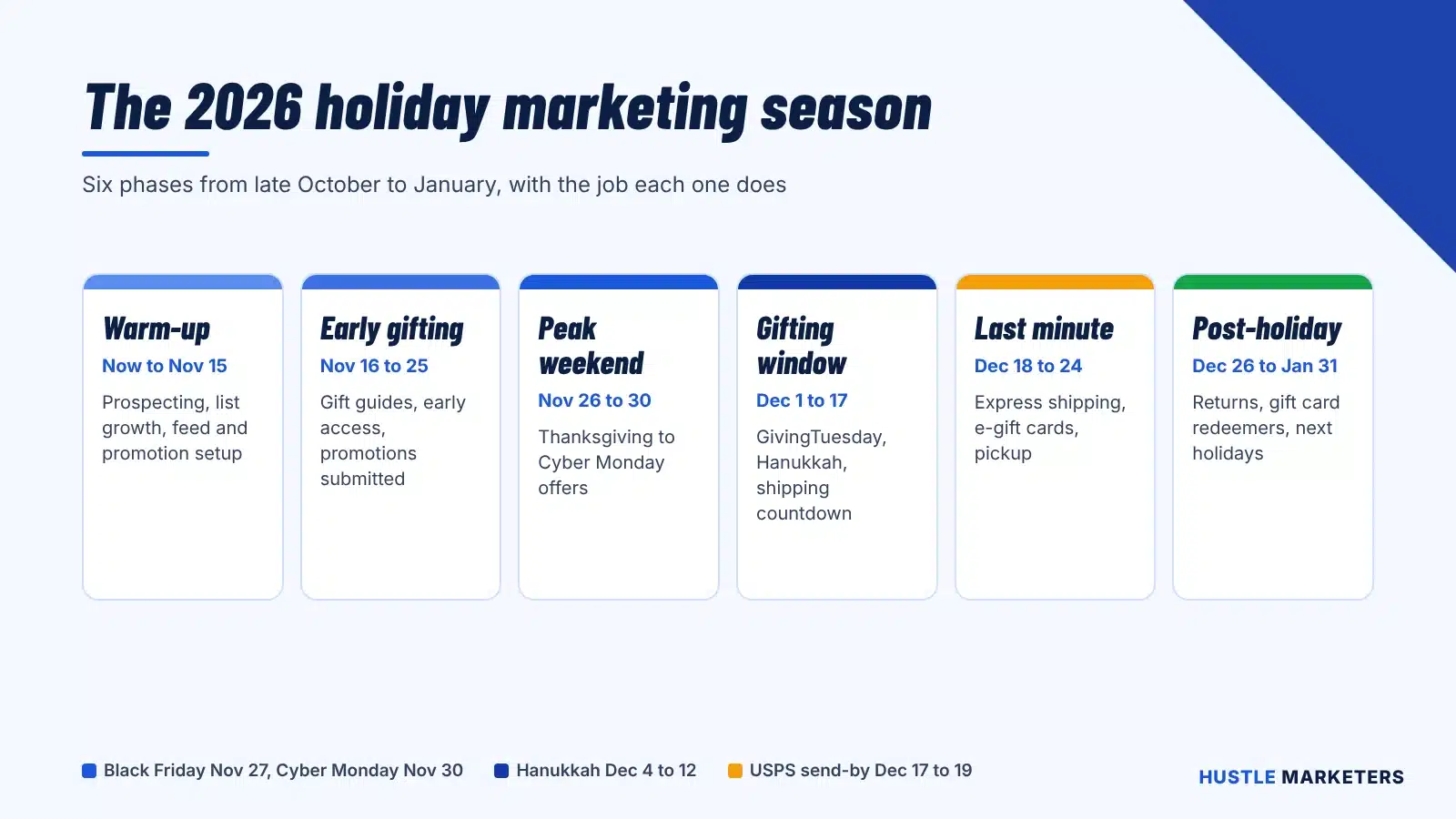
Here is the 2026 season in one view.
| Phase | Dates (2026) | Main goal | What to focus on |
|---|---|---|---|
| Warm-up | Now to November 15 | Build demand and audiences | Prospecting ads, email sign-ups, feed and promotion setup, Diwali offers on November 8 |
| Early gifting | November 16 to 25 | Win early shoppers | Gift guides, early access for subscribers, Merchant Center promotions submitted |
| Peak weekend | November 26 to 30 | Convert peak demand | Thanksgiving to Cyber Monday offers, brand search, retargeting |
| Gifting window | December 1 to 17 | Sell before shipping cutoffs | GivingTuesday, Hanukkah (December 4 to 12), countdown to shipping dates |
| Last minute | December 18 to 24 | Sell what you can still deliver | Express shipping, e-gift cards, local pickup |
| Post-holiday | December 26 to January 31 | Keep new customers | Returns, gift card redeemers, Kwanzaa, New Year, Lunar New Year planning |
Dates: federal holidays from the US Office of Personnel Management and shipping dates from USPS 2026 holiday shipping deadlines. The phase dates are our planning recommendations, not delivery guarantees.
Want a second pair of eyes on your holiday plan before peak week? Get your free holiday ads audit.
In this guide
- Holiday marketing vs seasonal marketing
- The 2026 holiday numbers that matter
- Key holiday dates for 2026 and early 2027
- When to start holiday marketing
- How to build the strategy step by step
- How much to spend on holiday advertising
- Google Ads setup for the holidays
- Meta Ads and Microsoft Ads
- Inclusive holiday marketing
- After the shipping cutoff
- Measuring holiday results
- Your January plan
- Service businesses and B2B
- What our clients learned
- Why choose Hustle Marketers
- FAQ
What is holiday marketing, and how is it different from seasonal marketing?
Holiday marketing is the planning, offers, ads, emails and content a business runs around specific holidays and shopping events, such as Black Friday, Hanukkah, Christmas and the New Year. Seasonal marketing is the wider version. It follows predictable shifts in demand across the year, such as back to school, summer or tax season.
Holiday marketing is usually the most intense part of a seasonal marketing calendar. NRF says November and December have averaged about 19% of total annual US retail sales over the past five years, which is why most retailers plan this window first.
This table shows how the two differ in practice.
| Question | Holiday marketing | Seasonal marketing |
|---|---|---|
| Time frame | Days or weeks around named holidays | Months or seasons across the year |
| Typical events | Black Friday, Cyber Monday, Hanukkah, Christmas, Kwanzaa, New Year | Back to school, summer, spring cleaning, tax season |
| Biggest risk | Missing a fixed date or a shipping cutoff | Missing a demand shift that builds slowly |
| Planning style | A dated calendar with hard deadlines | A rolling plan reviewed each quarter |
If you sell gifts, holiday marketing often decides your year. If you sell services, the holidays can be a slower period you plan around, which we cover in the service and B2B section below.
What do the 2026 holiday shopping numbers mean for your plan?
The 2026 holiday numbers point to steady growth, more mobile and AI-assisted shopping, and a long path to purchase. That means demand is there, but it rewards brands that start early, show clear product details and make buying easy on a phone. This table pairs each figure with what to do about it.
| Figure | Source and date | What it means for your plan |
|---|---|---|
| US holiday retail sales forecast to grow 4.2% to $1.013 trillion (November and December) | NRF forecast, October 15, 2026 | Demand is growing, so plan budgets from margin, not fear of a weak season |
| US online holiday spending forecast at $275.1 billion, up 6.7% | Adobe forecast, September 28, 2026 | Online keeps gaining share; feeds, site speed and checkout matter most |
| Cyber Monday forecast at $15.1 billion and Black Friday at $12.9 billion | Adobe forecast, September 28, 2026 | Fund both days and give Cyber Monday its own launch |
| Mobile devices forecast to drive 57.4% of online holiday spending | Adobe forecast, September 28, 2026 | Design emails, ads and landing pages for phones first |
| AI traffic to US retail sites forecast to rise 130% | Adobe forecast, September 28, 2026 | Write clear product titles, prices and offer terms that AI assistants can read |
| Ecommerce was 17.1% of total US retail sales in Q2 2026 | US Census Bureau, August 18, 2026 | Most retail spending still happens in stores, so local and pickup options count |
| 63% of US shoppers start before Halloween; the average conversion journey is 52 days | Microsoft Advertising, September 2026 | Start awareness ads in October, not on Black Friday |
| A record 202.9 million shoppers from Thanksgiving Day to Cyber Monday 2025 | NRF, December 2, 2025 | The peak weekend still draws the biggest crowd, so have your best offer ready |
Sources: NRF and Adobe press releases on the dates shown, the US Census Bureau quarterly ecommerce report (preliminary figures) and Microsoft Advertising’s 2026 holiday research. Forecasts can change, so check the latest release before you quote a figure.
How do AI shopping assistants change holiday marketing?
AI shopping assistants change holiday marketing by sending shoppers who already know what they want, so your product pages must answer their questions clearly. In our Armorpoxy SEO case study, GA4 recorded 3,686 sessions and $25,343.87 in revenue from ChatGPT referrals between January 1 and November 13, 2025. Clear titles, prices, delivery dates and return terms help these visitors buy. Our AI SEO for ecommerce guide covers the details.
What are the key holiday marketing dates for 2026 and early 2027?
The key holiday marketing dates for 2026 run from Diwali on November 8 to Valentine’s Day on February 14, 2027, with Black Friday on November 27 and Cyber Monday on November 30 at the center. The table includes shipping send-by dates, because a gift that arrives late loses you the sale and often the customer.
| Date | Event | What it means for your plan |
|---|---|---|
| Sunday, November 8 | Diwali | Gifting, sweets and lights; Google promotion assets include a Diwali occasion |
| Wednesday, November 11 | Veterans Day and Singles Day (11.11) | A good day to test early offers; keep any veteran discount terms clear |
| Thursday, November 26 | Thanksgiving | Online deals start; early access for subscribers works well |
| Friday, November 27 | Black Friday | Peak offer day in the US and Australia |
| Saturday, November 28 | Small Business Saturday | Local and independent shops |
| Monday, November 30 | Cyber Monday | Adobe forecasts the biggest online spending day of the season |
| Tuesday, December 1 | GivingTuesday | Donation matches and cause campaigns |
| Friday, December 4 (sundown) to Saturday, December 12 | Hanukkah | Eight nights of gifting; night one is four days after Cyber Monday |
| Thursday, December 17 | USPS Ground Advantage and First-Class Mail send-by date | Last standard shipping date for Christmas delivery in the contiguous US |
| Friday, December 18 | USPS Priority Mail send-by date | Shift messages to faster shipping options |
| Saturday, December 19 | USPS Priority Mail Express send-by date | After this, promote pickup, e-gift cards and digital gifts |
| December 24 and 25 | Christmas Eve and Christmas Day | Digital gifts only; schedule your post-holiday sale |
| Saturday, December 26 | Boxing Day (UK, Canada, Australia) | A major sale day outside the US |
| December 26 to January 1 | Kwanzaa | A cultural celebration created in 1966, not a religious holiday |
| December 31 and January 1, 2027 | New Year’s Eve and New Year’s Day | Fresh-start offers, clearance and resolution products |
| Saturday, February 6, 2027 | Lunar New Year | Gifting for many East and Southeast Asian communities |
| About February 8, 2027 | Ramadan begins (projected) | The start depends on moon sighting, so confirm it locally |
| Sunday, February 14, 2027 | Valentine’s Day | Start campaigns in mid January |
Sources: federal holidays from the US Office of Personnel Management, send-by dates from USPS, the Lunar New Year date from the Hong Kong government’s 2027 holiday list, and Kwanzaa history from the Smithsonian’s National Museum of African American History and Culture. The Ramadan 2027 date is a projection reported by The National, citing the UAE Astronomy Centre.
Two dates need their own plans. Our Black Friday marketing strategies guide has a week-by-week plan to Cyber Monday, and our Hanukkah marketing strategies guide covers the eight nights in detail.
Prefer video? This 3 minute video starts from the holiday calendar and works backwards, then walks through ideas for Black Friday, Small Business Saturday, Hanukkah, Christmas shipping cutoffs and January.
Which dates matter if you also sell in the UK, Australia or the UAE?
Black Friday falls on November 27 in Australia as well, and Boxing Day on December 26 is a major sale day in the UK and Australia. Christmas in Australia falls in summer, so beach and outdoor creative fits better than snow. For UAE audiences, check Ramadan timing for early 2027, because it shapes gifting and shopping hours.
When should you start holiday marketing?
Start planning holiday marketing in early October and have ads, feeds and emails live by early November. If you are reading this in late October, you still have time. Do the steps with the longest lead time first: Merchant Center promotions, product feed updates, audience building and conversion tracking checks.
The data supports an early start. Microsoft Advertising reported in September 2026 that 63% of US shoppers start before Halloween and that October was the first click for 56% of November conversions. Ads that run in October are not wasted. They start journeys that end on Black Friday.
Use these lead times to set your internal deadlines.
| Task | Lead time | Why |
|---|---|---|
| Merchant Center promotions | Submit at least 24 hours before the start | Google says review can take up to 72 hours |
| Black Friday promotion assets | Ready before November 16 | The Black Friday occasion is eligible from October 15 to December 15 |
| Shopping and Performance Max targets | A few days before each key day | Google advises making target changes ahead of key promotion days |
| Microsoft Ads import | In October | Imported campaigns need time to gather data |
| Gift guide pages | Live by early November | New pages need time to be crawled, indexed and linked |
| Email volume | Build through October and November | Sudden jumps from your normal volume can hurt delivery |
Sources: Google Merchant Center Help on promotions, Google Ads Help on promotion assets and Google Ads Help on Smart Bidding for Shopping and Performance Max.
How do you build a holiday marketing strategy step by step?
Build a holiday marketing strategy in seven steps: review last season by holiday-relative weeks, set profit-based targets, choose a few offers, map audiences to channels, prepare your site, feed and tracking, write a dated campaign calendar, and plan January before the season starts.
Step 1: Review last season by holiday-relative weeks
Compare results by the week relative to each holiday, not by calendar month. Hanukkah started in mid December in 2025 but starts on December 4 in 2026, so a December 1 to 7 comparison would mix a normal week with a holiday week. We use this method on our Judaica ecommerce Google Ads case study account, where every holiday moves each year.
Pull these five things from last season:
- Top products by margin, not only revenue. These deserve the budget and the hero spots.
- Search terms that converted. Gift searches such as “gift set” or “gifts under $50” often convert better than generic category terms.
- Days when costs jumped. They show where you need more margin headroom this year.
- The day sales stopped. This is your real shipping cutoff, which may be earlier than the carrier’s date.
- New versus returning customers. This tells you whether the season grew your customer base or only discounted existing demand.
Step 2: Set profit-based targets before you set budgets
Break-even ROAS is the return on ad spend at which an order covers its product cost, shipping, fees and ad cost with nothing left over. A discount raises it, because the price falls while your costs stay the same. Work it out for each offer before you choose one.
This example uses a $90 gift set. The numbers are illustrative, so swap in your own.
| Line | Full price | 20% off | Free gift worth $10 at cost |
|---|---|---|---|
| Price paid | $90.00 | $72.00 | $90.00 |
| Product cost | $36.00 | $36.00 | $46.00 |
| Shipping paid by the store | $8.00 | $8.00 | $8.00 |
| Payment fees (3%) | $2.70 | $2.16 | $2.70 |
| Margin left for ads | $43.30 | $25.84 | $33.30 |
| Break-even ROAS | 2.08 | 2.79 | 2.70 |
Break-even ROAS is the price paid divided by the margin left for ads. Our break-even ROAS guide explains the formula, and the ROAS calculator does the math for you.
Set your target ROAS above break-even, then divide your revenue goal by that target to get a budget. For example, a $40,000 revenue goal at a 3.2 target needs $12,500 in ad spend. If ROAS looks healthy but profit does not, read contribution margin vs ROAS.
Step 3: Choose two or three offers, not ten
Pick one offer for the peak weekend, one for the gifting window and one for last-minute shoppers. A short list keeps your ads, emails and feed consistent, and it stops shoppers from learning to wait for the next discount.
- Peak weekend: your strongest offer, protected by the break-even math above.
- Gifting window: bundles, gift sets or a free gift instead of a deeper discount.
- Last minute: e-gift cards, digital products or local pickup.
For 33 ready-to-use options, each with a lead time and a number to track, see our holiday marketing ideas.
Step 4: Map each audience to the right channels
Holiday buyers are not one audience. The person buying a gift searches differently from the person treating themselves, and both behave differently from a past customer.
| Audience | Best channels | Message that fits |
|---|---|---|
| Past customers | Email, SMS, Customer Match, Meta custom audiences | Early access and a thank-you |
| Gift shoppers | Google Search and Shopping, Microsoft Ads, Performance Max | Gift ideas by interest and budget, with delivery dates |
| Self-gifters | Meta, YouTube, email | A treat for themselves, limited editions |
| Local shoppers | Google Business Profile, local inventory ads | Pickup, store hours, Small Business Saturday events |
| Businesses buying gifts | Microsoft Ads with LinkedIn profile targeting, email | Bulk orders, branded gifts, invoicing |
Step 5: Prepare your site, feed and tracking
Most holiday problems start before the first ad runs. Fix these by early November:
- Show delivery cutoffs on product pages, in the cart and in ads.
- Add sale prices to the feed with effective dates, so Shopping ads show the right price at the right time.
- Extend your return window for the holidays. Google Merchant Center lets you add a holiday extension to your return policy.
- Check conversion tracking against real orders. Our enhanced conversions and Meta CAPI guide covers the setup.
- Build landing pages for each offer and gift theme. See our PPC landing page guide.
- Freeze big site changes during peak week, so a theme or app update does not break checkout.
Step 6: Write a dated campaign calendar
Put every launch, change and end date in one shared calendar: emails, budget changes, creative swaps, promotion assets, Merchant Center promotions and the date each piece of sale copy comes down. An “ends tonight” ad still running the next morning hurts trust and can break ad copy rules.
Here is an example calendar for an online gift shop that sells in the US. Adjust the dates to your own handling time and carrier.
| Date (2026) | Action | Channel |
|---|---|---|
| November 2 | Check conversion tracking against store orders; import Google campaigns into Microsoft Ads | Google Ads, Microsoft Ads, GA4 |
| November 9 | Gift guide pages live; custom labels added to gift products | Website, Merchant Center |
| November 16 | Submit Merchant Center promotions; add Black Friday promotion assets; send early access email | Merchant Center, Google Ads, email |
| November 23 | Raise budgets and adjust targets a few days ahead; schedule Meta creative swaps | Google Ads, Meta Ads |
| November 26 to 30 | Peak offer live; check accounts twice a day and avoid big changes | All channels |
| December 1 | GivingTuesday message; switch to the gifting offer | Email, social, ads |
| December 4 | Feature the Hanukkah collection if you sell one | Email, Shopping, social |
| December 14 | Start shipping countdown messages | Email, SMS, ads, site banner |
| December 18 | Move Shopping budget to products that can still arrive; push e-gift cards and pickup | Shopping, email, site |
| December 26 | Launch exchanges and gift card redeemer campaigns | Email, retargeting |
| January 15, 2027 | Start Lunar New Year and Valentine’s Day campaigns | All channels |
Step 7: Plan January before December ends
Decide in November how you will handle returns, gift card redeemers and first-time buyers in January. The January plan section below lists what to prepare.
How much should you spend on holiday advertising?
Spend what your margin allows at the sale price, not what you spent last year. Start from break-even ROAS for each offer, set a target above it, and divide your revenue goal by that target. Then give campaigns headroom on peak days, because demand rises faster than daily budgets.
Google’s guidance for Shopping and Performance Max goes further than most advertisers expect. It suggests you “set a budget of 3 times what you want or expect to spend” across retail holidays, so campaigns are not capped on the busiest days (Google Ads Help). Your target ROAS still controls efficiency, so headroom does not mean you must spend it all.
Google Ads offers four budget tools. This table shows when each one fits.
| Tool | What it does | Length | Best holiday use |
|---|---|---|---|
| Seasonal budget adjustments | Temporarily raises Search and Shopping budgets | 3 to 14 days | A short sale such as Cyber Week |
| Campaign total budgets | Paces one total budget over a set flight | 3 to 90 days (Demand Gen and YouTube up to a year) | A defined gifting window |
| Seasonality adjustments | Tells Smart Bidding to expect a conversion rate change | Ideal for 1 to 7 days | A major short promotion only |
| Daily budgets | Normal pacing, with up to 2x the daily budget on busy days | Ongoing | Evergreen campaigns |
Sources: Google Ads Help on seasonal budget adjustments, campaign total budgets and seasonality adjustments.
Across the season, weight spend toward the peak weekend and the gifting window, and lower it once shipping-dependent sales stop. Our Black Friday advertising guide (linked in the Google Ads section below) shows a day-by-day budget split for Cyber Week, and the Google Ads budget calculator runs the numbers for your account.
Do ad costs go up during the holidays?
Yes. Auction costs usually rise from mid November, most clearly on Meta, but conversion rates rise too, so cost per sale does not always rise with them. That is why we judge holiday campaigns on profit per order, not on CPC or CPM alone. If your account shows “limited by budget” on peak days, our limited by budget guide explains what to change.
How should you set up Google Ads for the holiday season?
Set up Google Ads for the holidays by putting offers into your feed and assets early, keeping campaigns that already have history, and making bid and budget changes a few days before key dates. Avoid launching brand-new Smart Bidding campaigns in late November, because they will still be learning at peak.
Work through this checklist:
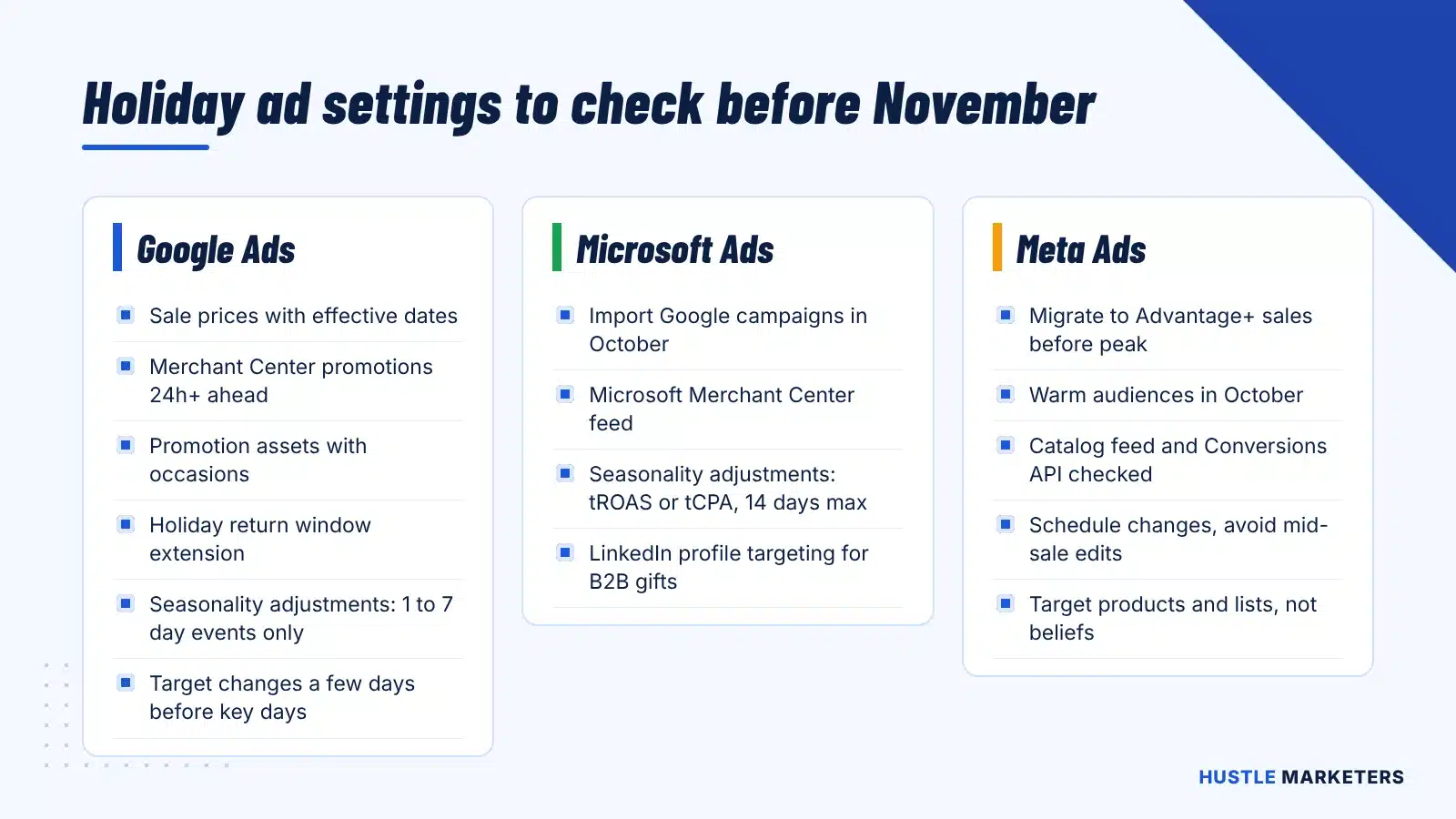
- Sale prices in the feed. Submit sale prices with effective dates and keep the regular price in the price attribute.
- Merchant Center promotions. Submit them at least 24 hours before they start and allow up to 72 hours for review.
- Delivery estimates. Google calculates “arrives by” from handling plus transit days, uses an 8:00 a.m. PST order cutoff if you leave it blank, and adds a day when delivery overlaps a listed holiday (Merchant Center Help).
- Holiday return window. Add a holiday extension to your return policy in Merchant Center (Merchant Center Help).
- Promotion assets with the right occasion. Occasions include Black Friday, Cyber Monday, Diwali, Hanukkah, Christmas, Boxing Day and New Year’s.
- Custom labels for holiday products. Group gift products and margin tiers so you can bid on them separately. Our custom labels by margin tier guide shows the setup.
- Gift searches kept open. Do not add “gift” as a blanket negative keyword. Review it by product line instead, as our negative keywords guide explains.
What should holiday ad copy say in each phase?
Holiday ad copy should change with the phase, so the message always matches what a shopper can still get. These example headlines fit the 30-character limit for responsive search ads. Use an offer or date only when it is true on your landing page.
| Phase | Example headlines (30 characters or fewer) | Landing page must show |
|---|---|---|
| Warm-up | Gift Ideas for Every Budget; Shop Holiday Gift Sets | Gift guide sorted by interest and price |
| Early gifting | Early Access for Subscribers; Ready-to-Give Gift Sets | The early access offer and its end date |
| Peak weekend | Black Friday Gift Set Deals; Cyber Monday Ends Tonight | The discount, the products it covers and the end time |
| Gifting window | Order by Dec 17 for Dec 25; Free Gift Wrap on Orders | Your verified order cutoff and gift wrap terms |
| Last minute | Instant E-Gift Cards; Pick Up In Store Today | Gift card delivery method or pickup hours |
| Post-holiday | Use Your Gift Card Here; New Arrivals for 2027 | Full-price products and how to redeem cards |
How do we run peak week for client accounts?
During Black Friday week we check accounts twice a day and monitor rather than optimize: pacing in the morning, the next day’s budget in the evening, new Merchant Center disapprovals, sold-out products and recorded conversions against store orders. After Cyber Monday we step budgets down over three to four days instead of cutting them at once. Our Black Friday advertising guide lists the full checklist.
Should you use seasonality adjustments for the holidays?
Use a seasonality adjustment only for a short event where you expect a big jump in conversion rate, such as a three-day sale. Google says Smart Bidding already accounts for normal seasonal demand, that adjustments are ideal for events of 1 to 7 days, and that they may not work as well beyond 14 days (Google Ads Help). You do not need a negative adjustment after the event ends.
Should you launch new campaigns in November?
Add holiday products, assets and labels to campaigns that already have conversion history rather than launching new ones late. Google advises allowing at least six weeks before evaluating Performance Max, so a campaign launched on November 20 is judged on data from January. If you want a new structure, test it in January with Google Ads experiments.
How should you run Meta Ads and Microsoft Ads during the holidays?
Run Meta Ads and Microsoft Ads as support for your Google plan, not as last-minute add-ons. Meta builds audiences and demand before peak, and Microsoft Ads captures extra search demand at a lower volume. Both work best when they are set up in October.
Meta Ads
Advantage+ sales campaigns have replaced Advantage+ shopping campaigns, and Meta’s developer documentation says migrating a campaign forces it back into the learning stage (Meta for Developers). Migrate before November, not during peak week.
- Warm audiences early. Video views, engaged visitors and email lists built in October make cheaper retargeting pools in December.
- Schedule changes. Set creative swaps and budget increases ahead of time instead of editing live ad sets mid-sale.
- Check the catalog. Catalog ads need a working product feed and pixel or Conversions API events. Our Meta Advantage+ catalog ads guide covers the details.
- Target products, not beliefs. Meta removed detailed targeting options tied to religion and other sensitive topics in January 2022, so build holiday audiences from interests in your products and from your own customer lists.
Microsoft Ads
Microsoft Ads is worth adding once Google Search and Shopping work, because you can import your Google campaigns instead of building from scratch. Its seasonality adjustments apply only to Target ROAS and Target CPA campaigns, for 14 days or less (Microsoft Advertising Help). Microsoft also reports that 76% of US shoppers plan to use AI to plan seasonal spending, so clear product data matters in AI-powered results too.
Start with our Google Ads to Microsoft Ads import guide. If you sell products, add a Microsoft Merchant Center feed and read Microsoft Performance Max.
How do you make holiday marketing inclusive?
Inclusive holiday marketing means naming the holidays your customers actually celebrate, getting dates and details right, and letting people choose which messages they receive. Pew Research Center found that 90% of Americans celebrated Christmas in 2017, but only 46% as a mainly religious holiday. Its 2023 to 2024 Religious Landscape Study found that about 7% of US adults follow a non-Christian religion and 29% are religiously unaffiliated.
Practical steps that work across channels:
- Use “the holidays” for season-wide campaigns and name a specific holiday when the offer is specific.
- Get timing right. Hanukkah begins at sundown, and Ramadan’s start depends on moon sighting.
- Offer a choice. Add holiday preferences to your email sign-up, and let people opt out of a campaign without leaving your list.
- Ask a member of the community to review symbols, greetings and food references before launch.
- Write gift guides by interest and budget rather than gender stereotypes.
- Make creative accessible: alt text on images, captions on videos, strong color contrast and readable fonts.
This table gives quick guidance for the main holidays in the window.
| Holiday | 2026 to 2027 dates | Do | Avoid |
|---|---|---|---|
| Diwali | November 8 | Gift sets, sweets, lights and home themes | Using the name only as a sale hook with no relevant products |
| Hanukkah | December 4 (sundown) to December 12 | Eight-night gift ideas and correct menorah images (nine branches) | Calling it “Jewish Christmas” |
| Christmas | December 25 | Gift guides, shipping countdowns, family moments | Assuming every customer celebrates it |
| Kwanzaa | December 26 to January 1 | Community, culture and handmade gifts | Describing it as a religious holiday |
| Lunar New Year | February 6, 2027 | Naming the communities you serve | Treating it as one single national tradition |
| Ramadan | About February 8, 2027 | Iftar and Eid gifting, confirmed local dates | Fixed dates in ads before the start is confirmed |
Data sources: Pew Research Center, “5 facts about Christmas in America” (2017) and the 2023 to 2024 Religious Landscape Study. For a full holiday playbook, see our guide to Hanukkah campaigns for Judaica stores and our Passover marketing strategies.
What should you do after the shipping cutoff?
After your last reliable shipping date, change every ad, email and banner from “order now” to options you can still deliver: express shipping while it lasts, e-gift cards, digital products, local pickup and experiences. Adobe reported that curbside pickup reached 39% of online orders on December 23, 2025, against 17.1% across the season.
- Update ad copy and promotion assets with the real last-order dates.
- Switch Shopping budget toward products you can still deliver, or to local inventory ads if you have stores.
- Promote e-gift cards with a printable card so the gift still feels like a gift.
- Keep brand search running. Late buyers often search your name to check stock and pickup times.
- Explain the drop to your team. A sharp fall in orders after the cutoff is normal, not a platform outage.
How do you measure holiday marketing results?
Measure holiday marketing on profit and new customers, not on platform ROAS alone. Ad platforms count conversions differently and keep adding late conversions for days after the click, so judge the season on store orders, contribution margin, returns and the number of new customers you can market to in January.
These are the numbers we track for holiday accounts.
| Metric | What it tells you | Where to find it |
|---|---|---|
| Contribution margin after ad spend | Whether the season made money | Store orders, product costs and ad spend |
| New customers acquired | How much the season grew your base | Store or CRM data |
| Return rate by product | Real revenue after January returns | Store returns report |
| Cost per order by holiday-relative week | Where costs outran conversions | Ad platforms, compared by week |
| Second purchase rate by March | Whether holiday buyers stay | Store or email platform |
If Google Ads, Meta and GA4 report different numbers, read why the three tools disagree on ROAS. For a larger budget, test incrementality with a holdout group, so you know what your ads added beyond the sales you would have made anyway.
What should your January marketing plan look like?
Your January plan should turn holiday buyers into repeat customers and reset your ad accounts for normal demand. Many first-time buyers arrived through a discount or a gift search, so the next 60 days decide whether they come back.
- Returns into exchanges. Make exchanges easier than refunds, and suggest an alternative product in the returns flow.
- Gift card redeemers. Show them full-price products and new arrivals, not more discounts.
- First-time buyers. Send a short series that explains care, use or refills, and asks for a review.
- Ad accounts. Return any targets you changed to normal, remove sale copy and labels, and review search terms. Seasonality adjustments end on their own.
- Next holidays. Start Lunar New Year (February 6) and Valentine’s Day (February 14) campaigns in mid January.
Some categories are expensive in January. In our fitness app Meta Ads case study, January was the costliest month because so many apps and gyms target New Year resolutions at the same time.
How should service businesses and B2B companies plan the holidays?
Service businesses and B2B companies should plan the holidays around availability and lead quality, not discounts. Offices close, decision makers travel, and lead forms filled in late December often convert slowly. Adjust ad schedules for your own closures, and keep tracking which leads become customers with CRM tracking for Google Ads.
Closures that move are the hardest to plan. One of our Judaica clients does not take orders on Shabbos, and in Brooklyn candle lighting falls around 4:10pm on Fridays in December but around 8:04pm in early June. A fixed ad schedule would either cut hours of Friday traffic in summer or keep ads running in winter when no one can buy, so the schedule has to update every week.
- Thank clients with a note or a useful year-end summary.
- Offer January booking slots in December, while people plan the new year.
- Sell corporate gifts through a dedicated page if you have suitable products.
- Use the quiet weeks to fix tracking and landing pages before Q1.
Our B2B PPC strategy guide covers lead generation campaigns in more depth.
What have Hustle Marketers clients learned from holiday seasons?
These lessons come from our published case studies. Each result covers a specific period and includes seasonal effects, so read the full study for its context.
Eichlers: plan around a calendar the ad platforms do not know
Brooklyn Judaica retailer Eichlers sells on a Jewish holiday calendar that moves every year. Its Google Ads campaigns run Highest volume bidding rather than a ROAS target, because a value target would starve them in the weeks between holidays. From June 5 to October 2, 2026, Google Ads returned $181K in conversion value on $10.6K of cost, a period that includes the run-up to the fall holidays. Read the Eichlers case study.
CANA Wine Company: gift searches are cheaper than category searches
For this Nashville spirits and wine retailer, gift-intent searches cost less to win than broad category terms and cluster into short windows. The plan readies Merchant Center and campaigns by mid October for the Thanksgiving to New Year gifting peak, and it never blocks “gift” as a negative keyword. Read the alcohol marketing case study.
Pet accessories brand: budgets that follow the calendar
This account scaled budgets up for peak periods such as Christmas, end of financial year sales in Australia and National Pet Day, then pulled back off-peak. It produced $346K in revenue at 5.12x ROAS. Read the pet accessories case study.
Baby care brand: a seasonal offer in the ad copy
Seasonal ad copy such as “New Year Baby Care Essentials” was one of the changes behind ROAS rising from 3x to a Q1 2025 peak of 9.29x, in an engagement that ran from September 2024 to March 2025. Read the baby care case study.
Why choose Hustle Marketers or Ishant Sharma for holiday marketing?
Hustle Marketers is a digital marketing agency founded in 2020 by Ishant Sharma, who has worked in Google Ads, Microsoft Ads and SEO since 2013. We plan and run holiday campaigns for ecommerce, local service and B2B clients in the US, UK, UAE and Australia.
- Google Partner, Meta Business Partner and Microsoft Advertising Partner status.
- $780M+ in trackable client revenue across 2,500+ brands, and $90M+ in lifetime managed ad spend.
- Published proof: our case studies show the accounts, periods and caveats behind each result.
- You own every ad account we manage for you.
- Specialists by channel: Google Ads management, Microsoft Ads management, Facebook Ads management and ecommerce PPC management.
Holiday marketing strategy FAQ
What is a holiday marketing strategy?
A holiday marketing strategy is a dated plan for the offers, ads, emails and content a business runs around holidays and shopping events. A good one sets profit targets first, matches each audience to a channel, and covers the weeks before and after the holidays, not only the peak days.
When should I start my holiday marketing campaign?
Start planning in early October and have ads, feeds and emails live by early November. Microsoft Advertising’s September 2026 research found that 63% of US shoppers start before Halloween, so ads in October and early November start journeys that end on Black Friday and in December.
What are the most important holiday shopping dates in 2026?
The most important dates are Thanksgiving on November 26, Black Friday on November 27, Small Business Saturday on November 28, Cyber Monday on November 30, Hanukkah from December 4 to 12, the USPS send-by dates of December 17 to 19, and Christmas on December 25.
How much should a small business spend on holiday marketing?
A small business should spend what its margin allows at the sale price. Work out break-even ROAS for each offer, set a target above it, and divide your revenue goal by that target. Spend more in the peak weekend and gifting window, and less after shipping cutoffs.
Should I use Google Ads seasonality adjustments for the holidays?
Use them only for short events where you expect a big jump in conversion rate. Google says they are ideal for events of 1 to 7 days and may not work as well beyond 14 days. Smart Bidding already accounts for normal seasonal demand.
What is the difference between holiday marketing and seasonal marketing?
Holiday marketing focuses on named holidays and shopping events, such as Black Friday or Hanukkah. Seasonal marketing covers predictable demand changes across the whole year, such as back to school or summer. Holiday marketing is usually the busiest part of a seasonal calendar.
How do I make my holiday marketing inclusive?
Name the holidays your customers celebrate, get their dates and details right, and let subscribers choose which holiday messages they receive. Ask a member of the community to review your creative, write gift guides by interest and budget, and make every asset accessible.
What should I do after the holiday shipping cutoff?
Change ads, emails and banners to options you can still deliver: express shipping, e-gift cards, digital products and local pickup. Move Shopping budget to products you can still ship, keep brand search running, and expect a sharp drop in delivered-gift orders.
How do I measure the success of a holiday campaign?
Measure contribution margin after ad spend, new customers acquired, return rates and the second purchase rate by March. Compare results by holiday-relative weeks, because platform ROAS alone can hide discounts, returns and late-reported conversions.
What should I do in January after the holidays?
Turn returns into exchanges, show gift card redeemers full-price products, welcome first-time buyers with a short email series, reset any changed ad targets, and start Lunar New Year and Valentine’s Day campaigns in mid January.
What should you do next?
Pick your three offers, work out break-even ROAS for each, and put every date in one calendar this week. Then check your feed, tracking and shipping messages before mid November, and write your January plan before the peak starts. If you would like a specialist to review your holiday campaigns first, get your free holiday ads audit. For the peak weekend in detail, read our Black Friday plan for 2026.
About the author: Ishant Sharma is the founder and CEO of Hustle Marketers, a Google Partner, Meta Business Partner and Microsoft Advertising Partner agency founded in 2020. He has worked as a Google Ads, Microsoft Ads and SEO specialist since 2013, across ecommerce, local service, SaaS and white label agency accounts, and holds certifications across Google, Meta and Microsoft Advertising.
He is an Upwork Top Rated Plus specialist with a 100% Job Success Score, and trackable client sales across his work have passed $780M across 2,500+ brands. He leads PPC management at Hustle Marketers. Ishant Sharma is the digital marketing specialist, not the Indian cricketer of the same name. More about Ishant.